
Residents raised concerns about recreation and the environment at a community meeting on the $2 million project. City officials now say they are exploring a smaller mooring field.
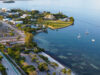
A proposed $2 million mooring field in the Marine Stadium Basin drew sharp opposition at a community meeting last week, prompting Miami officials to say they may consider scaling back the project.
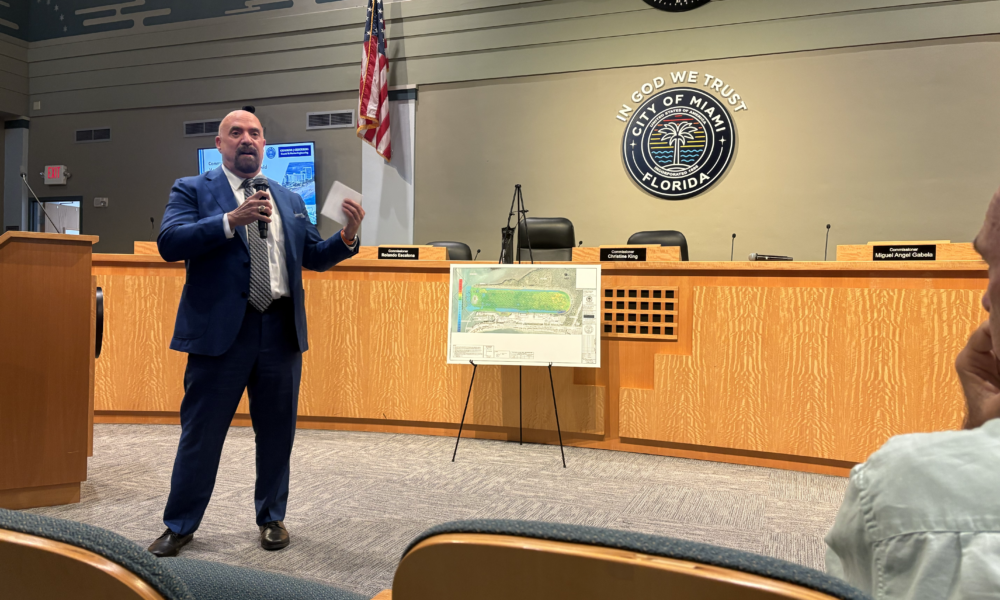
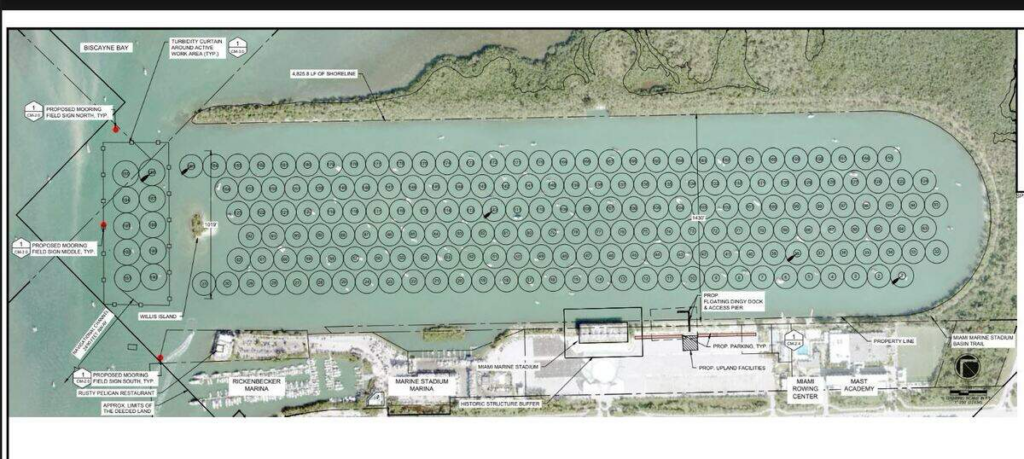
About 40 people attended the Sept. 29 meeting at City Hall, where boaters, watersports athletes and environmental advocates questioned plans to install 195 permanent anchors across much of the Virginia Key basin.
The anchors would provide flexibility for up to 75 active moorings, allowing boats to tie up without dropping conventional anchors into the seabed. City officials say the system would bring greater order and accountability to the basin while reducing environmental damage from unregulated anchoring.
But many residents argued that the proposed field is too large, potentially threatening seagrass and marine life and taking away open water now used for rowing, paddling, swimming and dragon boat racing.
Jennifer Bistyga of Cummins Cederberg Coastal & Marine Engineering, the firm that designed the field, told residents that mooring fields offer a more environmentally friendly alternative to conventional anchoring.
“When you have boats [anchoring] haphazardly, it could be dangerous,” Bistyga said. “There could be challenges with navigation, there could be environmental impacts.”
Bistyga said the firm conducted two environmental resource surveys and worked with government agencies during the permitting process. The project is awaiting approval from the Florida Department of Environmental Protection.
The mooring field is the latest in a string of development proposals for Virginia Key, much of which is owned by the City of Miami.
In November, city voters will decide whether to approve an $80 million redevelopment of the Rickenbacker and Marine Stadium marinas.
Miami-Dade County is separately considering a major redevelopment of the former Miami Seaquarium property on the other side of the island.
The mooring field proposal dates to 2021, when the Miami City Commission directed the administration to establish a mooring field for up to 75 vessels in the basin. At the time, rowers and other users were among those complaining about illegally anchored boats, speeding watercraft and abandoned vessels.
With the restriction, residents at last week’s meeting questioned why 195 anchors are necessary.
“Why would you build a giant parking lot if you don’t want [to fill it]?” said Julie Hanrahan, a longtime boater and former professional captain. “I’ve never seen a city so anxious to give up their quiet space, their beauty.”
Others raised environmental concerns, including the potential for boats to shade seagrass or increase the risk of collisions with manatees.
Anthony Barcena, assistant director of Miami’s General Services Administration, said a regulated mooring field would give the city greater control over activity in the basin.
“We want accountability,” Barcena said. “We want to make sure that our basin is clean.”
City officials said the field would also make it easier to deal with derelict boats.
Miami Marine Patrol Lt. Corey Couto said removing an abandoned or sunken vessel that has dropped anchor can cost the city as much as $40,000. A managed mooring field would make it easier to enforce rules and remove derelict boats, he said.
The proposal would also permit overnight stays in a basin where overnight anchoring is currently prohibited. Mooring fees would range from about $30.50 to $36 a day or $415 to $490 a month, plus utility fees.
Much of the opposition at the meeting came from people who use the basin for something other than powerboats or sailboats.
The relatively protected waters behind Marine Stadium have long been used by rowers, paddlers, dragon boat teams and open-water swimmers. Critics say the proposed field, which stretches across much of the basin, would substantially reduce the space available for those activities.
At least seven environmental and recreational groups have joined in opposing the current design, and a petition against it has collected more than 1,000 signatures.
The groups are proposing a much smaller field with 42 buoys concentrated in the center of the basin, leaving more open water for nonmotorized recreation.
Laura Reynolds, founder of Conservation Concepts and one of the opponents of the current plan, said the coalition plans to meet with Pardo’s office to discuss possible changes.
Any redesign, however, could put the project on a tighter timetable.
The Florida Inland Navigation District is providing a grant covering nearly half the project’s estimated cost, said Alexandra Alexieva, a community liaison for Pardo’s office, in an email to meeting attendees.
Bistyga told the Spotlight that the money could be jeopardized if the project is not permitted and under contract by September 2027.
Days after the meeting, Commissioner Damian Pardo’s office, which hosted the event, said the city is already exploring changes.
“We have begun working with the administration and our partners at Cummins Cederberg to explore a possibility of a revised proposal with fewer mooring anchors,” Alexieva wrote. Pardo’s office also promised another community meeting once a possible redesign takes shape.
“We will be glad to host you again for a second presentation once the process has produced meaningful information,” Alexieva wrote.