

In his provocative book, Coconut Grove journalist Michael Grunwald argues that organic, small-scale farming isn’t necessarily better for the planet — and that producing more food on less land may be the key to fighting climate change.
Editor’s Note: In a nod to this year’s Miami Book Fair, the Spotlight interviewed Coconut Grove author Michael Grunwald for today’s report. Grunwald was a featured author at last year’s book fair. On Thursday, we’ll profile a Coconut Grove poet who is a featured writer at this year’s book fair.
If you are buying organic kale from a small artisan grower at a local farmers market, Coconut Grove author Michael Grunwald won’t object.
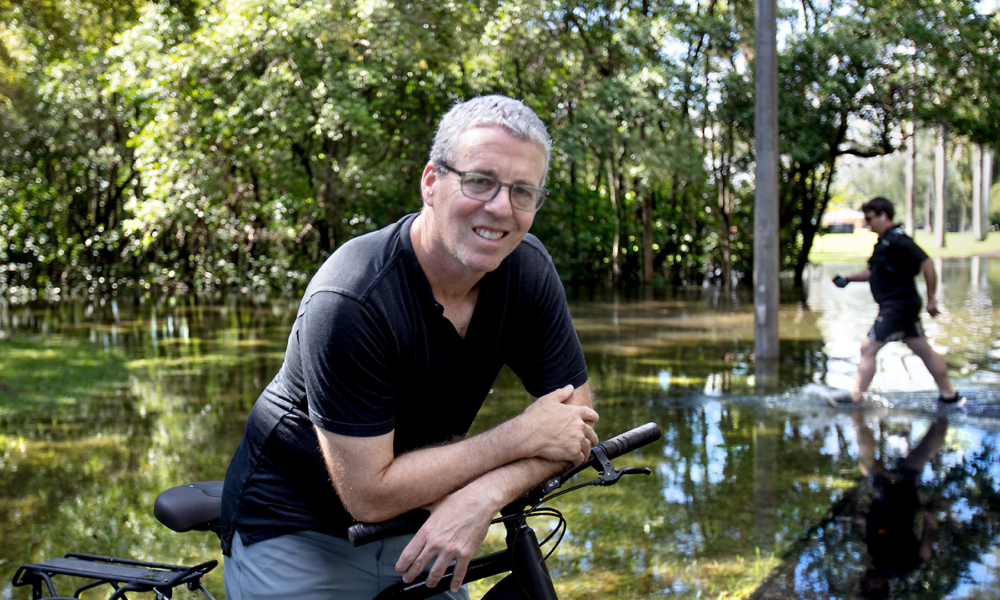
“If that’s what you want, I’m OK with that,” he said one recent morning sitting in Coconut Grove’s waterfront Kennedy Park, as a strong king tide flooded much of the area near him. “But you’re not doing the planet any favor.”
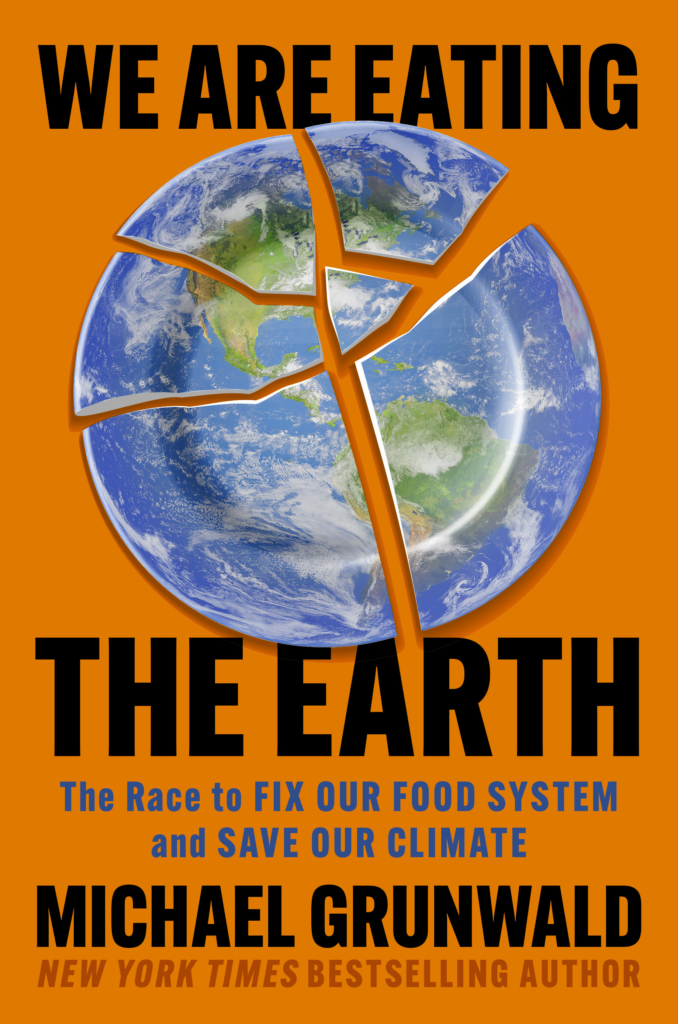
Grunwald is the author of the hard-hitting “We Are Eating the Earth: The Race to Fix Our Food System and Save Our Planet,” published by Simon & Schuster a year ago and recently released in paperback.
Grunwald argues that lower-yield farming can worsen climate change because producing the same amount of food requires more land, potentially leading to the destruction of forests and other natural areas that absorb carbon.
His preferred solutions include higher-yield crops, fertilizers, pesticides, genetic engineering, intensive livestock operations and alternatives to conventional meat — practices many environmentalists oppose.
Grunwald is no right-wing nut. He’s dedicated much of his life to writing about ways to protect the environment. He’s the author of “The Swamp: The Everglades, Florida, and the Politics of Paradise,” still in print two decades after publication. For the 60th and 70th anniversary editions of Marjory Stoneman Douglas’ River of Grass, he was chosen to write an afterward.
In his core advice on eating, he is in line with many environmental experts: Stop eating beef and stop wasting food.
Where he parts company with many environmentalists is over how to produce enough food for a growing world population.
“The one-third of our climate problem that isn’t about fossil fuels is mostly about land,” he wrote in the introduction to “Eating the Earth.”
The core issue is that nature — forests and prairies — absorb the carbon that is heating the atmosphere. Agriculture cuts down the forests and creates fields that do nothing to stop global warming. “Every farm,” he wrote, “even the scenic ones with red barns and rolling hills that artists paint and writers sentimentalize, is a kind of environmental crime scene.”
“We’re losing a soccer field of forest to agriculture every six seconds,” he said during his visit to Kennedy Park, a few blocks from his North Grove home. “And if we got twice as good, it’d be every 12 seconds. That’d still be a big impact.”
The overriding environmental issue, he believes, is increasing yields per acre.
“Agriculture now covers … about half the world’s land that isn’t ice or desert — an area equivalent to all of Asia plus all of Europe,” Grunwald wrote. More than three-quarters of this land supports livestock — either through pastures or crops fed to the animals.
Much of Grunwald’s book draws on the research of Timothy Searchinger, a Princeton scholar and expert on the environmental impact of agriculture.
“Searchinger calculated that eating five pounds of beef had the climate impact of driving an SUV cross-country. Ruminant burps and farts were a problem, but the main problem was that beef cattle used nearly half of the world’s agricultural land to produce just 3 percent of the calories,” Grunwald tells his readers.
For Grunwald, eating less beef is one of the clearest ways individuals can reduce the environmental impact of food.
The same with food waste. “It seemed perversely destructive to use a land mass larger than China to feed our garbage bins,” he wrote.
We agreed to meet on a bluff near Micanopy Avenue and Halissee Street in North Grove, one of the highest natural elevations in Miami-Dade County.
Befitting a serious environmentalist, Grunwald arrived by bicycle from his home about a mile away.
“Well, the nice thing about being at 20 feet elevation is that if you get 15 feet of sea level rise, you’re going to get beachfront property,” he said wanly, adding that by then, saltwater intrusion and flooding in nearby areas could make life on the bluff unpleasant.
There wasn’t much to see on the bluff, so we moved on to Kennedy Park, where a king tide had reportedly flooded much of the area. Grunwald cautioned against exaggerating its significance.
“The instinct is to say it’s a catastrophe,” he said. “So, you don’t want to exaggerate the dystopian nature of what’s happening now. What’s really frightening is that this is the coming attraction for more significant sea level rise coming down the road.”
Grunwald grew up on Long Island and went on to work for The Washington Post. In 2002, he wrote a four-part series examining pollution in the Everglades, drawing on research by Searchinger, whose work would become central to his latest book.
In October 2003, he moved to South Beach to start working on his Everglades book. He got married, had two children and lived in a Miami Beach house.
Ten years ago, he “got tired of trips across the causeway,” had plans to put his kids in Ransom Everglades School and bought a 21st-century house east of 27th Avenue that he describes as “a big box house” of the kind that many longtime Grovites criticize.
He was fully aware of elevation when he made his decision: “We went from six feet to 17 feet.”
He rides a bicycle around the Grove and drives a 2017 electric Chevrolet Bolt, while his daughter uses the family’s Tesla.
He’s worked for the political news outlet Politico and Time magazine and is now a contributing writer to The New York Times opinion section.
He started working on “Eating the Earth” in 2019. Quite a bit of the book is devoted to solving the food problem with technology. “Humanity had a better record of solving problems with innovation than self-sacrifice,” he wrote.
Grunwald can’t imagine the world going vegan, but he sees promise in meat substitutes and genetically modified crops that produce higher yields on less land. Despite disappointing sales of plant-based meat, he remains optimistic.
“Now, who the hell knows what’s in a chicken nugget, right? It’s just really a vehicle for sauce.”
Grunwald pointed out that food technologies are just getting started and could improve dramatically over time. “It took solar five decades to make a dent in the energy market.”
Grunwald’s argument puts him at odds with advocates of organic and regenerative agriculture, including renowned food writer Michael Pollan.
Those approaches emphasize practices such as reduced tillage, crop rotation and soil health. Supporters argue that they can reduce pollution and improve the resilience of farms.
Grunwald’s objection is that such farming produces lower yields per acre. “They just want to look at the acre in front of them,” Grunwald said, “and say look how nice we’re treating this acre, but if you have only have half the yield as the farmer next door, then you’ve got to cut down twice as much as the Amazon.”
Advocates of organic and regenerative agriculture also argue that healthier soils can store carbon. Grunwald and Searchinger question whether that carbon storage is substantial or permanent enough to make a meaningful difference in global warming.
Other researchers and advocates dispute parts of Grunwald’s case.
FoodPrint, a website promoting agroecology, argues that farmers can improve yields while relying less on synthetic chemicals. It also calls for reducing food waste and ending the use of farmland for biofuels — a position Grunwald shares.
Last year, Grunwald debated Timothy Bowles, a UC Berkeley professor and leading researcher in sustainable agriculture, who agreed that expanding farmland threatens the environment but argued that more sustainable farming methods can increase productivity while reducing the pollution associated with industrial agriculture.
Grunwald agreed that Big Ag — shorthand for large-scale industrial agriculture — should work on cleaning up its mess. “Ideally, Big Ag could make even more food with even less land while doing less to harm the environment.”
Intensive livestock operations, another approach Grunwald sees as land-efficient, face opposition over pollution and animal welfare. Thousands of chickens can be housed in a single building, in contrast to the space required for free-range flocks.
Grunwald understands: “No one wants a factory in their neighborhood.”
Recently, Grunwald went to New York, where he was “the skunk at the garden party” at an organic farmer’s conference. But even there, he said, his arguments got some farmers to acknowledge that perhaps they should try to increase their yields.
Grunwald also sees encouraging signs in efforts to produce more food on less land. One is Atlantic Sapphire, a company raising salmon in a sprawling indoor aquaculture facility in Homestead. The operation represents an ambitious experiment in producing seafood on land, although the company has struggled financially.
Another example is Fazenda Tropical, a Brazilian farm Grunwald visited where crops and cattle are raised on the same land. By rotating corn, soybeans and forage for livestock, the operation seeks to produce more food from each acre rather than clearing additional land.
The Everglades, the subject of Grunwald’s earlier book, offers another reason for cautious optimism. In 2023, Searchinger revisited a constructed wetland designed to filter fertilizer pollution from agricultural runoff. The system was working much as intended, Grunwald writes — evidence, in his view, that sustained investment in environmental solutions can produce results.
As far as his own behavior, Grunwald wrote: “I try not to be an annoying scold, I fly too much to criticize anyone else’s carbon footprint — but I can confirm that it’s possible to waste less food and eat less beef, the two most powerful daily challenges we can make for the climate. My family doesn’t waste any food at home since the Bay Area startup Mill Industries gifted me a food dehydrator,” which converts kitchen scraps into chicken feed.
He still uses the device, though at $900 he knows it is hardly a solution for everyone. “But like a lot of things, they will be getting cheaper and better.”
In Grunwald’s view, most of us find ways of blending our ideals with our desires. “Everybody finds the level of hypocrisy they’re comfortable with. … I still eat a fair amount of chicken and pork.” He added: “I try to eat what’s good for the planet, but I fail all the time.”