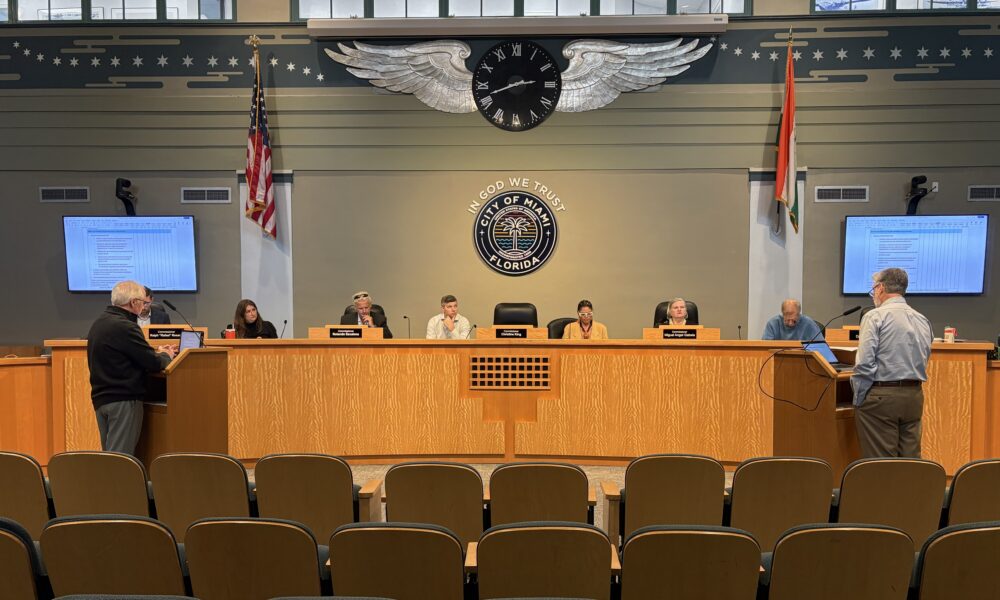


At Monday’s meeting of Miami’s Tree Ordinance Advisory Committee, developers offered their proposals for rewriting the city’s tree ordinance, while a committee member challenged city staff’s claim that state law limits the city’s authority to question certain tree removals.
Simpler permitting, greater flexibility in relocating trees and limits on what it calls frivolous appeals of tree-removal permits are among the changes South Florida builders want Miami to adopt as it rewrites its tree protection ordinance.
The proposals, submitted by the Builders Association of South Florida at Monday’s meeting of Miami’s Tree Ordinance Advisory Committee, mark the development industry’s first detailed recommendations after months of discussions largely focused on strengthening protections for mature trees.
But the debate over what Miami’s new rules should require has raised another question: How much authority does the city have to regulate tree removals in the first place?
In written responses distributed to committee members last week, city staff identified Senate Bill 180, a hurricane-related measure enacted in 2025, as a potential obstacle to strengthening Miami’s tree ordinance. The committee did not discuss the responses until Monday’s meeting.
The law temporarily restricts certain local governments listed in federal disaster declarations for Hurricanes Debby, Helene or Milton from proposing or adopting more restrictive land-development regulations and approval procedures before October 2027. At Monday’s meeting, committee members, facilitators and city staff disagreed over whether the restrictions apply to Miami. City staff said they would seek clarification.
Staff, in its written responses, did not identify which specific tree ordinance rules would violate SB 180. The committee is weighing proposals ranging from stronger replacement requirements to incentives that would give developers greater flexibility to preserve mature trees.
The committee, which began its work in July, is expected to submit its recommendations for revising the city’s tree protection ordinance to the City Commission by next March.
Read more: Miami Begins Review of Tree Rules as Removal Battles Intensify
Amidst that uncertainty, the Builders Association is proposing that tree-removal permits become a routine administrative approval, similar to building permits, with standardized checklists covering drainage, utilities and other site conditions.
The association also wants the city to identify suitable planting locations in public rights-of-way, give property owners greater credit for relocating existing trees and use Tree Trust Fund money to maintain large trees on public and private property.
The association also proposed to distinguish between single-family homes and duplexes and larger multifamily, hotel, office and commercial developments when setting tree-protection requirements. The builders also urged the city to prioritize planting new trees along public rights-of-way and pedestrian corridors.
BASF argues that tree-removal appeals delay construction and increase housing costs, although its written recommendations provide no figures documenting the extent of those delays or their financial impact.
The proposals come as residents, particularly in Coconut Grove, have increasingly challenged permits allowing developers to remove mature trees. Some appeals have resulted in negotiated agreements preserving or relocating trees that otherwise would have been removed.
Until now, the committee has largely focused on proposals to strengthen protections, including higher mitigation requirements, greater financial incentives to preserve mature trees and changes to development rules that could allow construction to proceed around existing trees. Members also supported reviewing potential tree removals earlier in the permit application process.
At its Nov. 2 meeting, all seven members present expressed support in an informal assessment for increasing the value assigned to mature trees and offering zoning flexibility to property owners who preserve them. Neither proposal has been formally adopted.
Read more: Miami Tree Panel Zeroes In on Canopy Protection Reforms
A separate disagreement over the city’s authority emerged Monday when committee members questioned how Miami interprets another state law governing tree removals.
Shawn Smith, the city’s acting chief of environmental resources, told committee members that Florida’s dangerous-tree exemption law prevents city officials from questioning certain tree removals when property owners say they possess documentation from a qualified arborist or landscape architect.
“We’re not allowed to ask,” Smith said.
But committee member Andy Parrish quickly challenged that interpretation.
“Who says you’re not allowed to ask?” Parrish responded.
The dispute centers on a Florida law, enacted in 2019 and amended in 2022, which allows owners of some single-family residential properties to remove dangerous trees without obtaining municipal permits, paying mitigation fees or planting replacements.
The exemption applies to properties with existing detached single-family homes, but not vacant lots or properties developed for multifamily or commercial use. It also does not provide a general exemption for removing healthy trees.

To qualify, a certified arborist or licensed landscape architect must document that a tree presents an unacceptable risk to people or property and that removal is the only practical way to reduce the risk below a moderate level.
Smith maintained that the law prevents Miami from questioning those assessments, even when officials have concerns about their validity.
“I cannot believe that the state statute allows blatant fraud to continue,” Parrish said, arguing that the city should be able to investigate potentially improper claims.
The exchange underscored a central challenge facing the committee as it considers an overhaul of Miami’s tree ordinance: how to reconcile developers’ demands for greater flexibility with residents’ calls for stronger protections, while determining how much regulatory authority the city actually retains.
Read more: Higher Fines, New Incentives? Tree Committee Explores Canopy Protections
Meanwhile, figures supplied by city staff at Monday’s meeting illustrate the scale of tree removals under Miami’s existing regulations.
During fiscal year 2026, the city issued permits covering the removal of 2,730 trees on private property. That figure excludes an unknown number removed under the state’s dangerous-tree exemption, which does not require qualifying property owners to notify the city.
According to city staff, property owners reported just seven removals under the exemption through October, although the actual number could be higher because reporting is not required.
Miami also permitted the relocation of 515 trees on private property and 37 in public rights-of-way, but staff acknowledged that it lacks complete information about how many of those trees survive.
Also Monday, city staff confirmed an oft-cited estimate of Miami’s overall urban tree canopy: approximately 20% coverage, based on 2020 imagery. The city’s comprehensive plan, adopted in 2009, calls for 30% coverage by 2030.
Anita Li is a Spotlight reporter and Report for America corps member covering government accountability in Coconut Grove and Miami City Hall. She joins us through our partnership with Report for America, a national organization that places journalists in local newsrooms across the United States.