
A city advisory committee is exploring tougher penalties for developers who remove large trees, incentives to preserve them and relief for homeowners struggling with costly regulations.
Developers who cut down Miami’s largest trees could face stiffer penalties, while homeowners who preserve them could gain greater building flexibility, under changes being discussed by a city advisory committee.
But committee members also want to make the city’s tree regulations less burdensome for ordinary homeowners, particularly seniors and lower-income residents who may struggle with the costs of removing dead or dangerous trees.
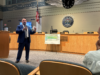
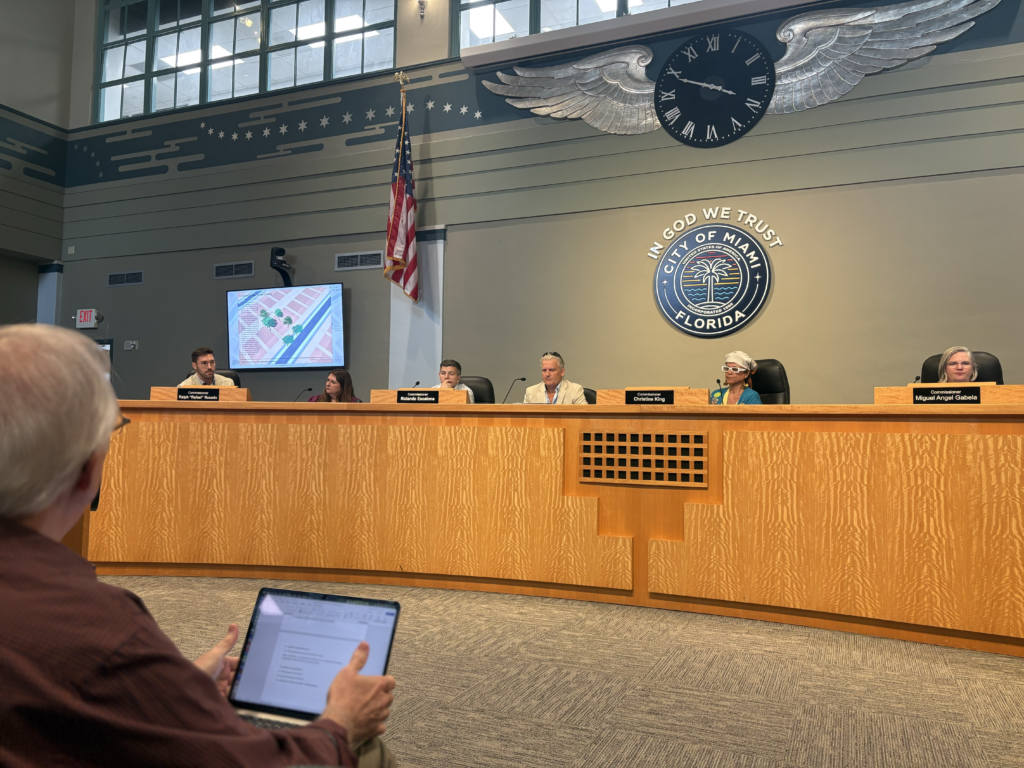
Those differing priorities emerged at the Oct. 2 meeting of Miami’s Tree Ordinance Advisory Committee, which is reviewing the city’s tree protection laws and is expected to recommend changes to the City Commission by March.
The committee was formed amid growing controversy over tree removals, weak enforcement and a surge in appeals challenging the city’s permitting decisions.
Read more: Miami Begins Review of Tree Rules as Removal Battles Intensify
After gathering public input through community workshops, the committee is now beginning to explore possible changes.
Among the ideas discussed Oct. 2 were increasing the financial consequences of removing large trees, creating incentives to preserve them and establishing different penalties for developers and homeowners.
Under current city rules, property owners who remove trees generally must plant replacements or contribute to the city’s Tree Trust Fund. The amount of mitigation depends in part on the diameter of the tree removed. Those who remove trees illegally face additional mitigation requirements and fines that vary according to the violation.
Critics argue that those costs are often too small to discourage developers who can make substantially more money by clearing land for construction.
The adequacy of those penalties came under scrutiny recently when a developer was fined just $1,000 for illegally removing a massive, 63-inch live oak in Miami’s Silver Bluff neighborhood — a tree that, by some estimates, was approaching three centuries in age.
Read more: A Giant Oak, an Illegal Removal and a Not-So-Giant Fine
Committee member Christopher Baraloto, director of Florida International University’s International Center for Tropical Botany, questioned whether trunk diameter alone provides an adequate measure of a tree’s ecological value. He also said contributions to the Tree Trust Fund can fall far short of the actual cost of replacing a mature tree.
“We’ve talked to the arborists about transport costs, costs of putting things in … and then project scenarios of how much it would really cost for this,” Baraloto said.
His research, he added, has found that planting numerous small trees does not necessarily compensate for the loss of one large tree.
“Sometimes these large trees can be valued at up to $300,000,” said committee member Deena Bell Llewellyn, a landscape architect. “People don’t really understand the monetary value of these large trees.”
Rather than simply increasing the cost of removing trees, several committee members suggested giving property owners more reasons to preserve them.
One possibility would allow homeowners to build around existing trees without sacrificing the total square footage they would otherwise be permitted to construct.
Aaron DeMayo, the committee’s representative from the city’s Climate Resilience Committee, described draft legislation that would give property owners greater flexibility to shift allowable building space to upper floors or build closer to property lines when necessary to preserve trees.
The proposal is aimed at single-family and duplex properties in the city’s T3 zoning districts, which DeMayo said account for much of Miami’s land area and tree canopy.
Existing zoning regulations limit building size and placement. The proposed changes would allow exceptions to some of those restrictions in exchange for preserving trees.
Committee members also discussed whether tree removal penalties should distinguish between developers building multimillion-dollar homes and residents who may have difficulty affording even routine tree maintenance.
“Your everyday resident that lives on their property … how do we create a fee schedule that’s realistic for those folks?” asked committee member Lindsay Corrales, a District 3 appointee.
Corrales said she had heard “horror stories” from working-class residents who removed dead trees without realizing permits were required, only to face substantial financial penalties.
DeMayo said the public workshops had revealed sharply different views about existing fines, with some residents calling them too low and others saying they were already too high.
“I think the difference is someone who owns their home versus maybe a property that’s owned by a business or an LLC that’s not necessarily someone’s primary [residence],” he said.
The challenge for the committee will be translating those ideas into enforceable regulations — and determining how much flexibility the city actually has.
Florida law limits local governments’ authority to regulate the removal of trees deemed dangerous by qualified professionals. County regulations also constrain some aspects of the city’s tree protections.
Committee members had hoped to hear from city staff about those legal limitations, but no city officials participated in the Oct. 2 discussion.
Instead, facilitators Hal Beardall and Rafael Montalvo of Florida State University’s Florida Conflict Resolution Center said legal guidance and other information requested by committee members would be presented at a future meeting.
Montalvo said the facilitators wanted members to have an opportunity to explore ideas and understand one another’s perspectives before introducing more complicated legal and technical questions.
“There’s very different levels of experience with this stuff, and so a verbal explanation might work well for some members of the group, whereas the others would be able to benefit from seeing something in writing, think about it, and see the whole picture,” Montalvo said.
Eight committee members attended the meeting. Two of the committee’s 11 seats remain vacant, and District 2 representative Ian Wogan was absent. No members of the public attended.
The committee has not yet adopted formal recommendations. Its proposals are expected to undergo another round of public review before being presented to the City Commission.
Dates for the next committee meeting and community workshops have not been announced. They will be posted on the city’s Tree Ordinance Advisory Committee website.
Anita Li is a Spotlight reporter and Report for America corps member covering government accountability in Coconut Grove and Miami City Hall. She joins us through our partnership with Report for America, a national organization that places journalists in local newsrooms across the United States.