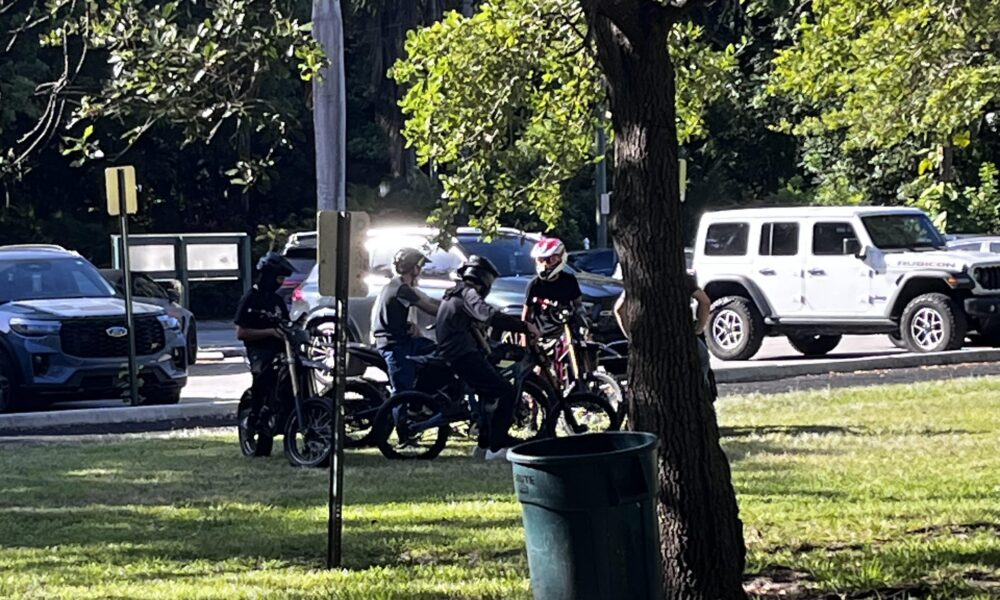



Electric bikes and scooters will be barred from city sidewalks under new rules adopted this month by the City Commission. Advocates for public safety applauded the move, while saying state and local officials need to do more to protect pedestrians.
Local advocates for pedestrian safety – including a Coconut Grove couple who were hit from behind by an electric bike and hospitalized earlier this year – are welcoming the new e-bike rules adopted last week by the Miami City Commission.
But they also say those regulations, which limit how and where e-bikes and electric scooters can be ridden in the city – don’t go far enough, and may add to the confusion over what rules apply to micromobility devices in which locations.
Stricter laws are needed, they say, with more consistency across jurisdictions.
“I am grateful the City of Miami is looking at this,” said Lisa Sloat, who was hospitalized in January along with her husband Hank Klein when a 15-year-old boy lost control of his electric dirt bike and struck them on South Bayshore Drive near Kennedy Park.
But, she added, the new rules don’t address many of the issues that she and her husband have thought about during their recovery – enforcement, education, parental responsibility, and whether e-bikes should be registered and insured.
“What if there is bodily harm? What if there is property damage?” Sloat asked. “If the goal is really to protect pedestrians, I believe there’s more that needs to be done.”
Read more: Safety Concerns Grow After Grove Couple Struck by Dirt Bike
The new City of Miami rules – passed on Oct. 22 – ban e-bikes and motorized scooters from city sidewalks and impose a maximum speed limit of 20 mph when those devices are ridden on city streets. Offenders can be cited and fined $100.
The rules also prohibit anyone under the age of 16 from riding an e-bike or motorized scooter on city streets, sidewalks, walkways and public rights-of-way.
Beginning next month, the rules will apply to city streets and sidewalks, but not to county roads like Main Highway, South Bayshore Drive, Grand Avenue and Douglas Road.
Henrietta Schwarz, a Grove resident who has been active on issues involving pedestrian safety, described the Miami rules as a starting point.
“It’s better than nothing,” she said. “It’s a shame that so many people needed to get hurt (before the city acted). I’m happy they did this, and it’s a big thing keeping them (e-bikes) off sidewalks.”
Ira Leesfield, a Coconut Grove attorney who has been advocating for e-bike regulations since 2019, said City of Miami commissioners were smart to act, given the growing popularity of micromobility devices and the danger those devices pose to pedestrians.
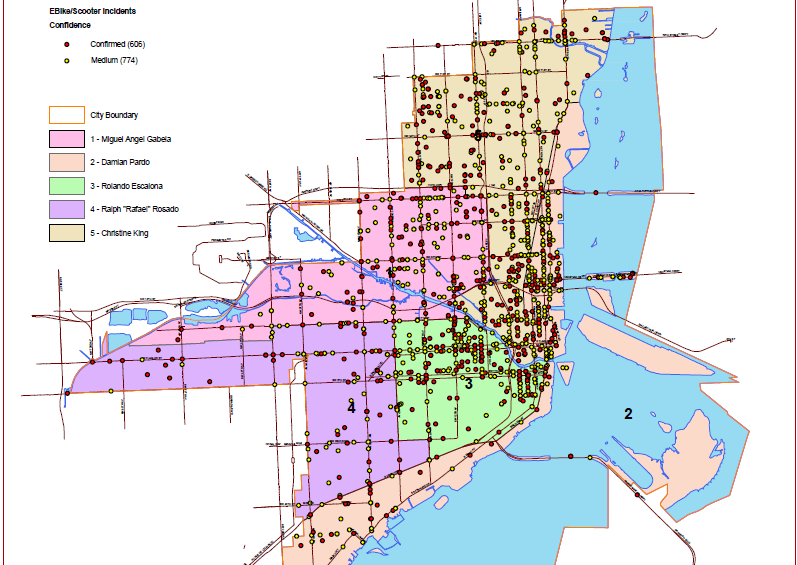
Read more: City of Miami: E-Bike and Scooter Incidents Are Rising
“I think they were given no choice,” he said.
But, he added, e-bike rules should be uniform across the state. Instead, cities like Miami, Pinecrest, and Miami Beach have enacted their own rules. In Pinecrest, for instance, e-bikes can be ridden on village sidewalks, but no faster than 10 mph.
“I believe that a stop sign in Pensacola means the same thing as a stop sign in Fort Lauderdale. I think it means stop,” Leesfield said. “That uniformity has to apply to what now has become a mushrooming problem.”
Leesfield criticized Gov. Ron DeSantis for vetoing a popular bill this year that would have set a statewide speed limit of 10 mph for e-bikes on sidewalks when pedestrians were present, and created a state task force to study e-bike safety.
“It is not a secret that this is a problem. The only secret is why did the governor veto the bill, which would have given us comprehensive, statewide, uniform legislation,” he said.
Read more: Governor Vetoes New E-Bike Safety Rules
“The rules should be uniform (and) the rules should tell people where they can and can’t go,” he added. “The rules should require some form of registration, just like if you buy a boat, (and) some level of safety training.”
Sloat also has a checklist – maybe a wish list – of issues she would like state and local officials to address, including registration, insurance, parental responsibility for teenage riders, and stricter penalties for scofflaws.
“A $100 fine is like sending someone to detention for talking in class,” she said.
Asked about her and her husband’s recovery, Sloat said they are making progress.
“We are very much recovered but not 100% recovered, and our lives are still very much impacted,” she said. “And, we are adding up our bills.”