
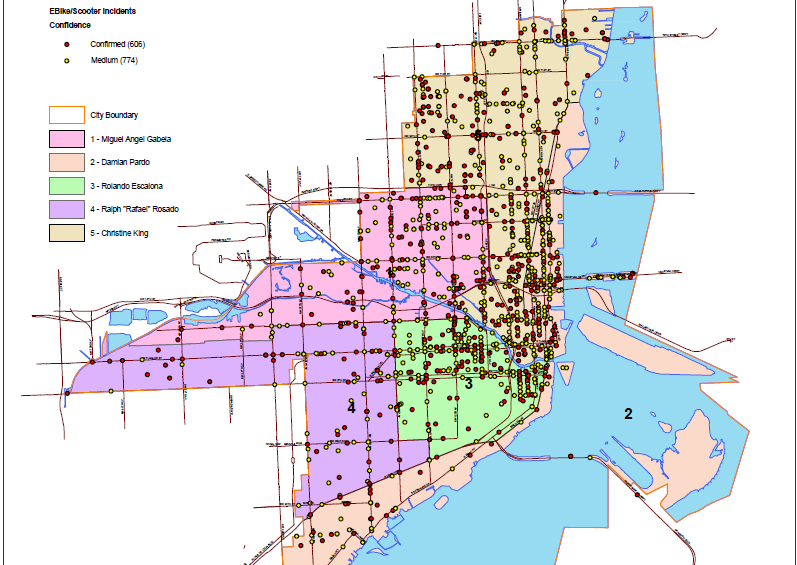




A new report by the City of Miami Fire-Rescue Department confirms what many Coconut Grove pedestrians already know: electric bikes and motorized scooters are dangerous, and the problem appears to be growing.
City of Miami first responders logged nearly 1,400 “incidents” involving electric bikes and scooters over the past two years, many of them causing serious injuries, at a time when the number of crashes involving micromobility devices appears to be on the rise.
The Miami Fire-Rescue Department released the statistics last week in advance of a preliminary vote by the Miami City Commission to restrict how and where e-bikes and scooters can be ridden in the city.
The legislation – proposed by Miami District 3 Commissioner Rolando Escalona – would ban e-bikes and motorized scooters from city sidewalks and impose a maximum speed limit of 20 miles per hour when those devices are ridden on city streets.
Read more: A Vote for Tougher E-Bike Rules in Miami
In total, first responders documented 1,380 incidents involving micromobility devices since September 2024, including 606 incidents that were classified as either “confirmed” or “high confidence.” The remainder were classed as “medium” confidence.
The injuries sustained in those 606 incidents were serious enough to result in 47 “trauma alerts” and a trip to the hospital in 418 cases.
Paramedics logged at least 86 head injuries, numerous wrist and ankle injuries, and one case of cardiac arrest (in an incident of “medium” confidence.)
The report doesn’t indicate whether those injuries were sustained by the individuals who were operating an e-bike or scooter, or someone else, but the Fire-Rescue Department said it had identified at least 15 pedestrians who were struck by a rider.
Of the 606 cases, 163 involved electric bikes. Another 443 incidents involved scooters, which were described variously as “electric” scooters” or “stand-up” scooters or just plain scooters.
The statistics also suggest that crashes involving micromobility devices are on the rise. Of the 1,380 cases logged by first responders, 472 cases occurred during the first eight months of this year, compared to 443 cases in the first eight months of 2025 — an increase of 6.5%.
The Fire Rescue Department also provided a breakout of the 1,380 incidents among 16 city fire stations.
Fire Station #8 on Oak Avenue in Coconut Grove responded to 58 incidents, or 4.2% of the total. Those incidents resulted in two trauma alerts and 41 trips to the hospital.
“This is a really big crisis for our district,” Miami District 2 Commissioner Damian Pardo said last week before voting in favor of the new restrictions.
The city’s Fire Station #2 on North Miami Avenue – also in District 2 — recorded the highest number of incidents, with 235 cases, or 17% of the total. Those incidents resulted in 17 trauma alerts and 138 trips to the hospital.
The Fire-Rescue report was requested by Escalona, the sponsor of the e-bike legislation adopted last week on first reading.


















The City Commission should try to obtain information on how many of the responded incidents occurred on County roads. Then it should work with the Miami-Dade County Commissioners to urge them to adopt a County Ordinance restricting how and where e-bikes and motorized scooters can be ridden on County roads. That is what the Village of Key Biscayne successfully did with regarding riding e-bikes and motorized scooters on Crandon Boulevard which is a County road. Miami-Dade County Commissioner Raquel Regalado sponsored the Miami-Dade County Ordinance.
Without a County Ordinance, an incident occurring outside of Kennedy Park on County roads would not be affected by the proposed City Ordinance. An incident occurring on any portion of Commodore Trail that is on a County road would not be affected by the proposed City Ordinance.
The City Commission needs to get involved in lobbying efforts to solve both the e-bike problem and the Live Local Act problem. Both of these issues aren’t being addressed in a manner that would hopefully solve the problem. They need to work with the Miami-Dade County Commission to solve the e-bike problem on County roads. They need to lobby the State Legislature to solve Live Local Act as it would apply to Coconut Grove. They need to follow what the Village of Key Biscayne did with regard to e-bikes on County roads. They need to follow the Miami-Dade County’s approach with regard to solving the Live Local Act by lobbying the State Legislature. Otherwise, problems won’t be resolved.
I am a retired physics professor and am currently work as an eBike repair technician. That combination gives me both a scientific and practical perspective on the issue of eBike usage. I
would like to address the methodology of the three-class system that is based solely on maximum velocity. Any meaningful classification system should consider not only speed, but also vehicle weight. In physics, the combination of mass and speed determines a vehicle’s kinetic energy, which is a key factor in the severity of a collision.
Recently an eBike that came into my shop that illustrates the problem. It looked and felt like a motorcycle, it was so heavy I could hardly lift it. It had a 70V battery, and was capable of speeds in excess of 40 mph. Yet because it had two little pedals attached to the chain that made it a legal
class-three ‘electric bicycle’. If we compare the energy imparted by this vehicle in a crash it is significantly worse than a heavy bicycle going 20mph.
In addition, the availability of inexpensive eBikes means that the riders may not be experienced riding with other cyclists. It is not uncommon for eRiders to pass without warning or to actually go opposite traffic. These devices are not bicycles with motors, but are motorcycles with pedals, and they do NOT belong in bike lanes and certainly not on a sidewalk. They should be classified by their damage potential, and required to be licensed and insured accordingly.