


Coconut Grove-based developer David Martin is promising a waterfront destination for everyone. We examined the proposed 99-year lease to see what’s free, what isn’t and who gets to set the prices.
When Terra Group CEO David Martin met virtually with residents on Oct. 21 to share his vision for redeveloping the former Miami Seaquarium on county-owned land on Virginia Key, he painted an inviting picture: a waterfront destination where families could stroll along Biscayne Bay, launch a kayak, enjoy a meal and take the kids to a new aquarium.
There would be gardens, restaurants, a “fisherman’s village,” a restored Golden Dome for special events and a marina to help pay for it all.
It sounded like the kind of place Miami could use more of.
But in a city where once-affordable waterfront hangouts have increasingly given way to upscale restaurants and entertainment venues, there’s another question worth asking: Will ordinary residents be able to afford to enjoy it?
While Miami-Dade County attracts a growing population of high-net-worth newcomers, the economic reality for many longtime residents is considerably more modest: The median annual household income in this county of nearly 3 million people is just under $72,000, meaning half of all households earn less.
According to one study, more than half of the county’s households earn too little to cover basic living expenses. For those families, even a modestly priced day at the waterfront is a luxury that must compete with more pressing needs.
Martin’s Coconut Grove-based Terra Group has built its reputation developing luxury residences and upscale commercial properties across South Florida. On its website, the company boasts that its projects “define — and refine — the meaning of modern luxury.”
But can a developer that has made its mark serving a high-end clientele deliver a waterfront destination that families of modest means can afford to enjoy? And what assurances would Miami-Dade County have that it will?
Martin’s Resilient Aquarium, an affiliate of Terra Group, is seeking a 99-year lease of the publicly owned property. The agreement calls for at least $100 million in private redevelopment investment, including a minimum of $10 million for public infrastructure and amenities that would be free to use.
The deal hit a snag this month when a Miami-Dade County Commission committee voted to defer consideration of the agreement, citing concerns about inadequate public review of the 249-page lease, which had been released just the night before the hearing.
Commissioners are now scheduled to consider the full redevelopment package — the proposed 99-year lease, comprehensive-plan amendments and zoning changes needed for the project — at a special meeting on Dec. 8. Martin is seeking approval ahead of a Dec. 30 deadline tied to the Seaquarium’s bankruptcy proceedings.
Read more: Seaquarium Plan Advances Despite Environmental Warnings
To assess how affordable Martin’s vision might be for Miami-Dade County residents once the project is complete, the Spotlight examined Resilient Aquarium’s public proposal for the 38-acre property and the county’s proposed lease governing its redevelopment.
We also submitted questions to Martin and Terra about parking, admission prices, dining, recreational activities and long-term affordability. The developer responded through a spokesperson but provided few specifics about what visitors might eventually pay or whether it would commit to keeping those costs affordable.
County officials, asked similar questions, declined to answer, instead referring the Spotlight back to Resilient Aquarium, saying the developer was “best positioned to discuss how it developed the proposal and what factors informed its proposed terms.”
Here are five things we found in the fine print.
1. The bay views are free. The parking? We’ll see.
Let’s start with the good news.
Resilient Aquarium’s proposed lease requires a continuous waterfront promenade, generally at least 18 feet wide, wrapping around much of the Seaquarium property. The three-quarter-mile Ocean Walk would offer views of Biscayne Bay, public seating and landscaped gathering areas.
And it would be free.
The lease prohibits admission charges, membership requirements or mandatory purchases for access to the baywalk and designated public spaces. Those areas generally must remain open daily from sunrise until two hours after sunset, with restrictions on temporary closures.
But there’s a catch that anyone who drives to Virginia Key will recognize: Parking.
Under Section 8.3 of the proposed lease, Resilient Aquarium and its operators would have broad authority to establish parking charges. The agreement doesn’t appear to require free or discounted parking for Miami-Dade residents or visitors who come only to enjoy the public waterfront.
Before the Seaquarium closed in October 2025, visitors paid $20 per vehicle to park.
Across Miami, parking at popular attractions on publicly owned land comes at a price. For a four-hour visit, published rates range from $18 at the Pérez Art Museum Miami to $20 at Jungle Island on Watson Island and about $24 at Bayside Marketplace downtown. Rates can rise during special events.
Asked whether visitors would be charged to park at the redeveloped property, the Terra spokesperson said the developer hadn’t decided whether to charge standard parking rates or offer free or discounted parking for people visiting the baywalk and other public amenities.
With limited public transportation to Virginia Key, many visitors would likely arrive by car, facing parking charges even when visiting only the free waterfront amenities.
2. Taking the kids to the aquarium could get expensive.
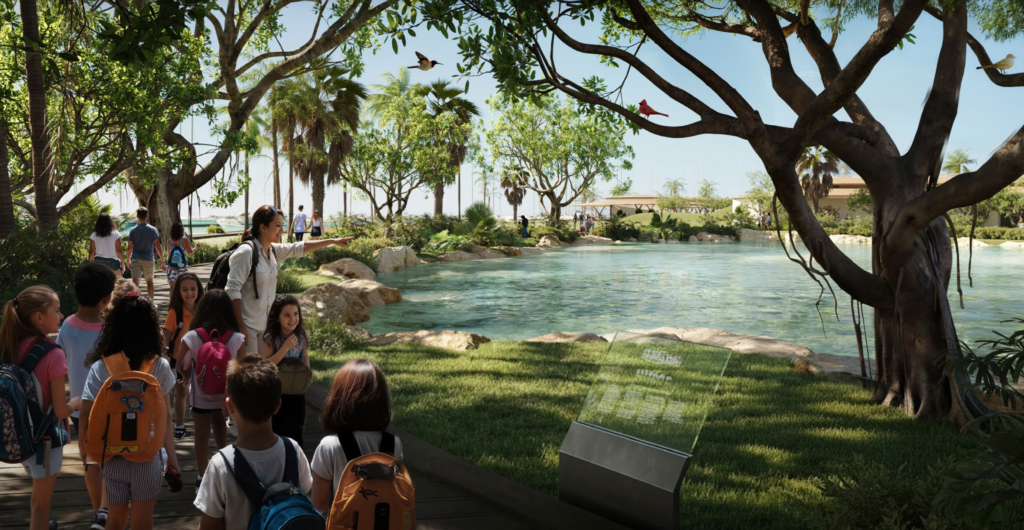
The centerpiece of Resilient Aquarium’s proposal is a new aquarium, one that would dispense with the marine mammal performances of the old Seaquarium in favor of marine education, conservation and exhibits celebrating Biscayne Bay.
Martin has emphasized the project’s family-friendly character, including opportunities for children to learn about marine life and the surrounding environment.
But the lease doesn’t establish an admission price for the aquarium or require discounted tickets for Miami-Dade residents. Those decisions would largely rest with the operator.
Asked about admission prices and possible discounts for county residents, the Terra spokesperson said only that prices had not yet been determined.
Before it closed last year Miami Seaquarium, catering mostly to visitors, advertised online tickets at $31.99 for adults and $24.99 for children. Jungle Island currently charges $36.95 for adults and $26.95 for children. At those rates, admission alone for a family of four — two adults and two children — would cost about $128 at Jungle Island or $114 at the former Seaquarium, before parking, food or other expenses.
For a family of four visiting on their own, the difference between a free waterfront stroll and a day at a major aquarium could be substantial.
The lease also envisions educational programming, environmental research and opportunities for students to learn about marine conservation. But it doesn’t specify how extensive those programs must be, how many school visits must be offered or whether students would receive free admission, leaving it to the developer’s discretion.
Resilient Aquarium said it was interested in partnering with local schools but had not worked out the details.
3. Fisherman’s Village: Come for the fish, stay for the fine dining.
Resilient Aquarium’s proposal includes a Fisherman’s Village with waterfront restaurants, shops and marine-oriented businesses. The name evokes a certain image: fishing gear, boating supplies, perhaps a casual seafood restaurant where the prices don’t require a second look.
But while the proposed lease allows up to 46,000 square feet of restaurant space and 19,000 square feet of retail, it sets no minimum requirements for marine-oriented businesses or affordable dining options.
Terra’s spokesperson said the village would feature local operators offering family-friendly dining at a range of prices, but had not identified specific tenants or what customers could expect to pay.
And Resilient Aquarium’s own financial projections suggest that restaurants and retail will be anything but a sideline.
According to the developer’s economic analysis, the project is expected to generate $31.25 million annually in restaurant and retail sales once fully operational — roughly 60% of its projected $51.8 million in total annual operating revenue.
That’s a lot of fish sandwiches.
The proposal also calls for preserving the Seaquarium’s historic Golden Dome, designed by Buckminster Fuller, and converting it into an event venue.
But while the dome would remain a prominent feature of the waterfront destination, the lease does not require it to be open to the public for free. Instead, it could generate revenue from weddings, corporate gatherings and other private events.
Miami-Dade County would get a small perk: free use of the event space for at least four days or nights each year.
For some Miami-Dade residents there may be a familiar ring to all this.
At Coconut Grove’s seven-acre Regatta Harbour, another redevelopment of publicly owned waterfront property, plans for marine-oriented retail in a historic seaplane hangar gave way to a year-round, luxury-branded event space. A promised mid-budget restaurant became an upscale nightlife venue.
Other promised public amenities, including a boat launch, rooftop terrace and a pedestrian pier, remained unbuilt years after the project opened.
Regatta Harbour has nevertheless been a financial success, generating millions of dollars annually in lease payments for the City of Miami.
Read more: Regatta Harbour: Sales Soar as Questions Mount
4. A waterfront for everyone. But bring your own kayak.
Martin has promised to open up a stretch of Virginia Key’s waterfront that has long been inaccessible to the public, offering what he calls “new access to the water.”
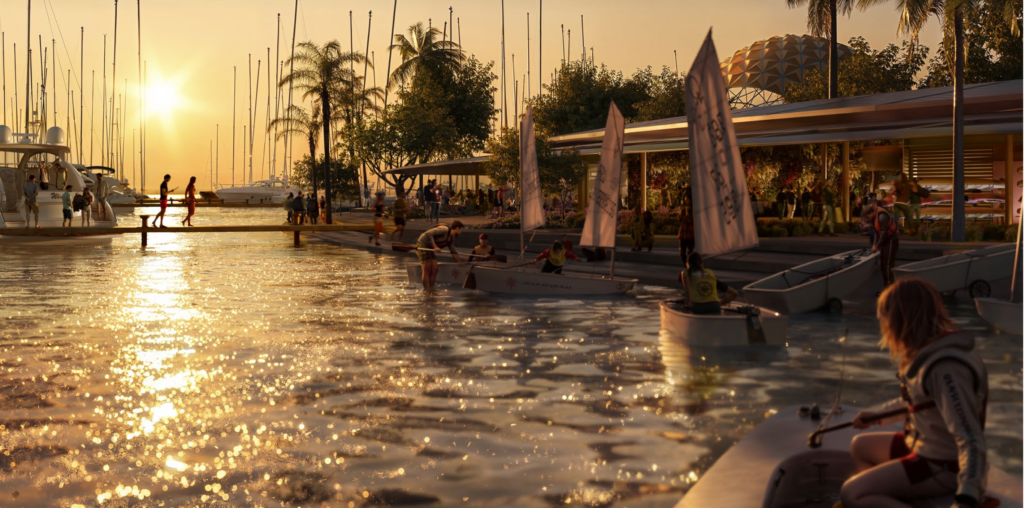
But Resilient Aquarium’s plans show much of that waterfront occupied by a sprawling commercial marina, with rows of boat slips extending into Biscayne Bay and a separate dry-storage facility for additional vessels.
Martin has described the marina as the financial engine that would make the redevelopment possible. The proposed lease allows Resilient Aquarium to charge for boat slips, storage and other marina services, without setting general price limits or requiring discounts for Miami-Dade residents.
And while Resilient Aquarium’s renderings depict an inviting waterfront dotted with boats, the lease doesn’t require a public boat ramp where residents could launch their own motorboats from trailers.
Even smaller boats aren’t necessarily accommodated.
One of Resilient Aquarium’s promotional renderings shows small sailboats being launched from a gently sloping shoreline, with people wading into the water nearby. But the lease doesn’t specifically require a launch for sailboats or facilities for sailing lessons and rentals.
What it does guarantee is a free public launch for kayaks, canoes and similar nonmotorized watercraft, with space for loading and unloading and access to fee-based parking. Some small, hand-launched sailboats might qualify, depending on how the facility is designed.
Asked whether it would offer equipment rentals or discounted recreational opportunities, the Terra spokesperson confirmed that the launch would be free but said it hadn’t decided whether rentals would be available.
And for those who want to get out onto Biscayne Bay without paying marina fees?
Just bring your own kayak.
5. A waterfront for everyone — including the VIPs.
There’s another revealing distinction in the proposed lease.
The agreement prohibits Resilient Aquarium from operating the development as a private membership club that excludes the general public.
But it expressly allows optional paid memberships offering benefits such as “priority reservations,” “behind-the-scenes or VIP experiences,” “preferred parking,” “invitations to members-only events” and “concierge services.”
Those memberships cannot restrict access to the waterfront or other public amenities. But they could create two considerably different visitor experiences: one for the general public and another, with additional privileges and amenities, for those willing to pay more.
That’s not unusual for a commercial attraction. Theme parks, resorts and entertainment venues have long offered premium services to customers willing to pay extra.
The lease does include one nod to affordability: It requires Resilient Aquarium to offer at least one membership tier at a price “reasonably accessible to a majority of the general public of Miami-Dade County.”
(The provision applies to membership benefits only, however, not the basic price of admission to the aquarium).
Asked what membership benefits might be offered and what they would cost, the Terra spokesperson provided no details, saying only that it would “fully comply with the terms of the lease.”
And what does a price that is “reasonably accessible” mean in a county where half of all households earn less than $72,000 a year and more than half struggle to make ends meet?
The lease sets no price ceiling or income-based formula for determining affordability. The county would retain the right to challenge Resilient Aquarium’s proposed membership prices, but the agreement provides no objective standard for deciding what’s too expensive.
For households with no disposable income, however, the math is straightforward: An affordable premium membership would need to cost exactly zero.
The bottom line
Asked whether it would make specific long-term commitments to affordable parking, admission, dining or recreation — or consider putting such guarantees into the lease — Resilient Aquarium had little to say.
Prices for paid activities and amenities would be determined closer to opening, a company spokesperson said in a written response.
In its original redevelopment proposal, Resilient Aquarium promised to transform the Seaquarium into “a revitalized community-oriented theme park.”
Under the terms of the proposed 99-year lease, just how accessible — and affordable — that vision ultimately becomes is largely left to the developer’s discretion.