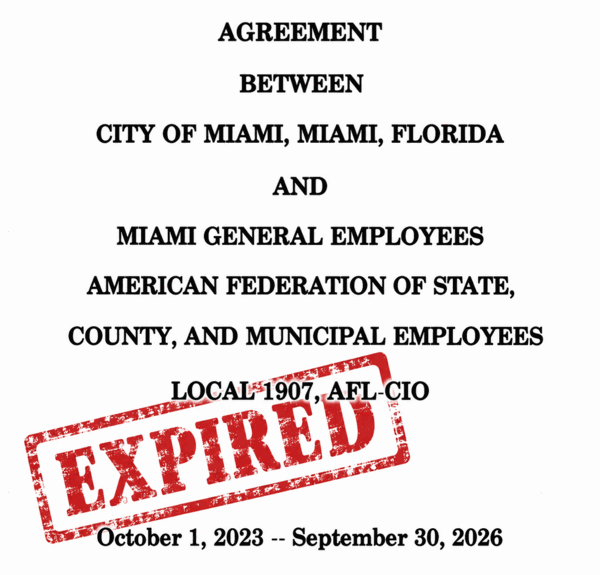




Miami’s last labor agreements delivered substantial raises. Now, with four contracts expired and voters approving Amendment 3’s sweeping property-tax cuts, City Hall is revealing little about what comes next — or what it might cost taxpayers.
Miami’s four labor contracts, covering more than 4,300 city workers, expired September 30, setting the stage for negotiations that could commit taxpayers to hundreds of millions of dollars in employee salaries and benefits over the next several years.
But City Hall has disclosed little about what the new agreements might contain or how much they could cost. City officials have said they were waiting until after the November 3 election to finalize the contracts.
The agreements cover police officers, firefighters, sanitation workers and other municipal employees. City payroll records put the combined annual salaries of employees represented by the four unions at approximately $441 million as of May 2025, excluding pension contributions, health insurance and other benefits.
Nearly $1 billion of Miami’s $1.3 billion general fund budget goes toward employee salaries and benefits — roughly 77 cents of every dollar available for basic municipal operations. Roughly 400 city positions — primarily management and administrative jobs — are nonunion, representing about 9% of the workforce.
The negotiations will resume as Miami confronts significant new financial pressures. Florida voters on Tuesday approved Amendment 3, a sweeping property-tax overhaul that will reduce taxes on owner-occupied homes and limit increases in assessed values for other properties. City officials estimate the changes will reduce Miami’s annual revenue by $53.9 million when fully implemented in 2028.
Miami voters also approved a $450 million public safety bond to finance improvements to police and fire-rescue facilities. With interest, city officials estimate the borrowing could cost taxpayers as much as $795 million over the life of the bonds.
The previous union contracts, which remain in effect until new agreements are approved, are key contributors to the city’s rising personnel costs, delivering substantial pay raises, some at more than twice the rate of local inflation. New agreements must be ratified by the affected bargaining units and approved by the city.
To find out where negotiations stand, the Spotlight requested the latest available working drafts or written proposals for each of the four successor agreements.
The city provided only a collection of individual contract provisions signed in July by representatives of its sanitation workers, the smallest of the four unions. The documents address disciplinary procedures, seniority, employee benefits and other workplace matters, but contain no proposed across-the-board wage increases.
No comparable documents were provided for the other three unions.
The city has not made any officials available to discuss the status of negotiations or the key issues that remain unresolved, despite requests from the Spotlight.
Based on the expired agreements, city payroll records and Miami’s latest budget, here are four things to watch when the new contracts come before the City Commission.
1. How big will the next raises be?
Under the expired agreements, two of Miami’s largest municipal unions negotiated across-the-board raises totaling approximately 19% over three years, when compounded.
Under the three-year contracts that expired September 30, general municipal employees received annual raises of 6%, while sanitation workers received raises of 5%, 7% and 6% over the same period.
Because each increase builds on the previous one, both sets compounded to approximately 19.1%.
By comparison, consumer prices in the Miami-Fort Lauderdale-West Palm Beach area rose about 9.1% between August 2023 and August 2026, according to the federal Bureau of Labor Statistics, meaning the negotiated raises were more than twice the increase in local consumer prices.
For an employee earning $60,000, three successive 6% raises would increase annual pay to approximately $71,460 — an additional $11,460.
Police officers and firefighters are covered by separate union contracts, each with its own salary schedule. Together, those two bargaining units accounted for approximately $256 million in annual payroll as of May 2025.
The city has not disclosed what general raises, if any, are being proposed.
2. Will employees keep getting raises on top of raises?
General raises tell only part of the story.
Under Miami’s agreements with its general municipal and sanitation unions, eligible employees can receive additional 5% raises as they advance through salary levels known as steps. These increases generally occur on an employee’s annual employment anniversary, subject to performance evaluations and departmental approval. They come on top of any across-the-board raises negotiated by the unions.
The cumulative effect can be substantial.
An employee earning $60,000 who received three successive 6% general raises and qualified for three additional 5% step increases would see annual pay climb to approximately $82,771 — nearly 38% more over three years.
Whether the new contracts will preserve or modify those increases remains unknown.
3. Will pension and benefit costs keep climbing?
Salary increases are only part of Miami’s employee compensation costs.
The city’s proposed $1.3 billion general fund budget for the fiscal year beginning October 1 included approximately $609 million in salaries and wages and $384 million in employee benefits. Those figures cover the broader city workforce, including employees who are not represented by unions.
Pensions account for a substantial share of personnel costs.
Budget documents projected approximately $174 million in annual contributions to the police and firefighter retirement system and another $61 million for the system covering general and sanitation employees.
Those contributions reflect retirement obligations accumulated over many years.
Health insurance adds another substantial expense. The previous budget included approximately $30 million for the firefighters’ health insurance trust.
Earlier this year, the Spotlight reported that employee benefit spending had increased 62% over five years, compared with 41% growth in salaries and a 5% increase in the workforce.
Read more: Inside City Hall: Miami’s Pay Raise Machine
Not all those expenses are determined through collective bargaining. Pension costs also reflect investment returns, estimates of future retirement costs and previously earned benefits. But salary increases can raise future pension obligations because many retirement benefits are tied partly to earnings.
The city has not disclosed whether the new agreements would change retirement benefits, health insurance contributions or other compensation provisions — or what those changes might cost.
4. What Else Is at Stake in the Negotiations?
Not everything in a labor agreement comes with a salary figure attached.
Contracts also govern discipline, seniority, scheduling, overtime and other workplace conditions that can affect both municipal costs and services.
One example: Under existing agreements, eight city employees are excused from their regular municipal duties to work full time for their unions, while collectively drawing more than $1 million annually in taxpayer-funded salaries.
Read more: Inside City Hall: City Paychecks, Union Jobs
The limited negotiating documents provided to the Spotlight offer a glimpse of other workplace protections.
One provision signed in July by city and sanitation union representatives would prevent records of verbal counseling, written warnings and reprimands from being used against employees after three years. More serious disciplinary actions, including suspensions, demotions and dismissals, are excluded.
Such protections can shield employees from having relatively minor infractions follow them indefinitely. But they can also limit the disciplinary history managers can consider when dealing with repeated workplace problems.
The documents do not establish whether this provision represents a new concession or a continuation of existing terms.
Similar provisions in police, firefighter and other municipal employee contracts can influence how managers discipline workers, assign duties and organize services. But the city has disclosed little about what changes it is seeking, what the unions are proposing or what concessions might be included in the final agreements.
Any changes to the contracts — or simply renewing them under their existing terms — will require City Commission approval. The city has not said when the proposed agreements will be available for public review.