



Miami’s annual bill for salaries and employee benefits has grown by nearly $500 million in a decade, while the number of budgeted positions increased only about 12%. Meanwhile, the city’s capital plan still carries a roughly $1.8 billion funding gap.
Developer David Martin’s newly completed 32,000-square-foot waterfront home in Coconut Grove sits on property assessed at about $42 million.
A few doors down, hedge fund billionaire Ken Griffin owns an estate he acquired in 2022 that is now assessed, for tax purposes, at about $100 million.
Both are recent examples of the extraordinary rise in real estate values that has transformed Miami over the past decade — and poured hundreds of millions of additional dollars into City Hall.
Since 2016, the city’s taxable property value has climbed from about $44.6 billion to more than $110 billion — an increase of roughly 147%.
Property-tax collections followed. A decade ago, Miami budgeted about $304 million in property-tax revenue. Under the proposed 2026-27 budget, it expects to collect nearly $691 million — an increase of roughly $387 million, or 128%.
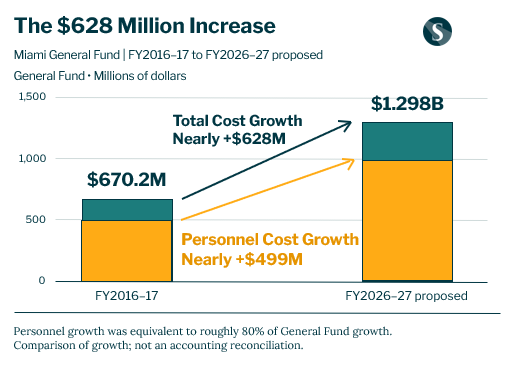
The city’s General Fund — its principal account for funding city operations — has grown from $670.2 million to a proposed $1.298 billion, an increase of nearly $628 million, or 94%.
Read more: Miami’s Billion-Dollar Boom, Part 1: Where Did All the Money Go?
So where did all that additional money go?
A large share went to the cost of the people who work for City Hall.
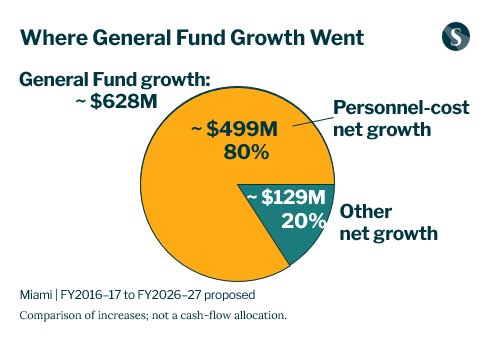
Over the same decade, Miami’s annual bill for salaries and employee benefits grew from about $494.6 million to $993.6 million — an increase of nearly $499 million.
That increase alone is equivalent to roughly 80% of the entire $628 million growth in the General Fund.
But the workforce itself did not grow anything close to that fast.
The number of budgeted positions increased from 4,346 to 4,883 — about 12%.
Inflation accounts for part of the difference. Adjusted using the same federal inflation data used throughout this Spotlight series, the $494.6 million Miami budgeted for salaries and benefits a decade ago would equal roughly $674 million today.
Even after that adjustment, Miami’s personnel spending has increased by roughly 47%.
Previous Spotlight reporting has shown what some of that growth looks like inside City Hall.
Consider the former city manager.
When Art Noriega became Miami’s top administrator in 2020, his annual salary was about $311,000. By the time he left office, at the beginning of this year, it had climbed to more than $525,000 — an increase of 69%.
And Noriega was hardly alone.
Between 2023 and 2025, the salary of Miami’s chief financial officer jumped 44%, to $285,935. The salary of a deputy city manager rose 47%, to $312,642. An executive secretary in the City Manager’s Office received a 31% increase, bringing her annual pay to $178,517.
Across City Hall, the number of employees earning more than $200,000 a year more than doubled in two years, reaching 110 by the end of 2025.
The increases are not the result of a single policy. As the Spotlight has previously reported, city employees can receive raises through several channels operating simultaneously, including union-negotiated increases, promotions, anniversary step increases and salary adjustments authorized by department heads and approved by the city manager.
Read more: Inside City Hall: Miami’s Pay Raise Machine
The trend has continued under the city’s new administration.
After taking office in December, Mayor Eileen Higgins replaced all but one member of the 19-person staff she inherited from former Mayor Francis Suarez.
The number of employees remained the same. The payroll did not.
Suarez’s staff had a listed annual payroll of about $1.56 million. Higgins’ totals just over $2.01 million — an increase of roughly $450,000, or 29%.
Her chief of staff earns $250,000, compared with $180,000 for Suarez’s. Five Higgins staffers earn at least $180,000; Suarez had one.
Read more: Inside City Hall: Higgins Spends Big on Revamped Office Staff
Those examples represent only a small portion of Miami’s nearly 4,900 budgeted positions, and they do not explain the entire rise in personnel spending.
But the broader budget numbers point in the same direction.
Over the decade, spending on salaries and wages increased about 93%, from $315.2 million to $609.2 million.
Employee benefits grew even faster — about 114%, from $179.5 million to $384.4 million.
Put together, the cost of Miami’s workforce has slightly more than doubled during a decade when the General Fund itself nearly doubled — even as the number of budgeted positions grew only about 12%.
The rise has been particularly pronounced in public safety.
Miami budgeted about $357 million from its General Fund for Police and Fire-Rescue in 2016-17. The proposed budget puts that figure at about $732.5 million.
The increase — roughly $375 million — is equivalent to about 60 cents of every additional General Fund dollar Miami has to spend today.
Read more: Miami’s Billion-Dollar Boom, Part 2: The Rising Cost of Public Safety
And for many Miami employees, what appears on the salary schedule is only part of the compensation picture.
That is particularly true in public safety, where collective bargaining agreements provide an array of additional compensation.
As the Spotlight recently reported, compensation credited toward Miami firefighters’ pensions averages about 32% more than their published base salaries.
The difference reflects specialty, incentive and other forms of pensionable compensation that are not apparent from the city’s published base salaries.
Those additional earnings can substantially increase what a firefighter makes while working. Because they can also increase the compensation used to calculate retirement benefits, their effects can continue for decades after an employee leaves City Hall.
A Spotlight analysis of pension records found that roughly 275 retired Miami firefighters — more than one-third of the city’s retired firefighters — receive pensions of more than $100,000 a year. The largest exceeds $220,000.
And 49 of the 50 largest pensions paid by Miami’s retirement systems go to former firefighters.
Read more: Inside City Hall: The Hidden Pay Fueling Miami’s Six-Figure Firefighter Pensions
Mayor Higgins’ proposed budget for the upcoming fiscal year reflects those costs.
The proposed budget allocates nearly $100 million in Fire-Rescue spending to just two employee benefit costs: approximately $62.7 million for the city’s contribution to the Firefighters’ and Police Officers’ Retirement Trust and another $37.2 million for the firefighters’ health insurance trust.
The retirement contribution alone has more than tripled from about $20.7 million a decade ago.
Fire-Rescue’s General Fund budget has grown from about $125.5 million a decade ago to roughly $294.6 million in the proposed budget — an increase of 135% — while its budgeted workforce grew 17%.
Citywide, the proposed budget includes another $17.7 million net increase in salary costs, driven primarily by higher regular salaries, contractual step increases and an average 5% increase for nonunion employees.
It also includes about $2.5 million in additional net overtime funding and $2.4 million in higher special-pay earnings, primarily for one-time payouts.
Yet there is one important number Miami taxpayers still cannot easily see: what each city employee actually takes home.
The Spotlight has repeatedly sought public records showing total annual compensation for Miami employees, including salaries, overtime, specialty pay, bonuses and other financial incentives.
The city has declined to provide records containing that information in the form requested.
That makes it difficult to determine how the hundreds of millions Miami budgets for salaries, overtime and other forms of compensation ultimately flow to individual employees.
It also leaves a significant piece of Miami’s growing personnel bill obscured from public view — even as the city faces enormous demands elsewhere.
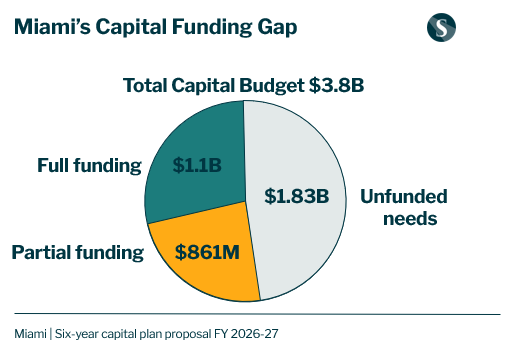
One number illustrates the scale: $1.83 billion.
That’s the approximate funding gap for projects already included in Miami’s six-year capital plan — streets, parks, public buildings and other infrastructure.
The plan contains about $3.8 billion in projects. Roughly $1.1 billion is fully funded, while the rest is either only partially funded or has no identified funding at all. Altogether, the amount still needed is approximately $1.83 billion.
That does not mean Miami could simply have taken the money it spent on employees and used it to eliminate the capital gap. Capital projects are financed through numerous sources, including bonds, grants, impact fees and General Fund transfers.
But after a decade in which taxable property values increased 147% and the General Fund nearly doubled, Miami still has approximately $1.83 billion in identified capital needs for which it has no identified funding.
City officials warned years ago that rapidly rising revenues could not be counted on indefinitely.
In his proposed 2019-20 budget, then-City Manager Emilio Gonzalez wrote: “We can be sure that heightened tax roll growth cannot continue indefinitely.”
He also identified another problem:
“Revenues have grown greatly, but expenses have grown even faster.”
Since then, Miami’s real estate boom has continued.
So has the spending.
The city is now preparing to adopt another record General Fund budget of nearly $1.3 billion. And its own projections show expenses continuing to grow faster than revenues.
Miami’s five-year forecast projects General Fund revenue increasing another 15.8%, compared with an 18.2% increase in expenditures. Salaries and wages remain the largest General Fund expenditure category, and the forecast assumes continued increases from employee step raises and comparable increases for nonunion workers.
The numbers show just how much of Miami’s extraordinary growth has been absorbed by the rising cost of its workforce.
Over the past decade, the city’s annual General Fund grew by nearly $628 million. Its annual personnel bill grew by nearly $499 million — an increase equivalent to almost 80% of the General Fund’s entire growth.
Yet the workforce grew by only about 12%.
And Miami’s capital plan still contains approximately $1.83 billion in projects for which funding has not been identified.
Commissioners will hold public hearings on the proposed budget Sept. 10 and Sept. 24. In November, voters will separately decide whether to authorize up to $450 million in borrowing for public-safety facilities.


















Excellent review and should be required reading for all city residents!
….and yet, those of us that have been here for a long time continue to be harassed about our canopy and the supposed obstructions it causes. The city continues to allow developers to feed their pockets at the expense of our trees/hedges/canopy. We live in the grove for a reason; stop messing it up!