




Newly obtained pension records show Miami firefighters are credited with an average of $31,500 more in annual compensation than their published base salaries — and for some, the difference approaches $100,000.
A Miami firefighter’s salary may say $100,000. The compensation credited toward that firefighter’s pension can tell a very different story.
Newly obtained pension records show just how different.
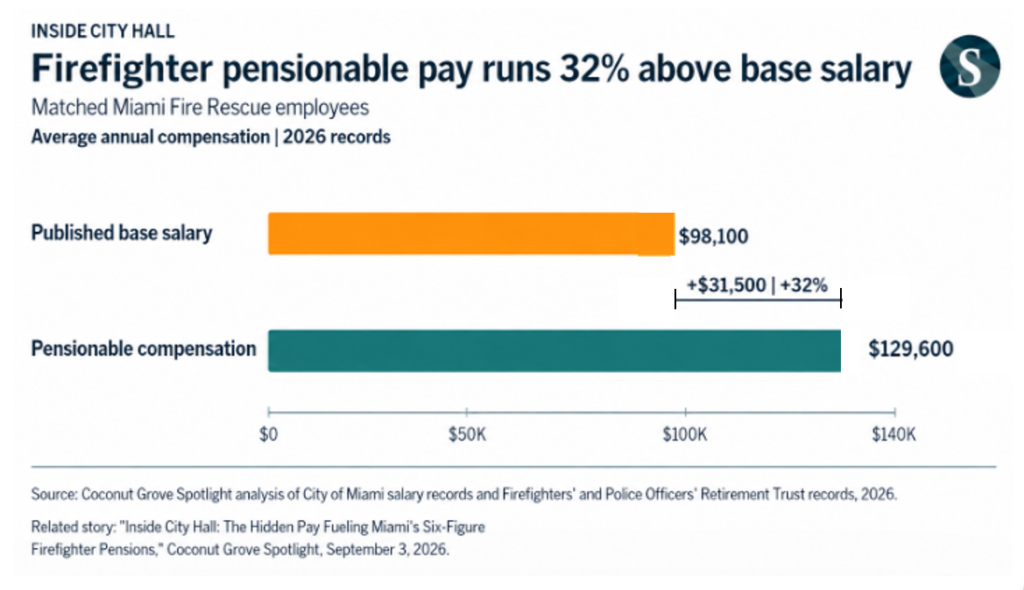
A Coconut Grove Spotlight analysis found that pensionable compensation for Miami Fire Rescue employees averaged about 32% more than their published base salaries.
Among employees matched across city salary records and pension records, the average published annual base salary was about $98,100. Average annual pensionable compensation was about $129,600 — roughly $31,500 more.
The pension records, provided by the City of Miami Firefighters’ and Police Officers’ Retirement Trust, list each active member’s “Total Pensionable Salary” for Pay Period 17.
Trust Administrator Dania Orta told the Spotlight that the biweekly figures should be multiplied by the city’s 26 annual pay periods to calculate annual pensionable compensation.
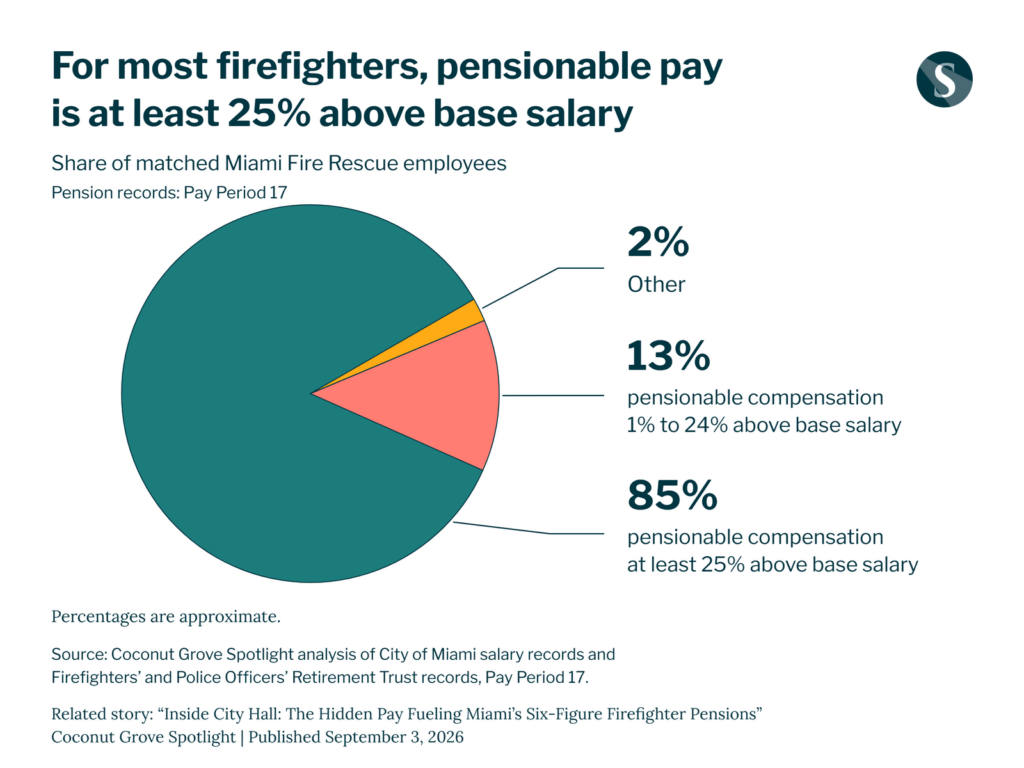
Using that calculation, the difference between base salary and pensionable compensation was widespread. Roughly 98% of the Fire Rescue employees matched by the Spotlight had annual pensionable compensation above their published base salary. For about 85%, the difference was at least 25%.
The findings provide another window into the rising cost of public safety in Miami. A separate Spotlight analysis published today found that annual General Fund spending on Police and Fire-Rescue has increased by about $375 million over the past decade — an increase equivalent to roughly 60% of the General Fund’s total growth during that period.
Read more: Miami’s Billion-Dollar Boom, Part 2: The Rising Cost of Public Safety
The new records also help fill an important gap in the Spotlight’s continuing examination of Miami’s firefighter pensions.
Earlier this summer, a Spotlight analysis found that 275 of the city’s roughly 760 retired firefighters — more than one in three — receive annual pensions exceeding $100,000. Of those, 73 receive more than $150,000 a year, while seven receive more than $200,000.
By comparison, only about 8% of the city’s approximately 1,076 retired police officers receive six-figure pensions. Among approximately 3,684 retirees in Miami’s two principal pension systems, 49 of the 50 largest annual pensions go to former Fire Rescue employees.
Read more: Inside City Hall: The Rise of Six-Figure Public Safety Pensions
The earlier analysis identified two primary reasons for the disparity.
Miami firefighters receive a richer retirement formula than other city employees. Most firefighters accrue pension benefits at 3% of pensionable salary for each of their first 15 years and 3.5% for each additional year, compared with a generally 3% multiplier for police officers and 2% for most general employees.
On top of that, the salary used to calculate firefighter pensions can be substantially higher than base salary.
Under the firefighters’ labor agreement, a range of specialty, incentive and assignment pays can count toward pensionable earnings, including additional compensation for paramedics, hazardous materials teams, dive teams, technical rescue, acting officers, management assignments and longevity. Overtime is excluded from firefighter pension calculations.
Read more: Inside City Hall: How Miami Firefighters Retire With Six-Figure Pensions
The extra pay adds up. The city budgeted about $19.7 million for firefighter specialty pay in the current fiscal year. Mayor Eileen Higgins’ proposed budget for the fiscal year beginning Oct. 1 would increase that to about $20.9 million — an increase of nearly $1.2 million, or 6.1%
Until now, the Spotlight had been unable to measure how much those additions can increase firefighters’ pensionable compensation.
Despite repeated public records requests, the city has declined to provide records showing the total annual compensation earned by its more than 4,883 employees after overtime, specialty pay, bonuses and other additions are factored in.
Read more: Inside City Hall: Miami’s Salary Secret
The new records came from a different source: the retirement trust that administers pensions for Miami police officers and firefighters.
Orta, the trust administrator, provided the Spotlight with the report listing each active member’s “Total Pensionable Salary” for the mid-August pay period.
Orta said the trust does not maintain the data used to calculate pensionable earnings; that information comes from city administrators.
“We do not have a breakdown of the specific pensionable items that add to the bi-weekly amount,” she wrote in an email to the Spotlight. “You can obtain that breakdown from the City’s payroll department.”
A public records request from the Spotlight is pending.
Even without that breakdown, comparing the pension records with the city’s published base salaries reveals substantial differences throughout Fire Rescue.
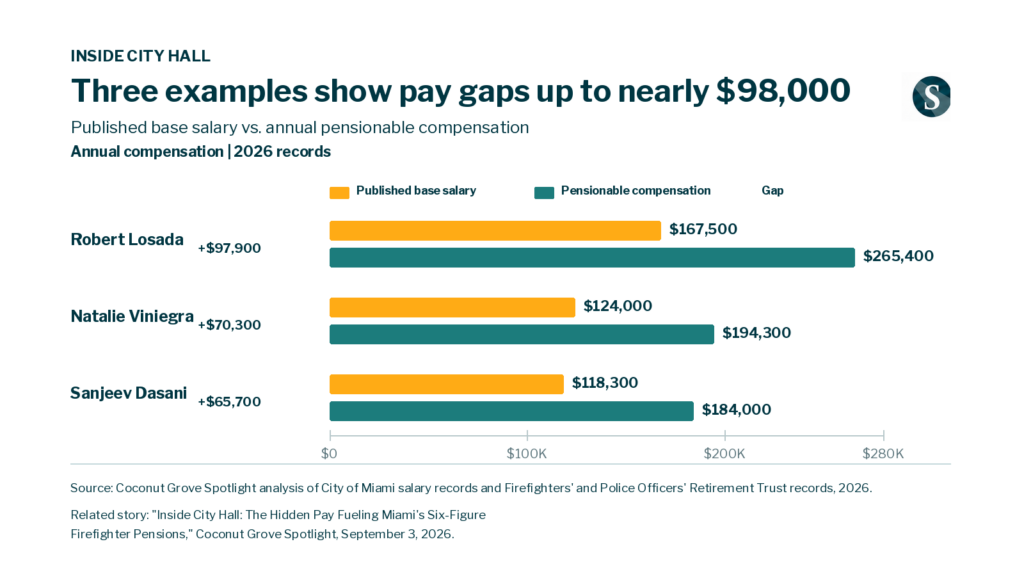
Assistant Fire Chief Robert Losada, for example, was listed by the city in March with an annual base salary of about $167,500.
His annual pensionable compensation, based on the retirement trust records and the calculation described by Orta, was about $265,400 — nearly $98,000 more than his published base salary.
Natalie Viniegra had a published base salary of about $124,000. Her annual pensionable compensation was about $194,300 — roughly $70,300 more.
Sanjeev Dasani had a base salary of about $118,300. His annual pensionable compensation was about $184,000 — approximately $65,700 more.
And the differences were not confined to a handful of chiefs or other highly paid employees.
Across the Fire Rescue employees matched by the Spotlight, the median difference between published base salary and annual pensionable compensation was about $31,100.
The findings underscore an important distinction in Miami’s retirement system: Base salary and pensionable salary are not the same thing.
And for firefighters, the difference can affect retirement checks for decades.
For many firefighters, retirement benefits are calculated using their highest year of pensionable earnings. Under the city’s pension formula, most firefighters earn 3% of their average final compensation for each of their first 15 years of service and 3.5% for each year thereafter.
That means a firefighter retiring after 30 years receives a pension equal to 97.5% of qualifying pensionable earnings, subject to applicable pension caps.
A firefighter retiring after 30 years with $100,000 in qualifying pensionable earnings would receive an annual pension of approximately $97,500 before cost-of-living adjustments.
Increase pensionable earnings to $150,000 and that pension rises to approximately $146,250.
At $200,000, it reaches approximately $195,000 a year.
And the difference compounds over decades: At $100,000 in pensionable earnings, a firefighter retiring after 30 years would collect about $1.1 million more over a 30-year retirement than a general city employee with the same earnings and years of service — even before cost-of-living increases.
And the numbers could climb higher.
In May, the Miami City Commission approved a series of firefighter pension changes that partially reversed retirement restrictions imposed during the city’s 2010 financial crisis and expanded participation in the Deferred Retirement Option Program, or DROP.
The changes were negotiated as part of the firefighters union’s collective bargaining agreement but were approved without a publicly disclosed estimate of their long-term cost.
Read more: Miami Eyes New Firefighter Pension Expansion Without Public Cost Estimate
The issue carries broader consequences for taxpayers.
Miami’s growing pension costs are part of a much larger expansion in City Hall spending over the past decade, as booming property values and tax collections helped nearly double the city’s General Fund.
Read more: Miami’s Billion-Dollar Boom, Part 1: Where Did All the Money Go?
According to the city’s most recent audited financial statements, Miami is responsible for roughly $3.5 billion in future pension benefits for current and former employees, with more than $1 billion of those obligations currently unfunded.
Employees contribute toward their pensions, but the city — and ultimately taxpayers — contributes substantially more.
Across the city’s pension systems during the last fiscal year, Miami contributed about $183 million, compared with about $38.1 million contributed by employees. The pension systems also generated approximately $269 million in net investment income.
Those taxpayer costs continue to rise.
Under Higgins’ proposed budget, the city’s required contribution to the Firefighters’ and Police Officers’ Retirement Trust would rise to about $164.6 million, an increase of approximately 12.8% from the current year. The proposed budget says the increase is driven primarily by poor investment performance.
The new pay records also arrive as Miami prepares for another potentially consequential round of labor negotiations. Collective bargaining agreements covering the city’s police, firefighters and general employees expire Sept. 30.


















More great reporting by Spotlight.
Lack of Transparency results in Lack of Trust. The average citizen like me, trying to pay attention, ends up concluding: (a) the City Commission is bought and paid for by developer campaign contributions; and (b) the “exorbitant” pension payouts guarantee that most city employees, especially fire and police, will automatically deliver their votes to whichever candidates promise to continue increasing them.
But is that true? We do have public records revealing legal campaign contributions to all candidates running for office. Do they always translate into commission votes for more high-rise buildings sprouting up everywhere? Or are they just the result of the “affordable housing” crisis and state Live Local Act? Hard to decide.
Same with pension obligations. It’s expensive to live in Miami. Even police and firemen often can’t afford a house on a $100k salary. Their work isn’t 9 to 5 and can be undeniably dangerous.
Because I can’t know the answers, even with the Spotlight’s mighty efforts, I end up saying “I just don’t trust the City.” Over time—and I’ve lived here for 40 years—I’ve concluded that the best and maybe only solution is to increase the number of commissioners to 9 from the current 5. We could end up with 9 “bad” ones, possibly, but there’ll be more transparency because each will be more local, more accountable. Plus, it’s harder to count to 5 votes than to just 3 and requires cooperation.
That’s my hope, and why I support Stronger Miami.