
Residents and tree advocates say the city is increasingly invoking traffic-safety rules to scrutinize long-time hedges and mature trees, raising questions about what the enforcement could mean for Coconut Grove’s lush character.
Michiel Johan van de Kreeke earned his lifelong nickname, “Monkey,” as a 6-year-old climbing trees on Braganza Avenue in South Grove.
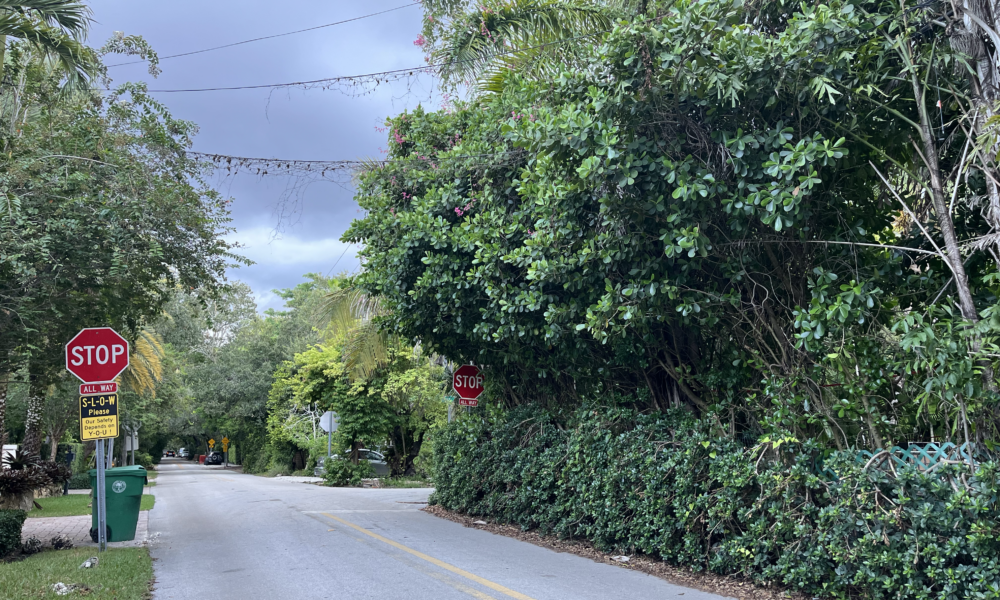
Decades later, when it came time to buy a family home in Miami, he chose one just a few blocks away, drawn to the lush canopy that reminded him of the neighborhood where he grew up. Nestled beneath towering palms at the corner of Loquat Avenue and Linden Lane, the home also came with a leafy hedge that formed a dense wall of privacy around the property.
But now, 14 years after moving in, the same greenery that drew van de Kreeke to the neighborhood has put him at odds with the city. Since February, he has received several notices stating that his long-established hedge violates city code by obstructing motorists’ view of the stop sign adjacent to his property.
According to environmental advocates, van de Kreeke’s hedge is among several recent cases in which established vegetation has been scrutinized for allegedly violating the city’s public right-of-way visibility requirements. The heightened enforcement has raised concerns among residents like van de Kreeke, who worries that renewed attention to such rules could threaten the quintessentially lush character of Coconut Grove’s neighborhoods.
“It’s becoming more aggressive as of late,” van de Kreeke said of the city’s enforcement of its sight-visibility requirements. “And it’s certainly changing the vernacular of the neighborhood, and it will continue to do so.”
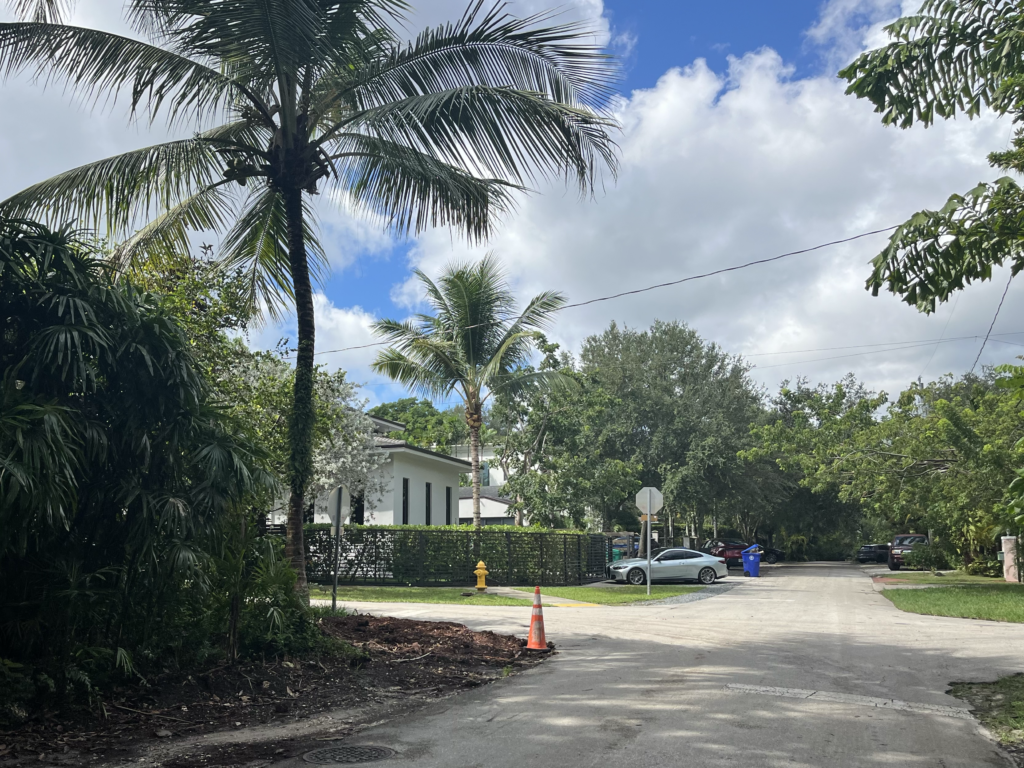
According to city code, sight-visibility regulations are intended to protect drivers, cyclists and pedestrians from traffic hazards. The rules establish “visibility triangles” at driveways and intersections — designated areas that must remain clear enough for people to see approaching traffic.
Depending on the type of intersection and whether a building is set back from the street, the required visibility triangle can extend from 5 feet to 25 feet along the edges of the roadway. Within those areas, vegetation, fences, walls and other objects between 2½ feet and 10 feet high cannot create a “material impediment to visibility.”
The debate over visibility enforcement extends beyond van de Kreeke’s property. Tree advocates challenging removals across Miami say sight-visibility concerns have become an increasingly common rationale for property owners, developers and city officials seeking to remove mature trees and other vegetation.
In North Grove, the city removed a decades-old Australian pine from the public right of way at Jefferson Street and Inagua Avenue earlier this summer. A neighboring property owner told the Spotlight that city officials cited sight visibility as the reason for the removal.
“It was heartbreaking to see this old-growth tree removed,” said Marlene Erven, president of the Coconut Grove Park Homeowners Association, who lives a few blocks from the site. “Over generations, it had become a small ecosystem of its own — home to hawks, parrots, migratory birds, squirrels and other wildlife, and a wonderful place for neighbors and children passing by to observe nature,”
Tree protection advocates also point to the pending removal of a mature oak at Northeast 64th Street and Northeast Seventh Avenue in Legion Park.
David Winker, a lawyer who represents local residents and neighborhood associations in appeals of city-issued tree removal permits, said he has recently seen sight-visibility concerns cited more frequently as a reason for removing trees.
Of the roughly 20 active appeals Winker was handling at the end of August, he said sight visibility was cited as an issue in most.
“The city all of a sudden is pushing it,” he said. “It seems like an excuse just to chop down trees. The city seems hell-bent on cutting down as many trees as possible.”
A city spokesperson did not respond to multiple requests for comment about the recent enforcement actions or questions about how the city applies visibility-triangle rules by publication time.
Van de Kreeke said he has discussed the dispute with Javier Gonzalez, Coconut Grove constituent liaison for District 2 Commissioner Damian Pardo, seeking his help in resolving the matter. According to van de Kreeke, Gonzalez told him the citations stemmed from complaints by nearby residents.
Gonzalez did not respond to the Spotlight’s request for comment.
But internal city records reviewed by the Spotlight suggest there may be confusion over how — and when — the sight-visibility requirement should be applied.
Earlier this year, a North Grove property owner cited sight visibility among several reasons for seeking a city permit to remove a mature Cassia fistula, commonly known as a golden shower tree, to make way for construction of a new home.
An Environmental Resources Division reviewing officer initially recommended that the application be denied, noting that the tree should be “grandfathered” because of its age under the sight-visibility requirement.
Neighbors successfully appealed the city’s tree removal permit last May, citing the reviewing officer’s initial recommendation as evidence that the tree should be allowed to remain.
Sandy Moise, conservation co-chair of the Sierra Club Miami Group and a leader of Miami’s Trees Matter Most coalition, said she, too, has noticed an increase in property owners and developers invoking sight visibility as a reason for removing trees. While she understands the city’s safety concerns, Moise said the rule is being applied “excessively” to trees.
“Common sense needs to be applied,” she wrote in a statement to the Spotlight. “The existence of a tree within a sight triangle does not necessarily mean the tree must be removed. The relevant question should be whether the tree actually creates an unsafe obstruction to required visibility, and whether pruning or another less destructive measure can correct it.”
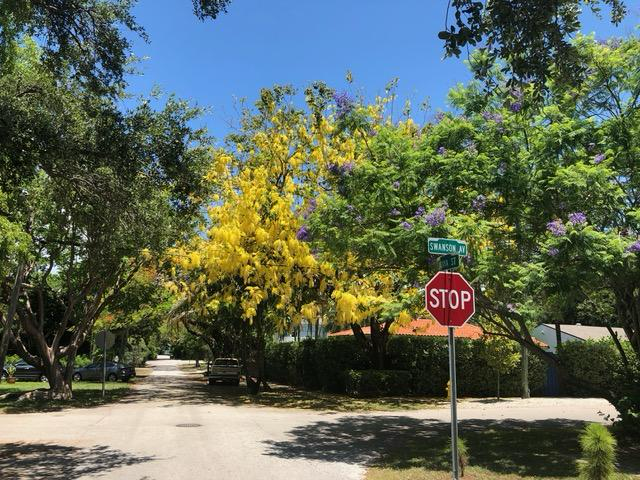
After van de Kreeke received several warnings from the city, he said he trimmed a “tunnel” through his hedge so drivers could see the intersection’s stop sign through the foliage.
Then, on Aug. 26, the city issued a formal notice citing three code violations, including obstruction of required visibility at the intersection. The notice also cited unpermitted fencing and plantings in the public right of way and directed him to remove several objects caught in the hedge.
Van de Kreeke must correct the violations or obtain required permits by Sept. 25.
Across the street, neighbor Roy Mathew said his property has also been cited by code enforcement. He and his wife, Lata, have cultivated a yard filled with native plants that extend toward the street.
The notice cited Mathew’s fence, which he acknowledged extending closer to the street without a permit, as well as a gravel pathway, hedges and shrubs in the public right of way. It also cited an obstruction to motorists’ view of oncoming traffic.
Mathew said he understands the need for code enforcement but questions why the city is enforcing the rules now, after 26 years of maintaining his canopied South Grove property without facing similar scrutiny.
“A couple of times in the past they’ve come by and said, ‘Oh, your hedges need to be trimmed a little bit,’ little warning-type things,” he said. “But never a case opened.”
“This just seems like they’re going after everyone for little things,” he said.
Van de Kreeke, meanwhile, said he plans to appeal his citation. Removing his hedge, he said, would undermine the character of the neighborhood that drew him to South Grove in the first place.
“If you were to cut and do all of these visual corners, you’d look just like Coral Gables, or just like one of these manicured cities where it’s wide open,” he said. “You’re losing the canopy, you’re losing the lushness and the greenery of the area — the reason why you live there.”
David Villano contributed to this report.
Sinclair Holian is a Spotlight reporter and Report for America corps member covering gentrification and development in Coconut Grove. She joins us through our partnership with Report for America, a national organization that places journalists in local newsrooms across the United States.