
As Merline Barton hands out free turkeys, she knows she has big shoes to fill.
For over 20 years, the Thelma Gibson Health Initiative, a Coconut Grove nonprofit co-founded by Barton, has been giving out food to people in need for Thanksgiving.
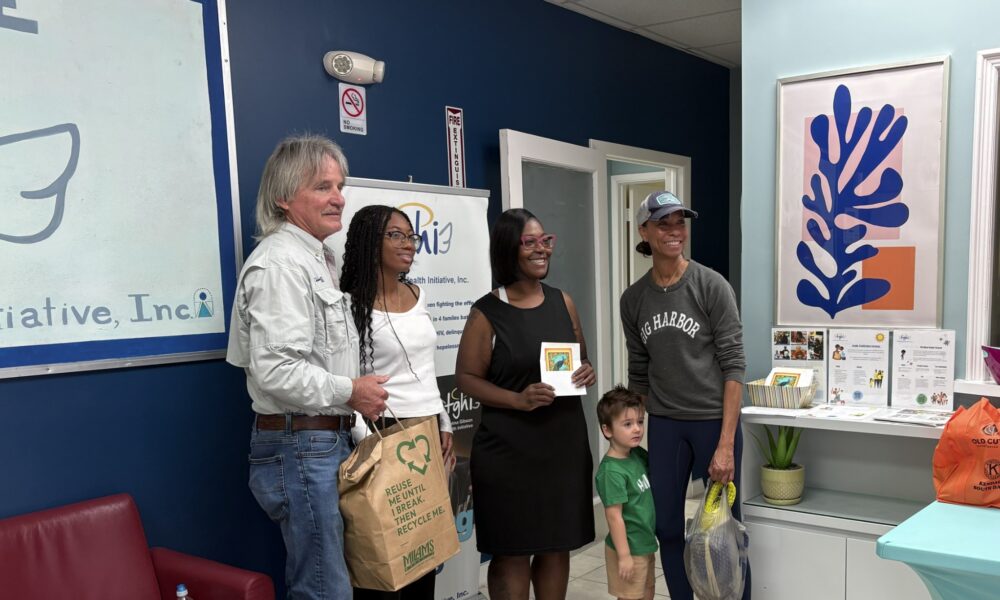
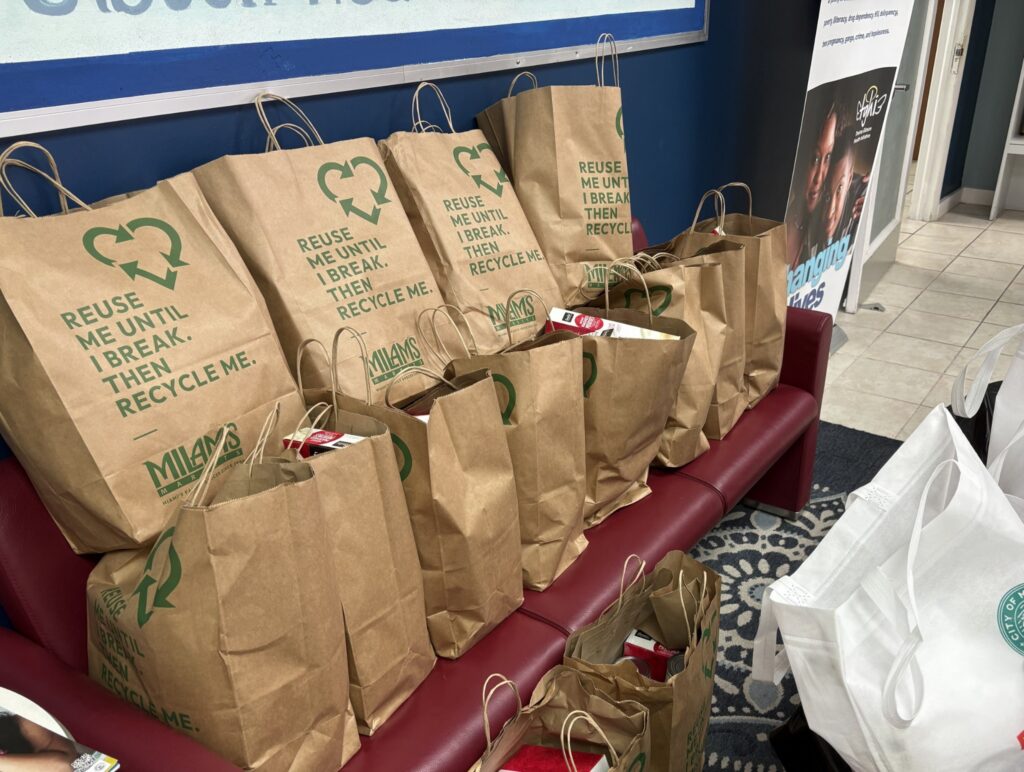
This year, the nonprofit handed out bags of groceries, frozen turkeys and grocery store gift cards to 69 residents and their families at its headquarters on Grand Avenue. “We try our best to make sure everyone has something to eat on Thanksgiving,” Barton said.
Barton founded TGHI in 2000 to help people struggling with drug addiction, HIV and homelessness. Today, the nonprofit serves about 300 clients a year, providing help to low-income families, youth programs, and counseling for people in need.
This year is different, though. This is the organization’s first Thanksgiving without Thelma Gibson – a loss that has left Barton and others thinking about Gibson’s legacy and the mission of the organization named in her honor.
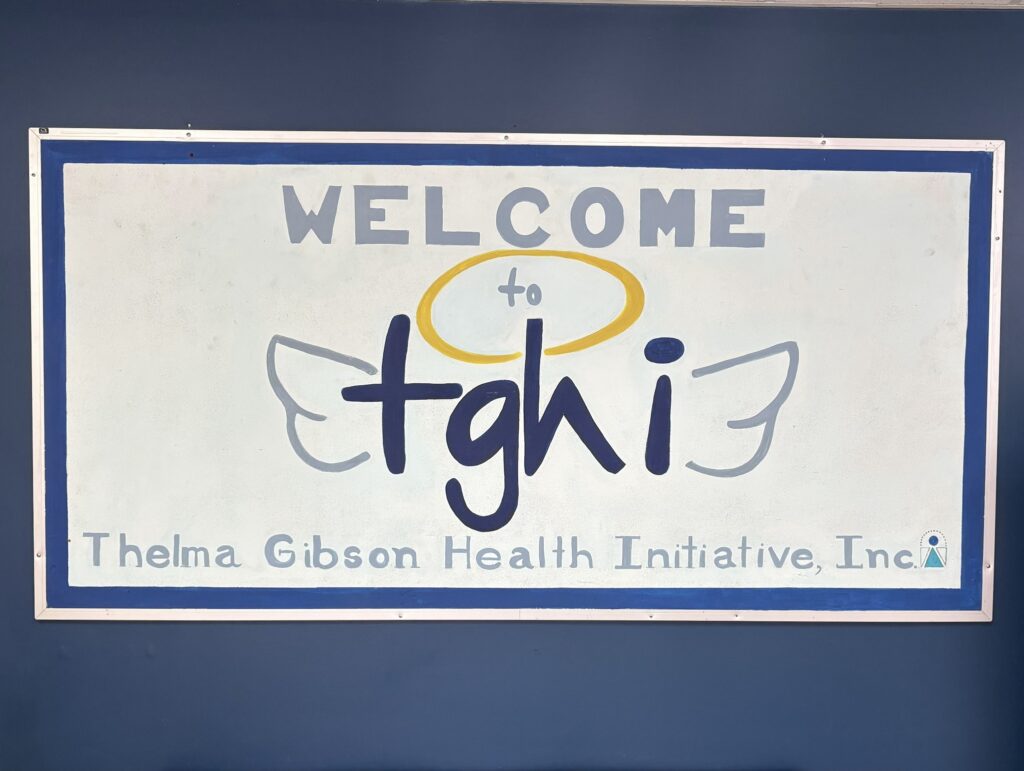
Gibson, who died in February at 99 years old, was one of the first Black nurses to work at Jackson Memorial Hospital and a lifelong civil rights and public health advocate.
Read more: Remembering Thelma Gibson
Now, TGHI is working to keep her legacy alive, as it looks forward to moving its offices into a home the nonprofit recently purchased on Washington Avenue.
“Mrs. Gibson gave so much, and she never wanted a thank you,” Barton said. “Every part of this agency, everything that we do is about Thelma Gibson and her amazing life that she lived.”
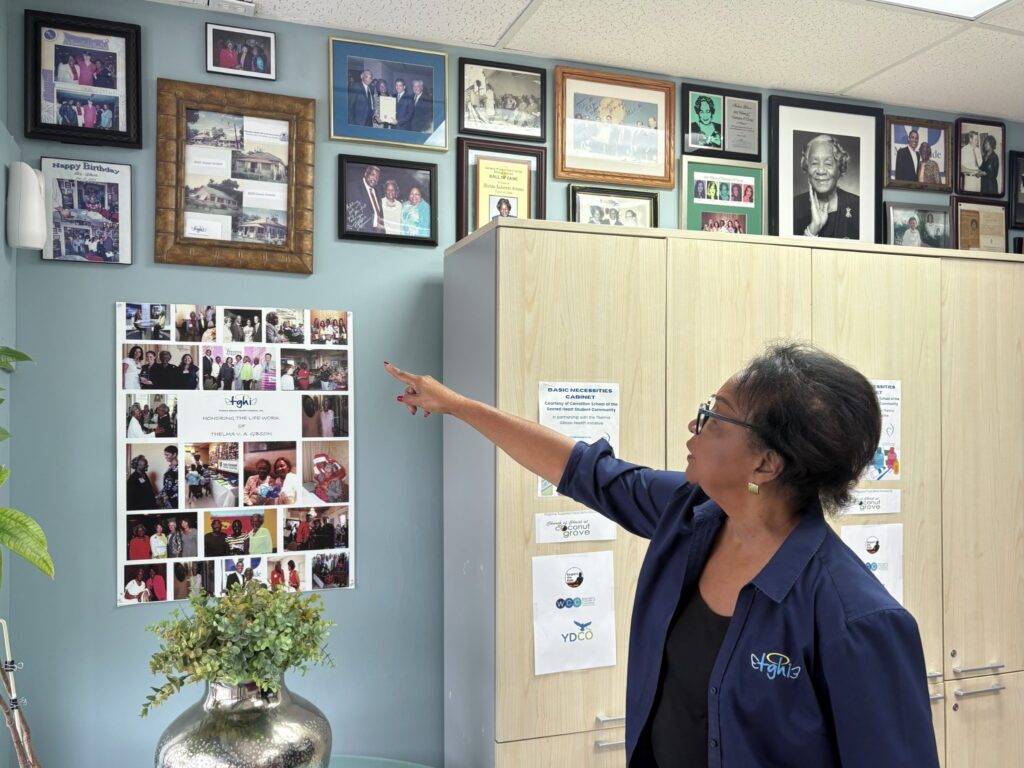
If you walk into TGHI’s offices on Grand Avenue today, Gibson is everywhere. Her awards and photos line the walls, including one of her smiling with former President Barack Obama.
Barton moved from New York City to Miami in the 1980s. She remembers going to Coconut Grove for reggae concerts and seeing the disparity between the West Grove and the village’s more affluent neighborhoods.
“Who cared about this little part of the Grove? Not too many people,” she recalled.
The former Wall Street banker went to work at a nonprofit focused on affordable housing. That’s when she was introduced to Gibson.
“I wanted to make a difference, and you don’t do that in banking, really,” Barton laughed. “Mrs. Gibson, she was our godmother.”
When Barton asked Gibson for help creating a nonprofit to improve the health and living conditions of West Grove residents, the late founder of Miami-Dade’s Women’s Chamber of Commerce immediately agreed.
Barton, a native of Jamaica, said Gibson’s influence and ties to the West Grove made naming the nonprofit after her a “no-brainer.”
“This was her community and she made us believe in her dream,” Barton said.
“We knew most of the residents in the Grove. We knew who was on drugs and who wasn’t. We knew the kids that just needed an opportunity to dream and to want better for themselves.”
Now, as TGHI’s clients have aged, the nonprofit is offering more services for elderly residents.
“I think what made us so successful apart from Mrs. Gibson…was the fact that they (the organization’s clients) knew that we weren’t going to start a program and then stop,” she said. “We were going to be here for the entire family.”
Darniqua Bogan is a fourth-generation Grove resident who knew Barton and Gibson since she was a little girl, when she would come to TGHI for summer camp and after-school programming. She said TGHI was always a safe space.
When she came by the TGHI offices last Saturday, Barton wrapped her in a hug. Bogan picked up a bag of groceries, a turkey and an ALDI’s gift card to feed her three kids.
“That’s a humongous help,” she said. “Everybody goes through their own struggles and trials, and during the holiday times it’s different because…you want to have family over, but everyone doesn’t have the pocket funds…I’m very grateful for it.”
Some of the food and gift cards that TGHI distributed this year were donated by organizations like the Kiwanis Club of South Dade, the Rotary Club of Coconut Grove, and the Coconut Grove Arts Festival, which donated 60 gift cards valued at $50 apiece.
David Hill, a former chair of the arts festival, was at the food distribution on Saturday. “The Grove is changing, a lot of the older people are getting pushed out, and so we decided to help out the community,” he said.
Bogan agrees the Grove has changed. Many of the more affordable stores she used to frequent are now gone. “I think change is good – I do – but put things in a neighborhood that people can relate to,” she said. “Who can afford to always eat at Cocowalk?”
Barton said the Grove’s socio-economic shift has affected TGHI’s clientele. What started as a nonprofit serving Grove residents now serves residents all over Miami-Dade County. Barton estimates that just 40% of TGHI’s clients live in the Grove.
Barton said a lot of TGHI’s revenue comes from city and county funding. While county funding can be used to provide assistance for any county resident, city funding can only be used for city residents, including those living in District 2, which includes the Grove.
“You learn to tweak, you learn to be more creative, we still offer the same services, it’s just that it’s less of the community residents,” she said.
“We have, through Mrs. Gibson, been honestly blessed with the county and the city. Every commissioner that has come into the city, in District 2, has been as generous as they can be with Thelma Gibson Health Initiative.”
Barton added that TGHI lost $50,000 in funding for HIV testing from Florida’s Department of Health over the past two years, meaning the nonprofit no longer offers HIV testing and cannot hire an employee dedicated to helping those diagnosed with HIV. Florida’s Department of Health did not respond to a request for comment.
Nonetheless, Barton said Gibson’s belief in treating everyone with dignity and respect continues to inspire TGHI’s work in the community.
“When someone like a Thelma Gibson comes into your life, you have no choice but to do good,” Barton said. “[I] miss her every day.”
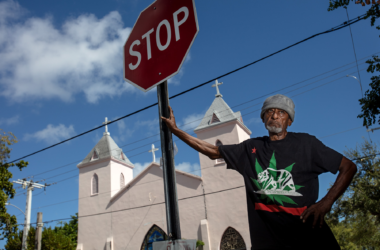
Gibson’s legacy, along with that of her late husband, the Rev. Theodore Gibson, will soon become a part of Miami’s landscape. In March, Miami’s city commission passed a resolution to rename a section of Franklin Avenue in their honor.
The street naming ceremony is scheduled for what would have been Gibson’s 100th birthday, on December 17 at 10:30 a.m. at Christ Episcopal Church on Hibiscus Street.