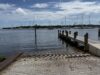


The waters surrounding Coconut Grove have improved since Miami-Dade County began monitoring the health of Biscayne Bay, but the overall picture remains grim.
The 2026 Biscayne Bay Report Card is out, and the results are lackluster.
Another year into the county’s Biscayne Bay monitoring program, Coconut Grove continues to show only modest gains, with slight improvements in water clarity and chlorophyll-a, while the bay as a whole remains stuck in the middle ground.
The annual Biscayne Bay Report Card, overseen by Miami-Dade County’s Division of Environmental Resources Management (DERM), is the leading assessment of the bay’s health, focusing primarily on its water quality and aquatic habitat.
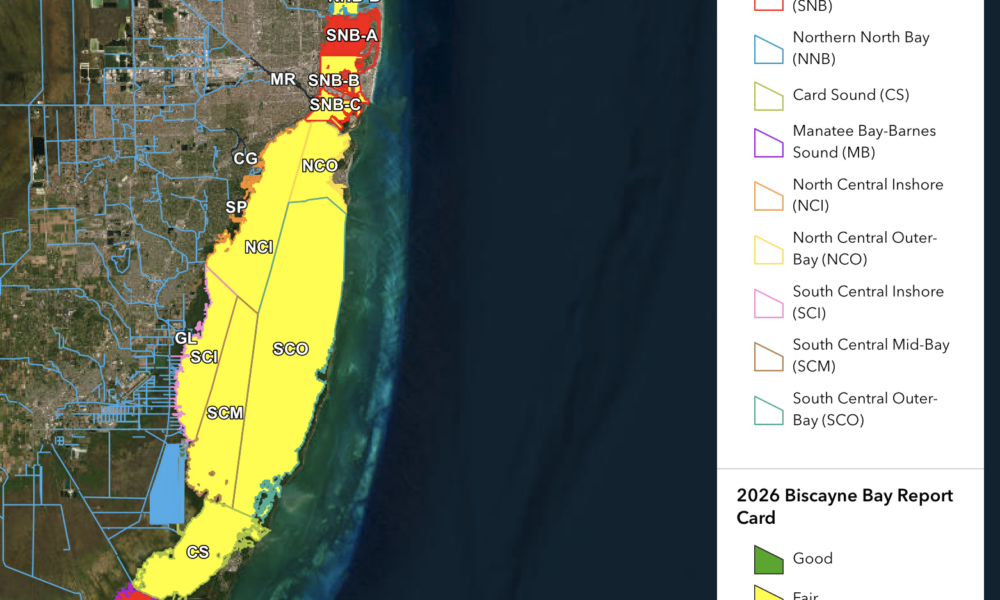
The report card divides the bay into 12 regions, with each receiving an overall “stoplight” score – red for “poor,” yellow for “fair,” and green for “good” – as well as a water-quality rating and individual scores for bacteria, algae, nutrients, sea grass and sponges.
The portion of the bay that laps Coconut Grove (described as North Central Inshore or NCI) has shown gradual improvement over the past six years, climbing from a rating of 2.8 in 2021 to 3.7 in 2026.
But the NCI region still has not achieved a coveted “good” rating.
That’s the case for most of the bay as well, with nine of 12 regions displaying “fair” results, and three marked in red as “poor.” No section received a “good” rating.
“This year’s findings show that while targeted restoration efforts are making a difference in areas, Biscayne Bay continues to face serious threats from pollution and nutrient runoff,” Miami-Dade Mayor Daniella Levine Cava said in a statement.
When the results of the report card were discussed at the Biscayne Bay Marine Health Summit on Wednesday, the reaction was mixed, said James Murley, the county’s former chief resiliency officer and a current member of the Miami River Commission.
“Several speakers said you have to have a sort of dual set of feelings,” Murley told the Spotlight. “There’s a sense of urgency that you need to get after these issues, but you also need to have patience that these issues don’t just turn overnight.”
Murley said that despite the overall “fair” rating, he’s feeling positive about the bay’s future, in part because of the turnout at this week’s summit.
“I have an increment of hope, encouraged by the amount of young people that attended,” he said. “When you have young people engaged who have that tenacity to see through all the bureaucracy and move forward, I am encouraged.”
Coconut Grove residents may also have reason for hope.
Across the board, the Grove NCI tied for the fourth-best water “score.” That’s mostly due to the neighborhood maintaining its “good” rating for water quality, phosphorus (one of the two nutrients responsible for algae blooms), and both fecal bacteria indicators.
The Grove’s water clarity, a measure of how turbid or clear the water is, also retained its “good” rating – up 23% from the prior year.
But the main success for the Grove came in chlorophyll-a – another indicator of algae levels – which improved by 33%, graduating the NCI from “poor” to “fair”.
The Grove continued to show bleak results on the habitat side, however, with sponges and seagrass – essential to the filtration of the water and providing habitat for the bay’s marine organisms – both underperforming.
And while phosphorus continues to be a high point for the Grove and the bay as a whole, its sister nutrient – nitrogen – fell from “good” to “fair” in the 33133 zip code.
When found in excess, phosphorus and nitrogen can create algae blooms leading to ecological disasters like red tide and Miami’s 2020 fish kill that resulted in the death of nearly 30,000 marine animals.
Other areas of the bay present more of a concern. The waters off Brickell’s shoreline, the only region of the bay to receive an overall rating of “good” since the 2021 report card, was downgraded to “fair.”
The water near the Turkey Point nuclear plant and a small section of the North Bay also reported a regression in progress.
There are signs for optimism, however. Every section of the bay has either improved or remained on par compared to its 2021 report card core — a silver lining that suggests, at the very least, conditions are no longer deteriorating.
That’s an important metric for the county, which found in a 2023 study that Biscayne Bay is an economic powerhouse, generating $64 billion in value each year across tourism, real estate, water recreation and more.
“From Miami Gardens to Homestead, from Miami Beach to Hialeah — our communities, our jobs, and our quality of life depend on a thriving Biscayne Bay,” DERM Director and Chief Resilience Officer Loren Parra said in a statement.
Running alongside the report card, the Miami Waterkeeper conducts weekly recreational water quality assessments throughout the county at 18 waterfront locations.
Among locations near Coconut Grove, the Rickenbacker Causeway met those swimmable-quality standards 87% of the time, followed by Shake-A-Leg Miami at 82%. Peacock Park lagged behind, passing only 67% of the time.