
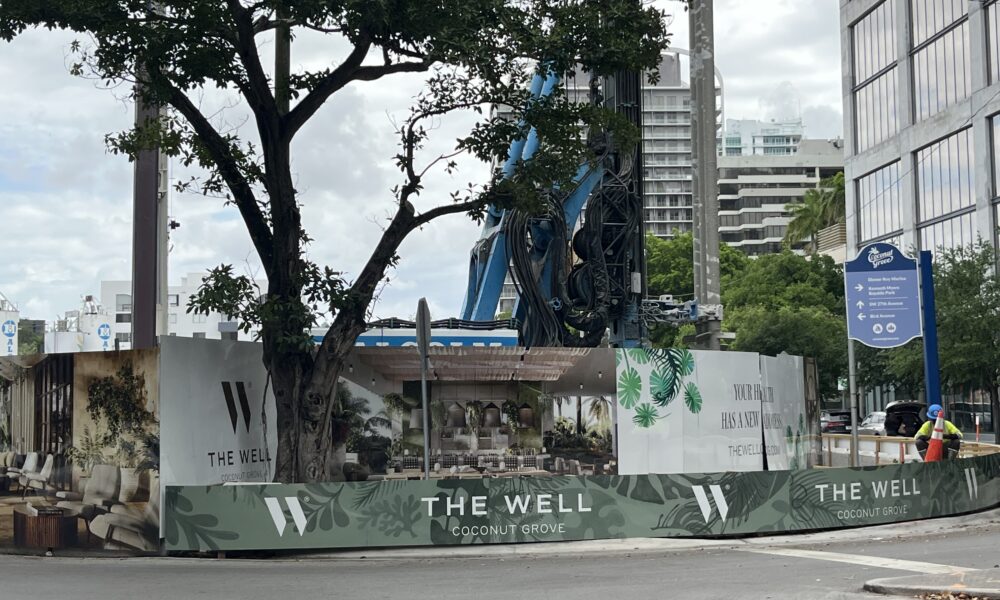


With little notice, Miami officials reassigned unused density credits from Mr. C Residences to The WELL Coconut Grove, allowing the proposed luxury condo project to increase its unit count by 50% — a first-of-its-kind maneuver with no clear basis in city code.
The proposed luxury condo project The WELL Coconut Grove can build 50% more housing units than typically allowed after city officials quietly signed off on a plan to transfer unused density credits from another luxury condo project in Center Grove, Mr. C Residences — despite no city rules or programs that authorize such a maneuver.
The transfer is the first of its kind, a city spokesperson confirmed to the Spotlight.
Under the plan, approved last December, Historic and Environmental Preservation Division chief Ken Kalmis amended a six-year-old development rights document — known as a certificate or transfer, or COT — to designate The WELL as the recipient of 66 units of density credits initially acquired and assigned to Mr. C in 2020.
The designation will allow The WELL to increase the housing unit count in its proposed eight-story tower from 130 to 196.
Both Mr. C and The WELL are projects developed by Coconut Grove-based Terra Group.
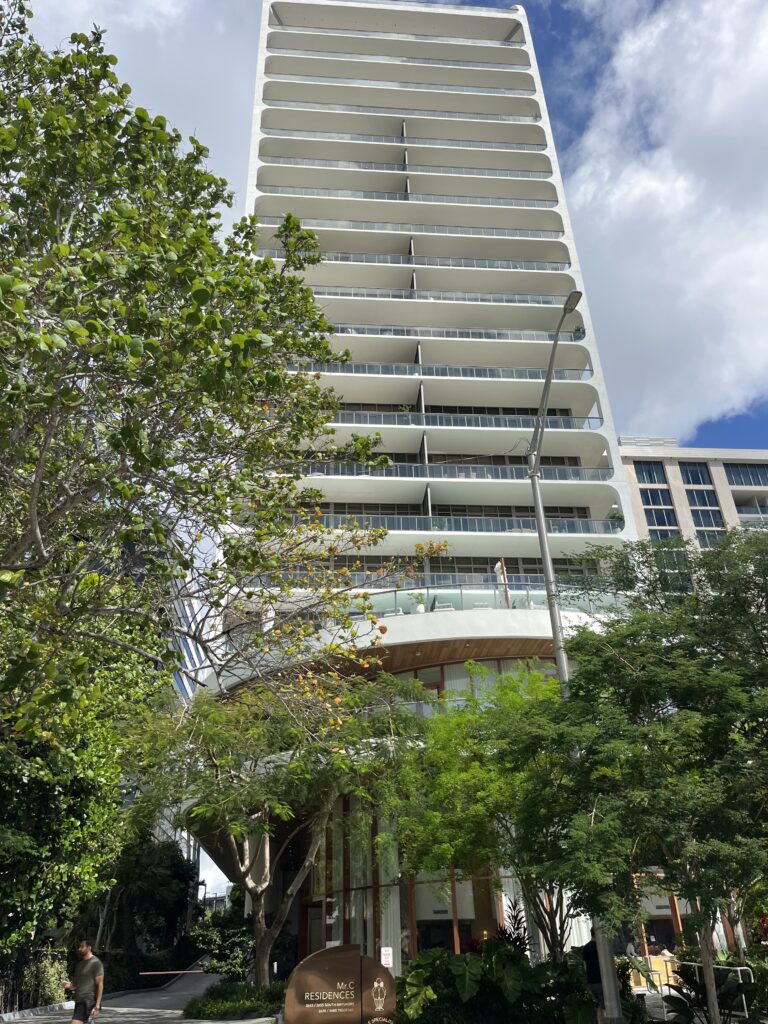
Miami’s zoning code limits the number of housing units that can be built on a parcel of land, but it also allows developers to increase those limits by purchasing excess housing density from projects elsewhere in the city — either from affordable housing developments that did not maximize their allowable density or from historic properties whose owners committed to preserving and improving the buildings.
Read more: City to Vote on Shifting Housing Density From Affordable Projects
In 2019, this so-called Transfer of Development Density program allowed Terra Group to propose 301 housing units at Mr. C Residences on a site otherwise zoned for 227.
To make up the difference, Terra purchased 74 units of excess density from a historic structure in downtown Miami, with those credits formally assigned to the project in June 2020.
Read more: How Mr. C Got So Big
But as preconstruction condo sales surged, Terra Group redesigned the project, replacing a proposed rental tower with a second condo tower that contained larger, but fewer, overall units — leaving unused the bulk of the historic density credits it acquired.
After downsizing, Mr. C was stuck with a surplus of credits it could not use.
In a recent email exchange with the Spotlight, a city spokesperson explained that only the “receiving site” — the property that acquires the density credits — can use them, and that the credits are not transferable: “If a property receives [transferred development density] units but uses only a portion, the remaining units cannot be used.”
But last December, Kalmis, who oversees the historic density transfer program, sidestepped the problem by simply changing the 2020 certificate of transfer to reassign the bulk of credits to The WELL — using the project’s preliminary name, Residences in the Grove — leaving only a handful to Mr. C.
His rationale? A clerical error.
In city records reviewed by the Spotlight, Kalmis describes the amended certificate as a “corrective” measure fixing a years-old mistake. The original 2020 document, he insists, “did not correctly include” The WELL, or whatever its name, as the “intended” recipient of the majority of credits.
But the same records also appear to contradict that explanation.
The city’s 2020 transfer certificate and supporting documents — including the Letter of Intent requesting the density credits — reference only the Mr. C property and make no mention of The WELL, Residences in the Grove or any other project or location.
Further undercutting the city’s explanation is the simple fact that The WELL did not yet exist in 2020 — not in name, design or corporate structure. Nor did any other proposed development at that location, regardless of name.
The project traces its origins to a March 2021 property acquisition by a Miami Beach company that later brought Terra Group on as a development partner.
Terra Group CEO David Martin declined to comment for this story, referring the Spotlight to the firm’s outside attorney, Iris Escarra.
In an email exchange, Escarra would not confirm that The WELL had always been the intended receiving site and did not address the fact that no such project existed in 2020, saying only that Kalmis “corrected the previous certificate” after a “complete new review process.” (Without explanation, that review has not been released by the city following a public request request).
Kalmis did not respond to a request for comment, and a list of questions submitted repeatedly to Director of Communications Helena Poleo went unanswered.
The density-transfer issue is not the only controversy surrounding The WELL. Last December, city officials confirmed that the project would be authorized to rise to eight stories — three more than zoning typically allows — under a controversial zoning amendment, since repealed, that expanded bonus height allowances near transit corridors.
Read More: The WELL: How 5 Became 8
A group of local residents has challenged the city’s determination in court, arguing that the now-repealed ordinance creating the bonus height was unlawfully adopted and that The WELL and other nearby projects should never have been granted vested rights to build above base-level height limits.
Read more: Judge Asked to Halt Permits for The WELL in Height Dispute
Construction on Mr. C’s twin 21-story towers was completed in June 2024.
The WELL, which has yet to receive a building permit, is forecasting completion in early 2028.
In her email, Terra Group attorney Escarra said the developer paid $10,000 per unit for the density credits purchased from the downtown historic structure.
At The WELL — where those credits will now yield 66 additional luxury condos — preconstruction prices range from roughly $1.4 million to more than $8 million.















Assuming the facts are as the SPOTLIGHT reports them, I believe the conduct of Ken Kalmis, the City employee involved, in altering in December of 2025 a document filed with the City in 2020 to benefit Terra at the WELL appears to raise the serious possibility that he committed a criminal act.
Specifically, Google Gemini states this:
Falsifying Records (Florida Statute § 839.13): It is a first-degree misdemeanor for any public agency employee to alter, falsify, or fraudulently deface any document belonging to a public office.
Official Misconduct (Florida Statute § 838.022): If the public employee knowingly alters an official record with the intent to obtain a benefit or harm another person, the act constitutes a third-degree felony.
If the facts as reported by the SPOTLIGHT are true, in my opinion Mr. Kalmis’s conduct should be referred to appropriate authorities for investigation and possible criminal prosecution and to the City’s Inspector General for investigation.
The citizens of this City have endured enough misconduct by City government officials bending or breaking the law to benefit well-connected developers. This needs to stop.
No news here!!! Look away. That’s what your D2 commissioner would like you to do. On May 28th (unless they get scared by the upwelling by neighbors willing to show up), there will be a commission meeting addressing this issue. However, the Well has proven one thing to a very engaged Coconut Grove electorate- they will do anything to get what they want. Organize now, write to your City Commissioners – all of them. This “hook or crook” method of planning and zoning is unacceptable!
This entire project reeks of corruption at every turn. Our commission especially our Grove representative has consistently supported developers in skirting zoning laws made to protect the feel of the Grove, density, traffic and our tree canopy. They are bold and unchecked. I would encourage residents to vote and replace these leaders with elected officials that represent the people that are living with these decisions not the developers that are profiting and deciding how our village will look in the future. We are headed towards the disaster that is Brickell.
Once again the City of Miami shows it is far more interested in pleasing developers than it is in protecting our quality of life.
This is the same developer for whom Commissioner Damian Pardo sponsored an agenda item that placed a ballot question to sell portions of Watson Island for 48 story high rise condos.
Coincidence?
You can read more about it here:
https://coconutgrovespotlight.com/2024/10/28/vote-no-watson-island-giveaway-a-bad-deal-for-all-residents/
HEPD chief Ken Kalmis and anyone else involved in this process should be ashamed of themselves. Our laws exist for good reason and the fact that they can be retroactively amended, or sidestepped for the financial gain of a few, is a travesty. To point to a clerical error as the reason for reallocation, when the recipient (The Well) was not yet even a concept at the time, is pathetic and unacceptable. Our politicians can’t even come up with a semi-decent lie to justify their actions. It is time for change and Ken’s name is near the very top of my list come elections.
This is yet another example of the rampant corruption in Miami politics which must be addressed.
Well well well well well…
“And liberty plucks justice by the nose,
The baby beats the nurse, and quite athwart
Goes all decorum.”
Hey there. Appreciate your comment . You just increased my IQ by 5 points. That was a really cool line and I had to know who wrote it. Well, I can recognize genius When I read it .ha!
And I also ran into a site that goes paragraph by paragraph and makes the language a little easier to understand with the original than the modern translation.
If you don’t know or maybe you don’t have an interest but the site is called measure by measure. Thanks again,
Cheers
Grovites need to make it so painful to try go around Miami21 and other detailed regulations governing development in the Grove that these developers stop trying to skirt the rules. They could make plenty of money following the rules, but, no, they want even more. Look up what happened with 4055 Poinciana, where a developer was initially approved to split one large lot (with a small older home on it) into three 7,000 sf lots where they planned to build three giant houses that don’t meet allowed lot coverage/total sf regulations. The neighbors appealed the decision, and it was overturned. We don’t need more out-of-scale housing for the rich at the expense of the character, tree canopy, traffic congestion and general sanity of our neighborhood. And, as for politicians who support this, like Pardo, vote them out.
The only way we can fight the development cartel is to stop electing their ‘legal representation’ in the City, County, and State. Sorry for all caps here, I’m thinking of making a yard sign saying DONT VOTE FOR ANY CANDIDATE THAT TAKES A DIME from developers, builders, or land use attorneys – no matter how many times they repeat the mantra ‘affordable housing’.