



A revised version of the controversial affordable housing density transfer program would exclude Coconut Grove from some aspects, but other late-stage changes — including a doubling of allowable bonus density — have dramatically expanded the scope of the proposal set for a final vote Thursday.
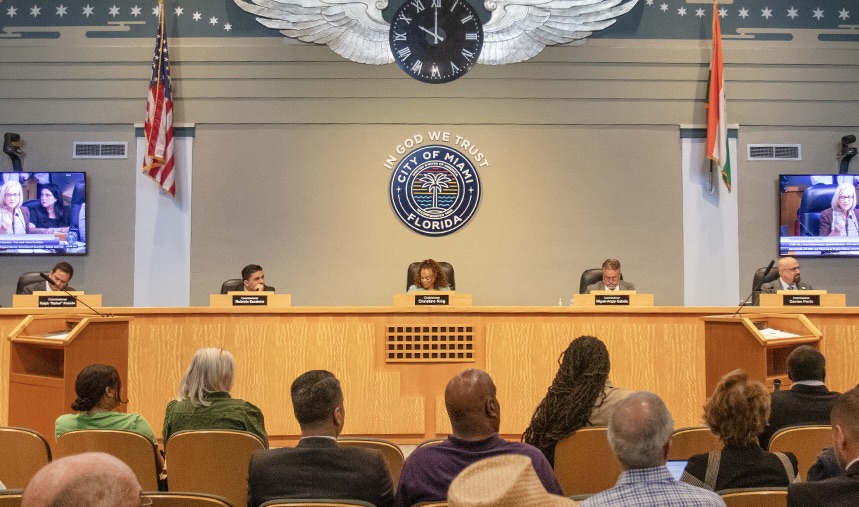
The Miami City Commission will vote Thursday on a final version of a controversial proposal to vastly expand a program that allows developers to transfer housing density from affordable housing projects to market-rate and luxury developments elsewhere in the city — even as Coconut Grove itself would be carved out from some of the program’s reach.
Under the proposed ordinance, Neighborhood Conservation Districts (NCDs), historic districts, and properties within 500 feet of single-family districts would no longer qualify as so-called “receiving sites,” where developers increase the size of their projects by purchasing and applying housing density credits tied to affordable housing developments in Miami’s economically distressed areas.
All of Coconut Grove falls within an NCD.
But the new law appears to have come with a compromise — the Grove carve-out in exchange for provisions that expand the program beyond what was initially proposed, by doubling the amount of density that receiving-site developments can add above base zoning from 50% to 100%, and by exempting bonus-density units from minimum parking requirements.
Those provisions — which quietly made their way into the measure before an initial commission vote last month — were detailed in a so-called “substitution memo” circulated among city staff and commissioners, but not publicly noticed before the vote.
The revised legislation was approved unanimously on first reading — the first of two required commission votes — without discussion.
Substitution memos are a common but highly controversial practice at Miami City Hall of altering the language of pending legislation, sometimes substantially, before binding commission votes and often with little or no public notice.
Read more: City Measures Often Approved with Undisclosed Changes
The ordinance also would add a new category of economically distressed areas that could qualify as “sending sites” — projects allowed to generate and sell unused density — significantly expanding the potential pool of developments eligible to sell affordable housing density credits.
Another key change would reduce, in some cases, the minimum number of affordable or mixed-income units required from 200 to 70 before selling and transferring the rest.
The revised measure also changes the program’s financial structure, requiring that 20% of transfer proceeds be directed to either the city’s Community Redevelopment Agencies or the city’s Affordable Housing Trust Fund.
City officials argue the density transfer program creates an important revenue stream that can help make affordable housing developments financially viable.
Under the program, which has been in effect since 2022, “receiving-site” developments have been able to increase unit counts 50% above base zoning limits — even if the added units themselves are not affordable.
Critics contend the policy incentivizes developers to build fewer affordable housing units than otherwise permitted under zoning rules, while exposing neighborhoods already struggling with rapid growth to increased traffic, parking shortages and other infrastructure pressures.
The issue of density transfer has become especially contentious in Coconut Grove, where residents mobilized earlier this year after learning that The WELL Coconut Grove on Tigertail Avenue and Mary Street planned to increase its housing unit count by 50% by purchasing density credits.
While the project’s developer, Terra Group, says it plans to use density credits — somewhat controversially, from a similar city program tied to historic properties rather than affordable housing, and not subject to the proposed receiving-site restrictions in Coconut Grove — the result would be the same: a luxury residential development increasing its unit count from 130 to 196.
Read more: The WELL, Mr. C and a Density Shell Game
The current proposal up for vote Thursday would not remove Coconut Grove entirely from the law’s provisions.
While projects in the area would no longer qualify as “receiving sites,” nearly all of the West Grove would fall within the expanded zone eligible for “sending sites,” potentially reducing the number of affordable units ultimately built there.
Miami District 2 Commissioner Damian Pardo, who proposed the partial Coconut Grove carve-out despite expressing overall support for the affordable housing density transfer program, did not respond to the Spotlight’s request for comment.
















“Substitution Memo”: Miami City Commission.
Building the Banana Republic, one bogus vote at a time!