



A City of Miami proposal billed primarily as a technical update to traffic-impact regulations would also eliminate a longstanding requirement for independent environmental impact studies on certain major city land transactions — a change that has received little public discussion despite its potential implications for upcoming redevelopment projects.
The ordinance, scheduled for consideration by the Miami City Commission on Thursday, establishes new thresholds for traffic studies and clarifies how transportation impacts will be evaluated for development proposals.
But included with the legislation is a provision striking language that currently requires independent environmental impact studies for city acquisitions, sales, and leases of publicly owned property valued at more than $2 million.
The legislation does not explain why the requirement is being removed. Nor does it cite concerns with the existing environmental-review process, identify instances where the requirement created delays, or explain whether another review mechanism would replace it.
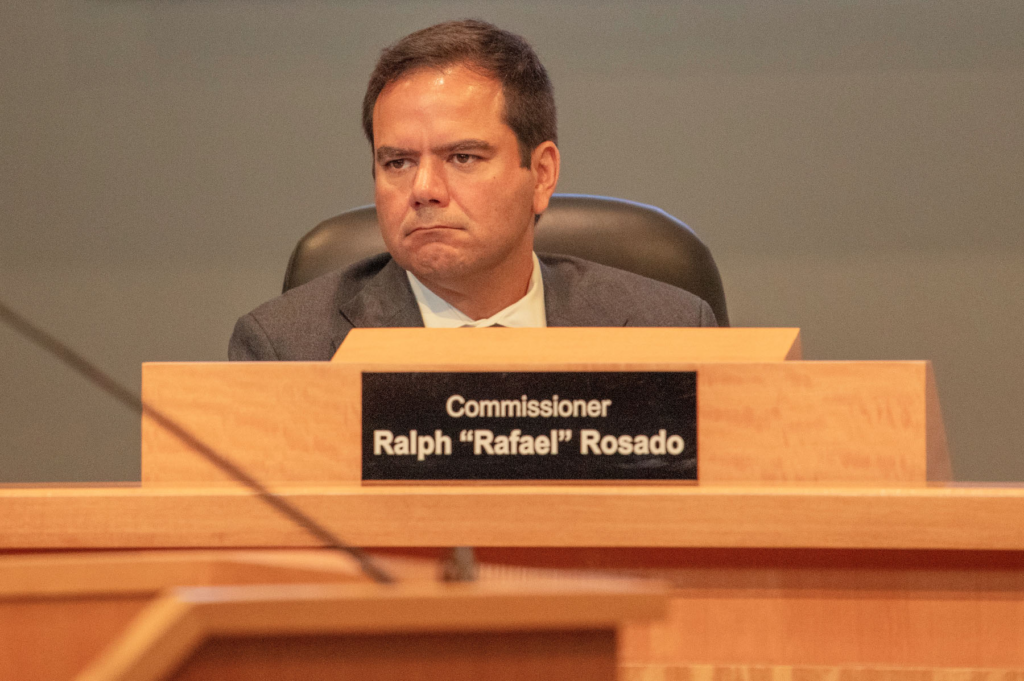
A city spokesperson and Miami District 4 Commissioner Ralph Rosado, who sponsored the legislation, did not respond to the Spotlight’s requests for comment.
Eliminating the city’s environmental review requirements could affect a range of future transactions involving some of the city’s most valuable public assets, particularly waterfront properties.
Among the projects currently drawing public attention is the proposed redevelopment of the Rickenbacker and Marine Stadium marinas on Virginia Key, where city officials are preparing to ask voters this fall to approve an approximately $80 million private redevelopment of nearly 28 acres of publicly owned waterfront land.
Other city-owned waterfront properties that periodically become the subject of lease negotiations, redevelopment proposals or public-private partnerships could also be affected, including a few sites in Coconut Grove.
Read more: Lawsuit Claims City Manipulated Grove Waterfront Appraisal
Under current code provisions, major transactions involving such properties may require an independent environmental study. The proposed ordinance would eliminate that requirement altogether.
Laura Reynolds, a biologist and science and policy adviser for the advocacy group Friends of Biscayne Bay, said the city’s proposed legislation echoed changes in recent years to Miami-Dade County’s environmental review process, where officials have weakened oversight requirements while presenting the changes as efficiency measures intended to eliminate regulatory redundancies.
“I’m not surprised,” Reynolds said. “[Former County Commissioner] Eileen Higgins was the one who rolled back and defanged DERM,” referring to Miami-Dade’s Department of Environmental Resources Management. “And now she’s the city’s mayor. So this isn’t dissimilar to what’s happening at the county level.”
The measure up for review Thursday has been largely framed as an effort to modernize traffic-review standards by creating clearer thresholds for when developers must submit transportation studies.
Under the proposal, developments expected to generate between 20 and 99 peak-hour vehicle trips would be required to submit a traffic statement, while projects generating 100 or more peak-hour trips would require a more detailed traffic impact study evaluating roadway conditions, site access, pedestrian and bicycle circulation, and potential mitigation measures.
The measure also would further centralize authority within the Department of Resilience and Public Works, giving the department broad discretion to determine whether studies are adequate, whether project changes require updated analyses, and what transportation improvements may be necessary to offset a project’s impacts. Several of those determinations would be made in the public works director’s “sole professional judgment.”


















We have lost our minds. What makes us think that we can just run roughshod across land without suffering the consequences? For all our smarts, humans are just plain dumb.