
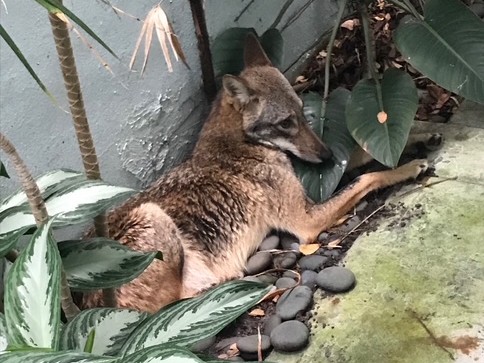




Wildlife experts say coyotes are here to stay, like the other exotic animals that have quickly adapted to life in South Florida.
Rebecca Whited had just dropped off her son at Ransom Everglades in late January for a 5:30 a.m. pool workout and was heading south on Main Highway when she saw what she thought were two dogs trotting toward her in the middle of the street.
“As I approached Douglas Road, I saw two identical-looking dogs and wondered why someone would let their pets out at this hour. As I got closer, I realized they were coyotes,” she said. “They ran into DeGarmo Estates. It was one of the most insane things, like something out of a movie.”
Meet your Coconut Grove neighbor – the American coyote – which joins the peacock, iguana and Burmese python as part of the menagerie of exotic species that live among us. Coyotes live in every state except Hawaii and in every county in Florida.
Read more: Python Kills Pet Rabbit in South Grove
If you haven’t seen one yet, just wait. The Florida Fish and Wildlife Conservation Commission (FWC) says coyotes are here to stay.
The Biltmore and Riviera golf courses in Coral Gables appear to be a hot spot, according to a map of sightings maintained by the FWC. So is the area around Mercy Hospital and Vizcaya in north Coconut Grove.
Marius Ronge, a frequent golfer, confirmed numerous sightings on the Biltmore course. Dominic Chaput, an employee of the golf school there, said he often sees coyotes by the fourth hole in the early evening. “They always run away from me,” he said.
According to the FWC, coyotes have been here since the 1970s, having migrated from western states after their population exploded due to the eradication of wolves, their chief predator.
Coyotes are the quintessential survivors, able to thrive in nearly any environment. They are opportunistic feeders, omnivores that consume small mammals, birds, insects and garbage. Fruit and plants make up one third of their diet.
You, however, are not on the menu.
“Coyotes don’t view people as prey and most are scared of humans,” said Dr. Hance Ellington, an assistant professor at the University of Florida’s Wildlife Ecology and Conservation Department.
“But certainly,” he added, “keep pets indoors, especially between dusk to dawn due to predation risk. When walking a small dog, keep it on a short leash and pick it up if a coyote should appear.”
Ellington also recommends increasing deterrence by removing attractants, such as outdoor pet food and fallen mangoes, and by making sure trash can lids are secure.
By all means, do not feed them. And, if you come face-to-face with a coyote, Ellington suggests making a big fuss by clapping hands, waving arms and yelling. Because coyotes can carry rabies, anyone bitten or scratched by one should immediately seek medical attention.
Signs that coyotes are here to stay and on the prowl include frequent sightings (as reported on Next Door) and a suspicious absence of other small mammals.
South Grove resident Debbie Dolson said she used to see a lot more wildlife around her home than she does these days.
“Our ring doorbell was always going off with video of lots of small animals like squirrels, possums and foxes. We don’t see them anymore,” she said.
South Grove resident Carole Janisse has noted the same phenomenon, recounting how doves and peachicks have been reduced to piles of feathers and other animals have largely disappeared from her yard.
In fairness, some of the predation is likely due to gray foxes, a protected species native to Florida and one third the size of a coyote. Foxes hunt at night and have the ability to climb trees. Their bushy tail is a distinctive feature that coyotes don’t share.
In 2017, Dr. Kate Marmesh of Coconut Grove Animal Clinic was on duty when she learned that an injured dog was lying in a passageway between two Commodore Plaza businesses.
“I walked over to take a look and immediately realized that it was a coyote,” she said. “After calling FWC and animal services, both of which declined to remove the animal, we were able to get the coyote picked up by South Florida Wildlife Center, which rehabilitated it and eventually released it back into the wild.”
In August 2023, Bay Heights resident Nancy Hornstein’s daughter took a video of a large coyote trotting outside their home at 4 a.m., and Nancy saw one herself one evening as it walked along South Miami Avenue. She is unfazed.
See more: A coyote seen trotting on Bay Heights Drive in 2023
“We’ve never had an issue, and we have elderly cats living outside. As long as we don’t have a problem with them, I’m good,” Hornstein said.


















Does this mean our road runners will be in danger?
Do these coyotes order hardware from Acme?
According to YouTube, so it must be true, coyotes have acquired a taste for Python and their eggs.