
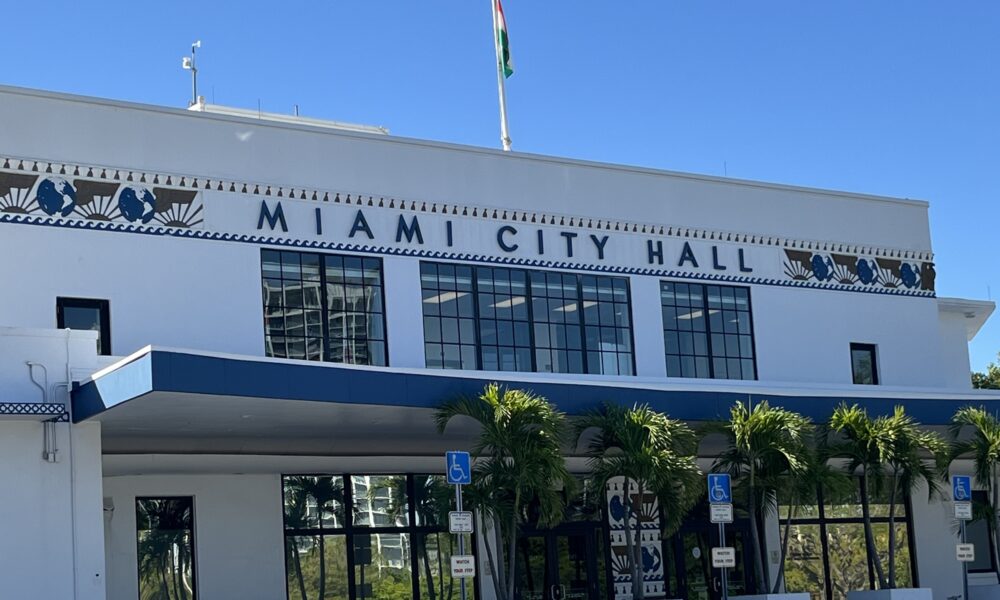


The Miami City Commission agreed to sell the historic Jackson Medical Office in downtown Brickell to billionaire Ken Griffin so it can be moved to Coconut Grove. The commission also approved new sidewalk protections for pedestrians at construction sites.
The Miami City Commission on Thursday approved the sale of the historic Jackson Medical Office to billionaire Ken Griffin for $2.98 million, the first step in a proposed deal to move the Brickell building to Coconut Grove and transfer title to Dade Heritage Trust.
“We are thrilled to have found a long-term solution to preserve our 121-year-old historic headquarters building,” Chris Rupp, executive director of Dade Heritage Trust, told commissioners before the vote.
Others urged delay, however, saying the deal lacked transparency.
Dade Heritage Trust announced this week that it had identified a Coconut Grove location for the 1905 wooden cottage it now leases from the City of Miami, but the organization has not disclosed the proposed site.
Becky Roper Matkov, the past executive director of Dade Heritage Trust and a member of The Villagers, another preservation organization, said the public deserved to know the details of the deal before moving forward.
“This appears to be an excellent deal for Dade Heritage Trust, but the public is still entitled to hear details of how this plan will ensure the building’s structural safety prior to and during the relocation,” she said.
The proposed move, which will need approval by the city’s Historic and Environmental Preservation Board, would mark the second time Griffin has spearheaded the relocation of a historic building in Miami.
Griffin previously cut a deal with Vizcaya Museum and Gardens to move the historic Villa Serena home from his bayfront estate just south of the Rickenbacker Causeway to Vizcaya Village. Separately, Griffin donated $20 million to Vizcaya.
Read more: Vizcaya Village: A Major Gift and a Major Move
In other action Thursday, the City Commission:
- Approved new rules for sidewalk closures at construction sites that are intended to keep sidewalks open and safe for pedestrians, with certain exceptions. The measure was sponsored by District 2 Commissioner Damian Pardo. “As a downtown resident, I thank you very much for this,” Mayor Eileen Higgins told Pardo. “It’s going to make a big difference walking around.” Read more: Sidewalk Protection Ordinance Heads to Final Vote
- Withdrew a proposed change that would have allowed historic structures like The Hangar at Regatta Harbour in Coconut Grove to operate as year-round event venues. Read more: Event Ordinance Affecting The Hangar Returns for City Vote
- Deferred a decision on whether a property owner should be allowed to remove 15 trees — 10 hardwoods and five palms — and relocate five others at a property on El Prado Boulevard in the South Grove. Read more: City Board Tosses One Tree Appeal, Grants Two Others














A developer is going to hire a general contractor and a licensed engineer or licensed architect who opines that sidewalk closure is impractical. Then the same City of Miami Department of Resiliency and Public Works Department officials who approved MOT permits to allow the sidewalks at both The Well and the Four Seasons Coconut Grove construction sites to be closed for almost two years (after demolition was completed) while soil improvement work was being done will accept the finding(s) of the developer-hired general contractor and the developer-hired licensed engineer or developer-hired licensed architect. Yesterday’s resolution isn’t going to make any difference walking around… like zero difference.
I just returned from a visit to Chicago where I learned that Aaron Montgomery Ward has to sue the City of Chicago four times to prevent private and public development in Grant Park. His efforts successfully secured the legal precedent that the lakefront must remain “forever open, clear, and free” of buildings.
He wrote said towards the end of his life, “Had I known in 1890 how long it would take me to preserve a park for the people against their will, I doubt I would have undertaken it. I think there is not another man in Chicago who would have spent the money I have spent in this fight with certainty that gratitude would be denied as interest . . . I fought for the poor people of Chicago . . . not the millionaires . . . Here is park frontage on the lake, comparing favorably with the Bay of Naples, which city officials would crowd with buildings, transforming the breathing spot for the poor into a showground of the educated rich. I do not think it is right.”
Instead of preserving our historic buildings and canopy (which surrounds that building), Ken Griffin would like to build something for himself. At least he’s donating the building. But would it kill him to build around it? Geez.
We will see if the City of Miami’s Department of Resiliency and Public Works (“DRPW”) requires the sidewalk at The Well construction site to be opened after the deep excavation has been completed. Then we will know if the DRPW will continue its practice of granting MOT permits to close sidewalks during routine construction, as it has done for almost two years at the Four Seasons construction site and at The Well construction site while soil improvement work was being performed.