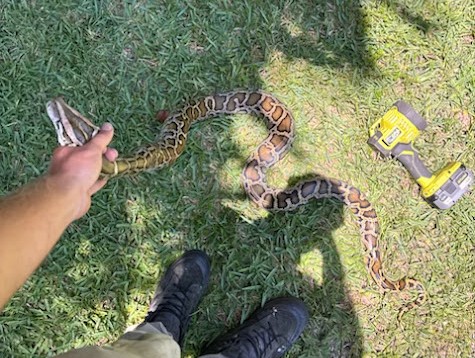




The death of a family’s pet rabbit may be the latest evidence that Burmese pythons are expanding beyond the Everglades and becoming an increasingly common presence in Miami’s residential neighborhoods.
A seven-foot Burmese python that killed a family’s pet rabbit in a South Coconut Grove backyard last month may be the latest sign that one of Florida’s most destructive invasive species is becoming increasingly common far from the Everglades.
The snake was discovered mid-morning on May 8 in a backyard on Ingraham Highway, where homeowner Cenaida Cifuentes found it coiled around her three-year-old Mini Lop rabbit.
“This was a terrifying and heartbreaking experience for our family,” Cifuentes told the Spotlight. “We moved here less than three years ago from London with our bunnies. We were always concerned about the falcons and hawks flying around, but never did it occur to us there could be a python in the garden.”
Within an hour, a private wildlife trapper had located and euthanized the snake.
“I expected the snake to be gone because they don’t normally stay (in the same location),” explained Jonah Nelson of Palm Beach Wildlife Services.
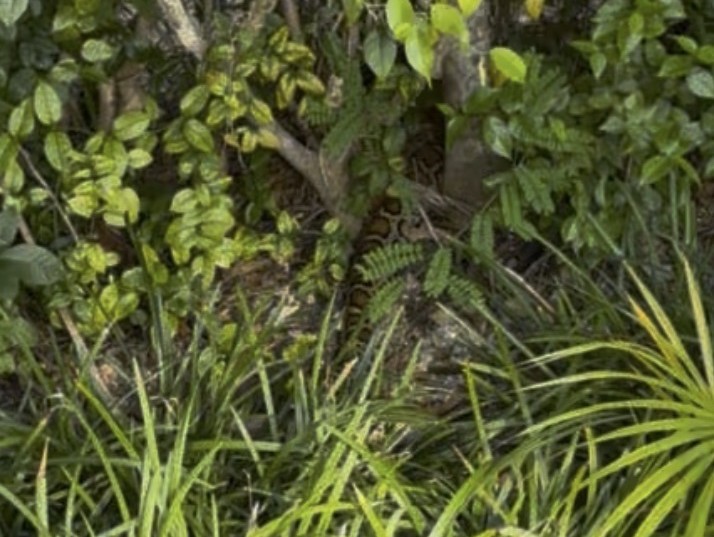
“By using a spotlight, I was able to see the snake in the bushes. I got hold of its tail and then made a perfect grab on his neck with my right hand as it hissed at me.”
Nelson said the snake’s behavior during the encounter suggests it was likely born in the wild, not a former pet that had escaped or been released.
Seeing Burmese pythons in suburban areas is part of a growing trend throughout Miami-Dade County. Whether this snake was wild or an escaped pet is an open question, however.
Captive snakes that escaped or were released into the wild established the breeding population of wild pythons that has come to dominate the food chain in Everglades National Park.
It’s not known whether there were any reports of escaped pythons in the area prior to the May 8 bunny attack, but keeping the snakes as pets is forbidden under Florida law.
An interactive map of python sightings maintained by the Florida Fish and Wildlife Conservation Commission shows at least 10 snakes have been reported in Coconut Grove in recent years. In early 2025, a Burmese python estimated to be 11 feet long was photographed at Matheson Hammock Park in nearby Coral Gables.
Read more: Pythons at the Gate
Such sightings are likely to become more common as the invasive snakes continue to expand their range beyond the Everglades, said Ron Magill, goodwill ambassador and conservation liaison for the Zoo Miami Foundation.
“The same beautiful trees and flowers all over Coconut Grove that attract people are also attractive to animals like pythons,” he said. “The snakes go wherever they find food, whether it’s squirrels, rats and mice or cats and small dogs. People need to be aware of that.”
After returning home to find the snake coiled around one of the family’s two pet rabbits, which are allowed to roam freely in the backyard during the morning hours, Cifuentes called the Florida Fish and Wildlife Conservation Commission. Frustrated by what she described as an endless loop of menu options and extensions, she eventually gave up.
Her husband, Cameron Phillips, then contacted Nelson, who arrived 20 minutes later.
Nelson agrees that Coconut Grove is the perfect habitat for Burmese pythons because of a lack of natural predators, a high reproductive rate and plenty of heavy undergrowth which allows for the snakes’ ease of movement. On top of that, he says, their earthy brown colors make them incredibly hard to spot.
Although the snakes are nonvenomous and are of little threat to humans, Burmese pythons clearly pose a danger to small mammals, birds and other reptiles.
In the Everglades, Burmese pythons are wreaking havoc on the ecosystem by decimating populations of native mammals and disrupting the food web for predators such as Florida panthers, bobcats and raptors.
A female python can lay between 50 to 100 eggs annually and hatchlings can be up to 24 inches long at birth. The vast majority don’t make it to adulthood, often falling victim to birds, alligators, crocodiles and other snakes.
The South Florida Water Management District advises anyone who spots a Burmese python to call 888-483-4681 to report the sighting. There is also a free app called IveGot1 that can be downloaded to a cell phone and used to report nonnative species.
The Florida Python Challenge, a contest involving novice and professional snake hunters searching for Burmese pythons, will take place in the Everglades from July 10 though 19.