
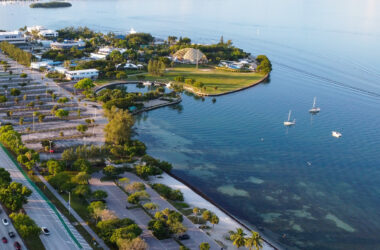
After more than a year of public debate, the design plans for Kirk Munroe Park and Fuller Street in Coconut Grove’s central business district are headed to the Miami City Commission for review and final approval.
More than a year ago, Spencer Morris, chief executive of the Allen Morris Company, stood before a crowd of Coconut Grove residents and presented a proposed redesign of Kirk Munroe Park and Fuller Street – the two public spaces that sandwich his firm’s new Ziggurat development on Grand Avenue at Matilda Street.
Not everyone was charmed. Grove resident Barbara Lange said the design was “beautiful,” but better suited for Coral Gables.
“I would like to see a design that looks more like Coconut Grove,” she said.
Thirteen months later, the Allen Morris design team has landed on a plan that not only appears to embrace that feedback, but that is winning public plaudits.
The true test, of course, will come next month when the company’s design plans are presented to the Miami City Commission for final approval. For now, however, those plans appear to have pleased a core constituency of Grove residents.
“I am super excited. This is much better than any expectation I had for both Fuller Street and for Kirk Munroe Park,” said Ben Glatzer, a Center Grove resident whose children attend Coconut Grove Elementary School, which neighbors the park and Fuller Street.
Glatzer was one of about two dozen people who attended a fourth and final public meeting on Thursday at Miami City Hall to hear Rafael Portuondo of Portuondo-Perotti Architects and Andres Arcila of Naturalficial, a landscape design firm, describe their updated vision for the two public spaces.
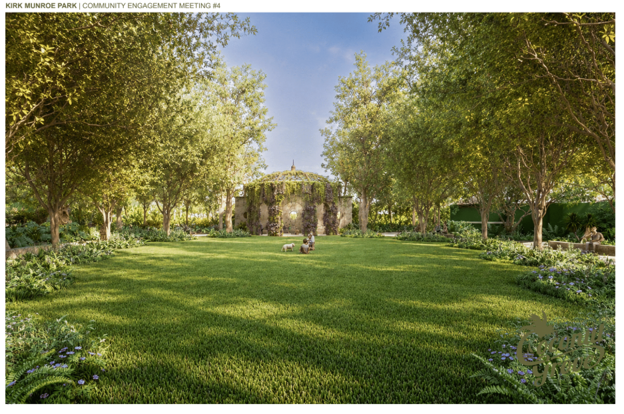
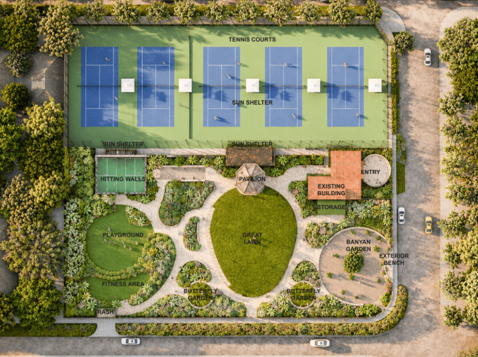
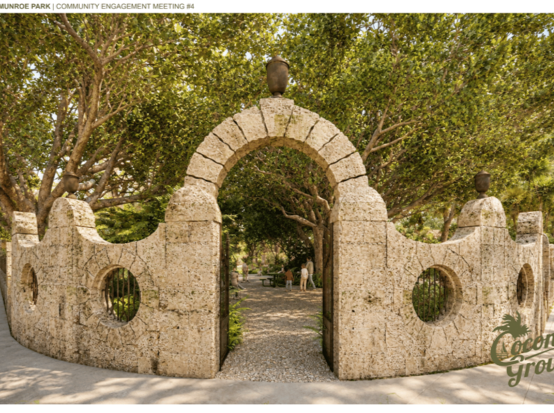
In the case of Kirk Munroe, the proposed design transforms a dated, dog-eared park into a serene, storybook-like garden. “We want a park that could be something significant at a national level,” Portuondo told the crowd.
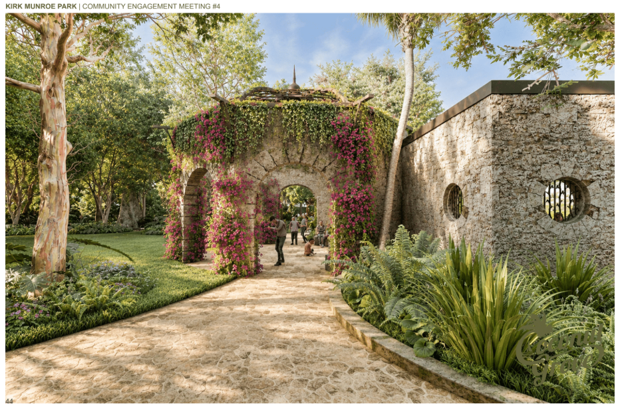
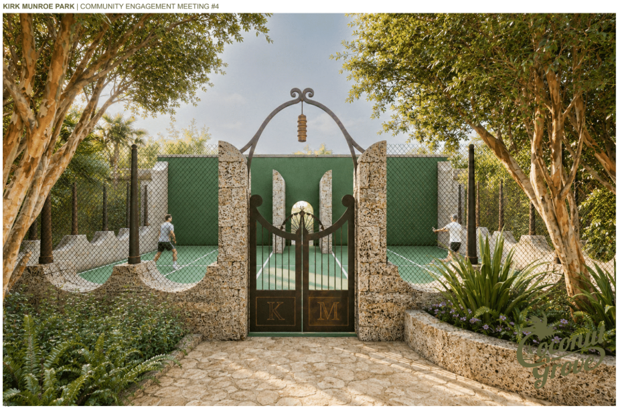
Residents who attended got a fresh look at the park’s proposed aesthetics, including oolite benches, keystone-paved pathways and custom iron gates and fencing designed to look like the feathers of a peacock and tree branches.
“We’re trying to do something really special in terms of the fences and the gates, and not to do something standard, so that it becomes something more bespoke,” Arcila said.
The new design reimagines the park’s current amenities – a hitting wall, a playground and fitness area – while adding several new features, including butterfly gardens, sun shelters and a garden surrounding the park’s towering banyan tree.
In a nod to the Grove’s verdant and untamed character, the proposed design would add 105 new trees to the park, in addition to those already on site, including a specimen kapok tree, 12 live oaks, five gumbo limbos and 21 pigeon plums.
The design team said paved areas would be kept to a minimum, with impervious surfaces covering 27% of the park — up from the current 19% – largely due to ADA accessibility requirements.
The design process for both the park and Fuller Street has been led by Allen Morris under a development deal the company struck earlier this year, in conjunction with the company’s planned five-story, mixed-use Ziggurat development on Grand Avenue.
As part of the deal, Allen Morris agreed to lead a public planning process to solicit community feedback and share ideas before arriving at a final proposed design.
Read more: Design Process to Begin for Kirk Munroe, Fuller Street
“This is how it should work,” Javier Gonzalez, the District 2 liaison for Coconut Grove, told meeting participants last week.
The company also agreed to contribute $2 million to fund the proposed improvements, with an additional $3 million to come from the city. Allen Morris will manage the construction phase of the project as well, and absorb any cost overruns.
Last week, some attendees questioned whether the final design could be completed within the $5 million budget. Project representatives assured residents the designs had been calculated to stay within those limits.
“Fuller Street is a simpler project, so we can shoot the moon on the park,” Gonzalez told the crowd.
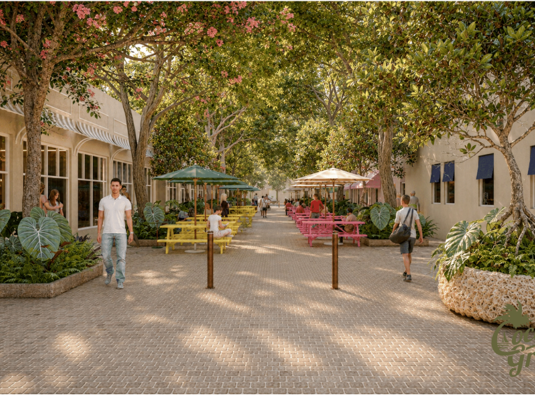
The proposed Fuller Street improvements would double down on the city’s previous decision to close the street to traffic. The level of the street would be raised to match the sidewalk and the asphalt roadway would be replaced with porphyry stone pavers.
“What we’ve been told is Fuller Street is great, it functions, don’t overdo it. So, we tried to simplify the plan,” Arcila said.
Some of the trees that now grace the street, deemed to be in less-than-prime condition, will be replaced by others, including a specimen chestnut tree, a rainbow eucalyptus and several mahogany trees in planters.
The proposed design also calls for the introduction of a “silva cell” system – a suspended pavement system that creates space for tree roots to grow beneath the pedestrian promenade.
Participants at last week’s meeting suggested some added improvements, including the creation of public seating – separate from the outdoor seating sponsored by local businesses – and a community bulletin board for meeting and event announcements.
Members of the design team welcomed those and other suggestions, acknowledging the role that residents had played in transforming the team’s initial design, first presented in April 2025, into a plan that reflected community priorities.
“You guys have been integral to the design,” Arcila said.
“We always come in with preconceived notions about what we think something should be. We get inspired really quickly, and we want to do it, but this has been a very sort of informative process for us, and has become a labor of love.”
The design is now headed to the City Commission on June 25 for public review and final approval. Construction timelines are tentative, but an Allen Morris representative said the company is tentatively planning to break ground in summer 2027.