


Miami District 2 Commissioner Damian Pardo is asking voters to move city elections to even-numbered years beginning in 2034, but critics say his proposal either doesn’t go far enough — or shouldn’t happen at all.
On July 28, City of Miami voters began receiving text messages urging them to approve a consequential charter amendment on the Aug. 18 primary-election ballot.
“YOUR MONEY IS BEING WASTED,” one message declared in all capital letters.
The text promoted Referendum 1, which would move Miami’s municipal elections from odd- to even-numbered years. The measure, the message said, would end an “unnecessary expense” and save taxpayers millions.
Three days later, a similar message went to voters who typically vote early: “Save Miami Taxpayers Millions. Vote YES on Referendum 1.”
Both text messages were paid for by We Can Do Better Miami, a political action committee linked to Miami District 2 Commissioner Damian Pardo, the principal architect of Referendum 1.
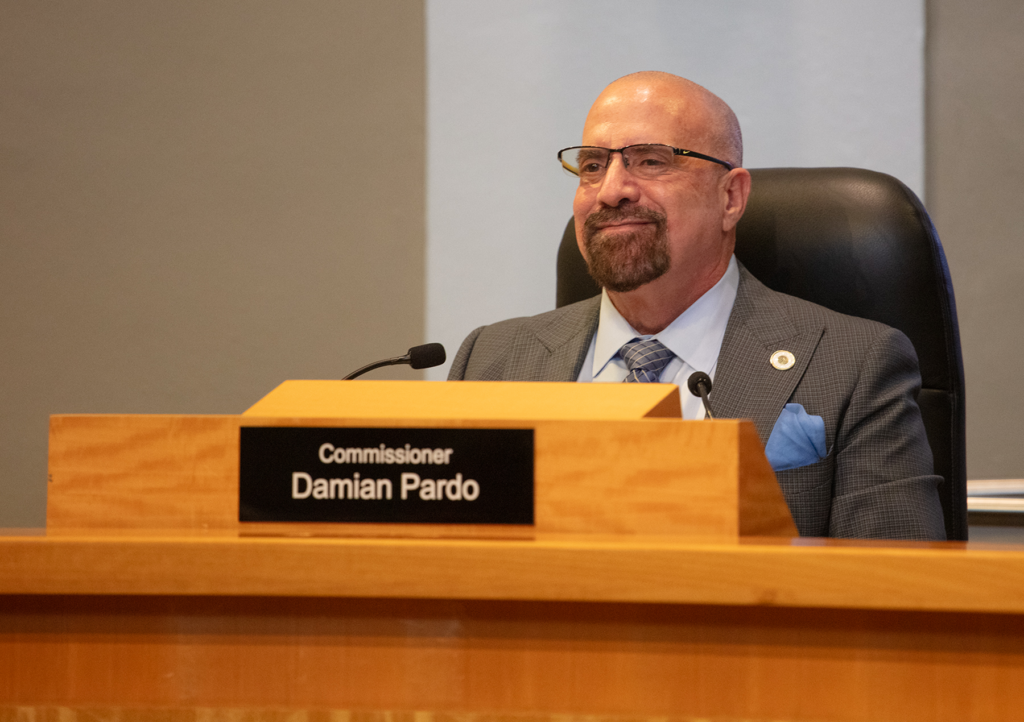
Pardo did not respond to text messages seeking comment for this story.
Moving city elections to even-numbered years has been a linchpin of Pardo’s self-described reform agenda at City Hall. Last November, Miami voters overwhelmingly approved lifetime term limits for elected city officials, another Pardo-backed charter amendment.
But Pardo’s first attempt to change Miami’s election calendar ended in court.
The City Commission voted last year to postpone the 2025 municipal election by one year, a move that would have extended the terms of sitting officials by one year.
A state court struck down the plan as unconstitutional after a lawsuit brought by former City Manager Emilio Gonzalez, who subsequently lost the mayoral runoff to then-Miami-Dade County Commissioner Eileen Higgins.
The city spent more than $150,000 on outside attorneys unsuccessfully defending the plan in court.
Read more: Miami Spent $150K on Long-Shot Election Appeal
Referendum 1 took a different route with Pardo and his four City Commission colleagues voting in January to ask voters whether future city elections should be held in even-numbered years, concurrent with state and federal contests.
If approved, the change would begin with the 2034 election cycle. To accomplish the shift, the mayor and all five commissioners would serve a shorter term in office – three years instead of four – starting in 2031 and 2023, before the first even-year election.
Pardo has argued that moving municipal contests to higher-turnout election years would broaden participation and reduce the expense of staging stand-alone city elections.
But critics say the referendum postpones the change for too long — and falls short of the more sweeping reforms sought by Stronger Miami, a coalition of neighborhood, voting-rights and civic-engagement organizations.
“The current amendment on the ballot is not good enough,” Teresa Guzman Pagan, Florida Rising’s director of expanding democracy, told the Spotlight. “It doesn’t go into effect until 2034. People want change now.”
In addition to Florida Rising, other groups banding together under the Stronger Miami umbrella include One Grove Alliance, Engage Miami, Miami Freedom Project and the American Civil Liberties Union.
Stronger Miami’s proposed charter amendment also would move city elections to even-numbered years, but it goes considerably further, calling for an expansion of the City Commission from five to nine seats. It also would establish standards intended to curb political gerrymandering and preserve neighborhoods during the redistricting process. The changes would take effect in 2028.
The proposal requires 20,426 valid petitions — 10 percent of the city’s registered voters — to force its way onto the ballot.
Andy Parrish, a longtime Coconut Grove activist and chairman of the Stronger Miami coalition, said simply shifting the election calendar will not by itself address what organizers see as Miami’s deeper problem: commissioners serving districts that are too large to provide close neighborhood-level representation within a city of roughly a half-million residents.
“The key change proposed by Stronger Miami is going to nine City Commission districts,” Parrish said. “We need more local representation that aligns with other cities that have a representative for every 50,000 people.”
Under the proposal, each commissioner would be required to maintain a primary office in the district they represent — an added expense, Parrish said, that would be more than offset by the efficiencies of a more responsive city government.
Parrish said Mayor Eileen Higgins, before her election last December, indicated that she would support the proposal.
“I did meet with [her] before she ran for office,” Parrish said. “She realized all commissioners are against it. But she said, ‘I will support it.”
Guzman Pagan said Stronger Miami’s signature drive is ongoing. As of May, the Miami-Dade Supervisor of Elections had certified only about half of the more than 20,000 petitions submitted, with thousands rejected for reasons including duplicate or incomplete petitions and signatures from people who were not City of Miami residents.
Read more: Stronger Miami Petition Drive Falls Short Ahead of Election
Guzman Pagan said the campaign is working with county election officials to improve its signature acceptance rate, with an eye toward reaching the ballot sometime in 2027.
“We comply [with] all existing petition laws, and we are [in] communication with the supervisor of elections office,” Guzman Pagan said. “We have a good working relationship — definitely no pushback — just talking to them [about] ways we can increase our acceptance rates.”
At the same time, Guzman Pagan and other Stronger Miami organizers are urging the City Commission to bypass the petition process altogether and use its authority to place the coalition’s broader charter amendment directly before voters.
“We have continued to have meetings with city commissioners and conversations with Mayor Higgins to get them to do the right thing,” Guzman Pagan said. “There is nothing stopping city commissioners from putting the Stronger Miami petition on the ballot. They need political courage to put something the people really want and deliver on their promises.”
But Gonzalez, the former city manager who successfully challenged the city’s previous attempt to postpone the 2025 election, opposes both even-year voting and Stronger Miami’s proposal to expand the City Commission.
Aligning municipal elections with presidential, congressional, state and county contests, he argues, would bury city candidates on a much longer ballot dominated by higher-profile races.
“We should retain the odd-number years. It allows people to focus on city elections,” Gonzalez said. “If you are running for city commission during an even-numbered year, you are going to be on page 14 of that ballot.”
He also questioned whether candidates for city office could raise money in a crowded state and federal campaign season.
“You won’t raise any money if you are in an election cycle where you have candidates for president, senator, Congress, the state legislature and County Commission,” Gonzalez said. “Everyone is tapped out when a guy running for City Commission starts asking for contributions.”
Gonzalez also pointed to what he sees as an irony: a referendum intended to increase voter participation is itself being decided during an August primary, when turnout has traditionally been weak.
“Knowing that everyone is on vacation in August, for an administration that wants to increase turnout, they scheduled [an] election when turnout is historically the lowest,” he said.
Early voting for the Aug. 18 special election runs through Aug. 16. All registered voters within Miami’s city limits may vote on the city referendums, regardless of party affiliation.
As for Stronger Miami’s proposal to expand the commission, Gonzalez is no fan, arguing that better candidates — not more elected officials — are the key to improving city government and civic engagement.
“We need better candidates,” he said. “If we have that, the voters will show up. As long as we have mediocre candidates, the voters will stay home.”
Parrish vehemently disagreed, arguing that the mismanagement and dysfunction that have long plagued City Hall demand more fundamental change. “That these five current commissioners are dead-set against nine districts is the biggest reason to support it, he said.”
Meanwhile, Pardo’s We Can Do Better Miami is spending money to promote Referendum 1. On July 31, the PAC paid $2,437 to Miranda Advocacy, a Coral Gables consulting firm headed by Pardo campaign consultant Alex Miranda, for “voter contact,” according to a state campaign-finance report.
Guzman Pagan argues that the lack of transparency surrounding the Pardo-linked campaign for the August ballot measure does residents no favors — and may itself bolster the case for Stronger Miami’s broader reform proposals.
“These claims are being made and you don’t know who it is from,” Guzman Pagan said. “It seems extremely well-funded by a group that no one knows who [it is] coming from. … Why are we getting obscure message[s] from a PAC with a seemingly positive name to push a reform that hasn’t had a ton of education on?”
And while even-year voting remains part of Stronger Miami’s platform, Guzman Pagan and other organizers are urging voters to reject next week’s referendum in favor of what they say is a more sweeping overhaul of city government.