
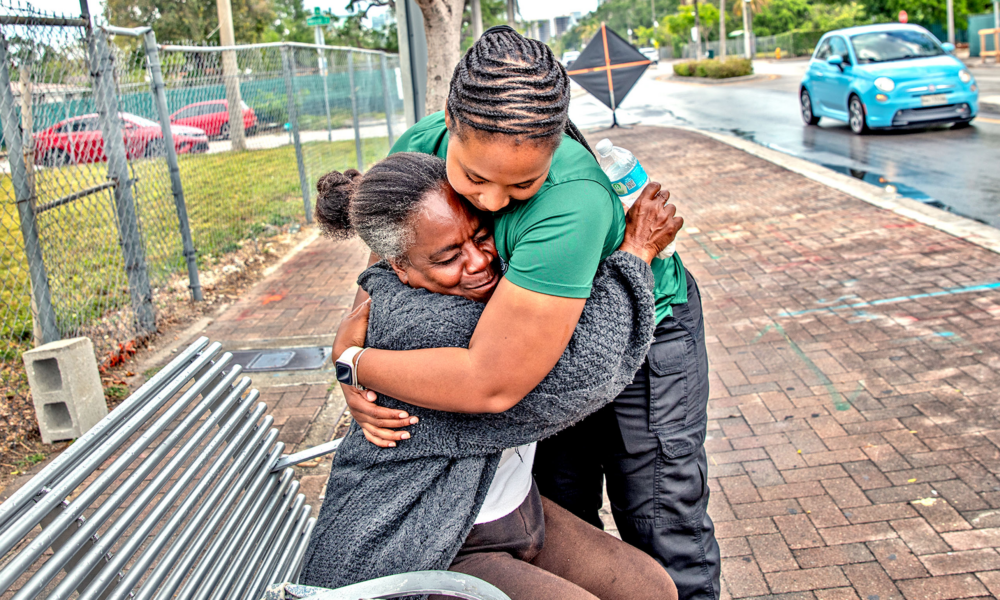




For nearly 20 years, Sheila Dixon has lived outdoors in the neighborhood where she grew up, repeatedly turning down offers of housing. A new Miami ordinance may soon challenge the life she’s chosen.
For most of the past 20 years, Sheila Dixon has lived on the streets of Coconut Grove, unhoused, unafraid and unconcerned about what anyone else — including her family — thinks about her unconventional lifestyle.
Lately, the 66-year-old mother of five lies down at night on a Grand Avenue sidewalk with her head so close to the street that she can feel the breeze from passing cars.
Asked if she thinks about the danger of sleeping outside, inches from a major thoroughfare, Dixon says, “I am not frightened because I stay in prayer. It is better to be out front. The police come through there.”
By almost any definition, Dixon is homeless. She is also one of the best-known characters in the predominantly Black West Grove, a neighborhood where she grew up, a community where eccentricities are tolerated. And she does not feel homeless, say those who have known her for years. She is home.
“She is comfortable being on the street,” says Nicola Archer, a math coach and pastor’s wife who has befriended Dixon. “She says, ‘I choose to be here.’ But with everything happening in the Grove, I do fear that it’ll happen, that she’ll be picked up.”
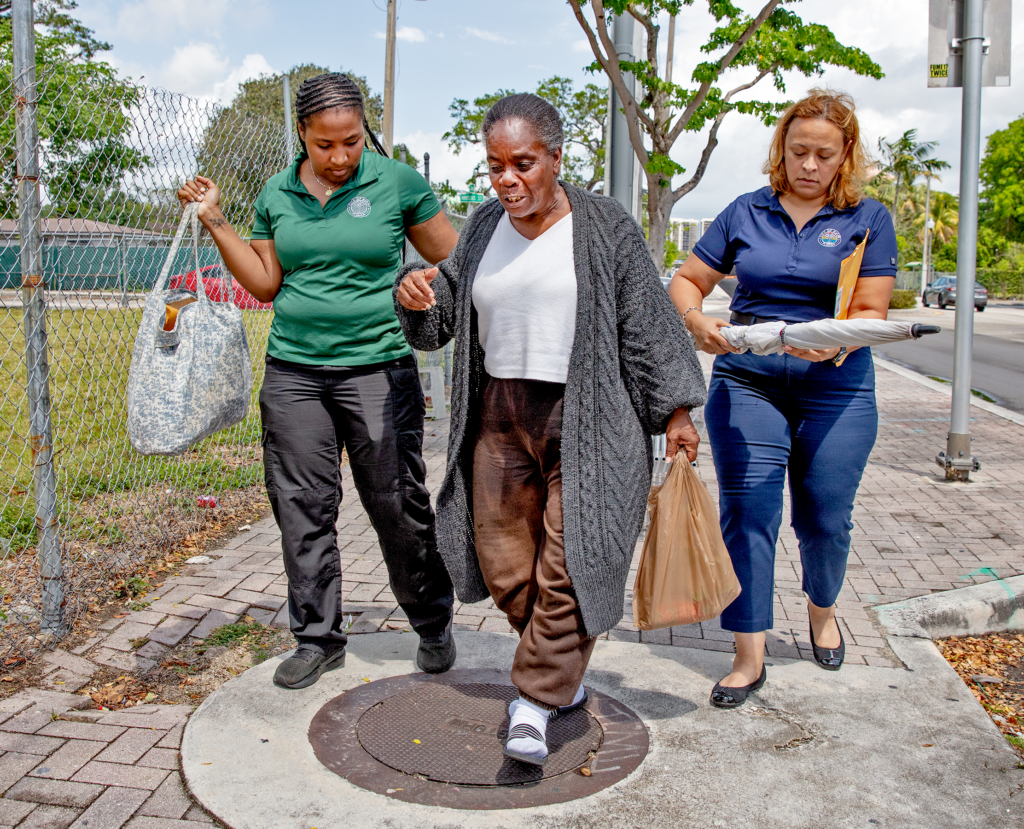
What’s happening in the West Grove, of course, is change, and Sheila Dixon, with a couple of blankets, a small suitcase and some cans of food, is sitting right in the middle of an urban makeover driven by development aimed at a far wealthier demographic.
Ratcheting up the threat to Dixon and others living outdoors is a city ordinance approved last month that aligns Miami’s enforcement procedures with a state law that took effect last year. The ordinance eliminates the previous requirement that police first issue a written warning before making an arrest. Instead, officers may give a verbal warning and allow what the ordinance describes, without defining, as a “reasonable amount of time” for a person to remove an encampment.
If a person refuses an available shelter bed or other government assistance that would result in immediate housing, and remains after the warning, police may arrest the person. The ordinance prohibits an arrest if no shelter bed or immediate housing option is available.
The ordinance passed by a 3-2 vote, with District 2 Commissioner Damian Pardo and District 5 Commissioner Christine King voting no. “For me, there is this slippery slope that I’m not comfortable with,” Pardo said. “In my case, I’m going to be on the no side.”
Mayor Eileen Higgins, who could have vetoed the ordinance, signed it into law July 24, one day after the commission approved
Pardo declined an invitation from the Spotlight to speak further on the measure.
To Dixon, Miami Ordinance 14488, “Encampments on Public Property Prohibited,” is of no concern. Nor has she shown much interest over the years in accepting offers of help that come her way.
She has been visited often by the “green shirts,” the street teams who work for the city’s Department of Human Services in partnership with the Homeless Trust. She has been offered housing, including an apartment in the Grove, but has refused to take it.
Neither does she take anything from the Coconut Grove Crisis Food Pantry, said outreach coordinator Deb Dolson.
“She is stubborn,” says her sister, Lillian Ambrister, a North Miami-Dade resident who, unlike some of her West Grove relatives, spells the family name with two Rs instead of three. “The Grove is still her home. I ask, ‘What made you think it’s OK to sleep on the sidewalk?’ It’s not a drug issue with her; it’s mental. She doesn’t have to be out there. But she’s OK with it.”

As a youngster, Dixon was known as a talented dancer and gymnast, according to her sister. As a young mother, she went to work for the post office, and also obtained a real estate license. She never worked in real estate, Ambrister said, but renewed her license year after year.
“She is very smart,” says Ambrister. “She went to night classes at Gables High, just to be there.”
Dixon lived in a house on William Avenue with her mother and her children. The death of her mother in 2001 triggered a downward spiral, her sister said. She eventually lost custody of her sons, who went into foster care and then to live with their father and his girlfriend in New Smyrna Beach.
The story of one of those children, D’Cota Dixon, was widely told by The New York Times, NFL.com and other news outlets in 2017 when he was a standout defensive back for the University of Wisconsin and the Badgers came to town to play the University of Miami in the annual Orange Bowl football game.
Before the game, Dixon set out to look for his mother, whom he had not seen since he was 9 years old. With the help of his two sisters, who still lived in Miami, he found her, sitting on a blanket in the West Grove. They spent hours together.
“When we were talking, it was like I was 5 years old again,” Dixon, then 23, told The New York Times. “Everything — her voice, her tone, her eyes, how direct she is when she’s talking. She’s a very real person.”
After his senior year at Wisconsin, Dixon was named the Jason Witten Collegiate Man of the Year, an award presented annually to the college football player who best exemplifies leadership, courage and exceptional character. After graduating with a degree in rehabilitation psychology, he had a brief stint with the Tampa Bay Buccaneers and later played professional rugby. He recently worked as a Christian evangelist in Colorado. He could not be reached for this story.
Dixon’s eldest son, Ulysses Daryl Dixon II, is in prison after a human trafficking conviction, according to state records. Another son, Dexter, may be living in Texas, Ambrister said. Dixon also has two younger daughters.
According to a census conducted by the Homeless Trust, there were more than 3,600 unhoused people in Miami-Dade County in January. Of that total, more than 2,400 were in shelters and 1,184 were unsheltered on the day of the count.
The census also found slightly more than 1,000 men and women deemed chronically homeless, which is usually defined as having been without a home for 12 consecutive months.
The number of homeless people found in Coconut Grove on Jan. 22 was 10.
That may be an undercount. “Counting areas like the Grove is different from counting downtown, because that population is moving,” says Homeless Trust Chairman Ron Book. “They may be harder to find.”
Dolson of the Crisis Food Pantry said, “We see 20 to 25 people who say they have no permanent address.” And, she adds, “I have heard from more than one person who says they prefer to stay [on the street]. They don’t want a roof. They say, ‘I want my freedom.’ That’s their comfort zone.”
The next point-in-time count is scheduled for Aug. 27.
For many, Dixon’s refusal of help defies logic and is difficult to understand.
One who does understand is David Peery. He has a law degree from George Washington University and is president of the Florida Coalition to Advance Racial Equity, a grassroots organization battling systemic disparities in housing, income and health care. He has also been homeless himself, living on the streets of Miami for nearly a decade.
He does not know Sheila Dixon, but he knows many people in similar circumstances.
“You cannot apply a housed person’s perspective and logical analysis to someone living on the streets,” Peery says. “Rather than choosing to be on the streets, you are simply making the best of a threatening environment. You find a spot that best meets your safety needs, where you have connections to eating, a place to sleep, a bathroom. Once you find that place, you return to it. It’s known.”
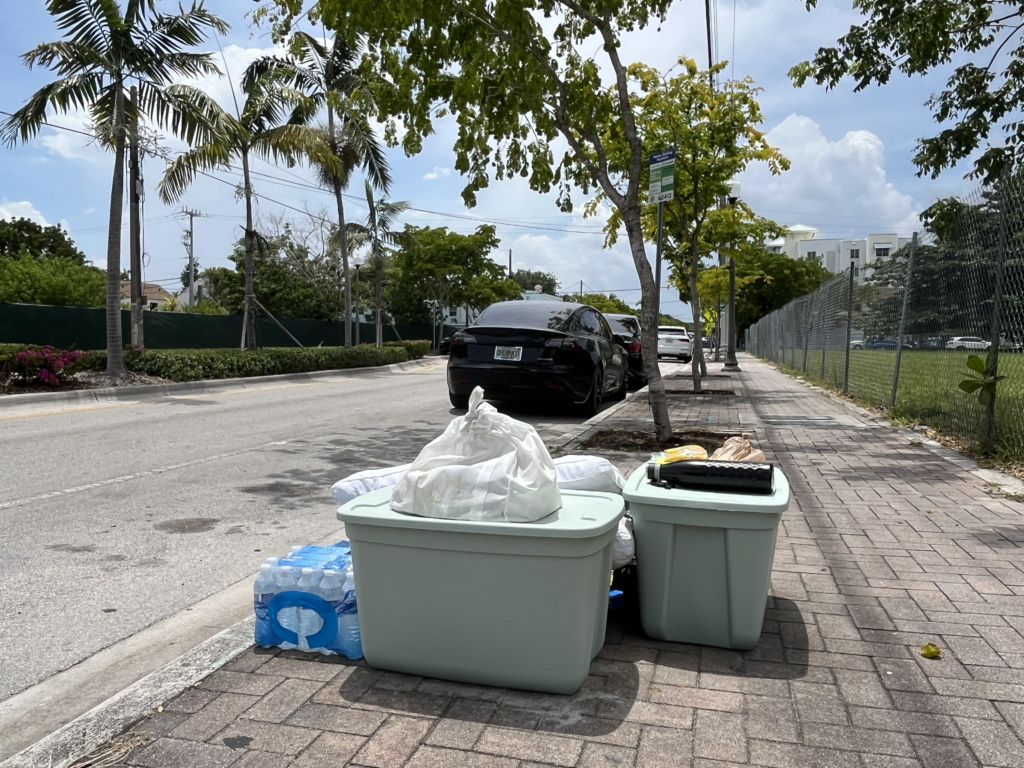
Peery says, “It is futile and stupid to arrest homeless. Once released, they are likely to return to the same place where they were arrested.”
As for Dixon being offered an apartment, Peery said, “In her framework, that apartment is an illusion. She can’t imagine it. It’s like choosing to go to Mars.”
Sheila Dixon lately spends most days at the Virrick Park branch library, where she watches videos of evangelists, following along in her well-worn, pink-covered Bible and making notes. The pastor Creflo Dollar is a favorite.
Aside from a troublesome knee, she apparently remains healthy. She said she recently went to Mercy Hospital for a checkup but had not received the results because her phone was stolen. “Sheila is gaining weight, she is clean, her hair is kept neatly,” says her sister.
How does she survive?
“God watches over her,” said Ambrister. “She’s found her peace.”


















For years, I have been in contact with homeless people and many of them are not dangerous for the community. They don’t deserve to be arrested. They have a dignity and deserves compassion and understanding of their fragility. Otherwise, mental health issues, veteran’s traumas, drug addiction, are circumstances that unable them to have a home. Arresting them will have nefarious consequences in their difficult life. Please, politician, reconsider this!
A great story, both uplifting and tragic. For years I have observed this woman on the sidewalk and have wondered about her. Now I know. And it’s nice to see Damian Pardo opposing the measure to prohibit such activity. None of us want to see someone living on the street, but if she is happy out there, why not?
What a heartbreaking story. As much as I don’t think arresting homeless people will solve anything, neither will leaving them on the street to suffer. This is certainly an outlier but the entire situation can not, honestly, be painted with the same brush. Nobody wants the Grove to turn into a homeless encampment and open air drug market like LA, SF, and other cities have allowed with overly permissive laws that might feel compassionate but are ultimately enabling a horrible existence. A jail is certainly not the answer but abandonment is just as cruel.
I thought about not posting this out of respect for Ms. Dixon’s remaining privacy. Instead I shared with a friend for advice who reminded me that drugs, both good and bad, have changed society. It’s not about me, or even Ms. Dixon. It’s about us. So here goes:
I used to stop and talk with Ms. Dixon when she was on her meds and not agitated. Highly intelligent and articulate woman. Always clean so obviously some family member was looking after her. She has extensive oral history of the Grove going back quite a way, and about the many prominent West Grove families. I know enough to verify that at least most of her stories are true. Once I gave her a lift to the Metrorail but usually to the library. She says she just likes being outside and not confined.
She makes me think of Boo Radley in “To Kill a Mockingbird.” And how families — and not always black or low income – used to take care of their children and adults like Ms. Dixon without relying on “the State.” I’m assuming that neighbors were ok with this, mostly.
I think as a whole we’ve become less tolerant of having even to see them, maybe because we refuse to remember “There but for the grace of God go I.”
This is a moving portrait, and I don’t doubt Ms. Dixon’s story is complicated.
But there’s a bedrock principle at stake: equality before the law. It’s one of the few ideas that Americans across the political spectrum still agree on. We have no kings here. We believe that no matter who your father is or how rich you are, the law should apply to you the same as everyone else. And the principle has to cut both ways. It also can’t matter how poor you are, how sympathetic your story is, or how long you’ve lived in the neighborhood. One law for some and another for the rest of us is exactly what this country was founded to reject (and, incidentally, it’s one reason I left my home country and came to America).
That’s why selective enforcement is so corrosive. When police apply a rule to some people and quietly waive it for others, nobody is protected by law anymore. We’re all subject to the whims of a community that might find my story moving but not someone else’s. The court of public opinion is no way to decide who the law applies to.
If this ordinance is too harsh, the remedy is democratic: change it through the commission and the ballot box, as the two dissenting commissioners tried to do. What we can’t do is keep the law on the books and decide case by case who it applies to.