

Just hours before a final City Commission vote on Miami’s controversial affordable housing density transfer expansion, city administrators are moving to scale back a politically sensitive carve-out sought for Coconut Grove and other protected neighborhoods — a reversal likely to inflame criticism that major zoning changes are again being rewritten behind the scenes at City Hall.
In a memorandum circulated Wednesday evening, City Attorney George Wysong III recommended substituting the pending ordinance to preserve the “status quo” for Neighborhood Conservation Districts (NCDs), historic districts and properties within 500 feet of single-family neighborhoods, rather than fully exempting them from the expanded program as previously proposed.
“It is recommended that this item be substituted to revise the language addressing NCDs, historic districts, and properties within 500 feet of a single-family residential zone — not affecting or altering any existing rights of those properties under the current program and preserving status quo of those properties,” Wysong wrote in the memo.
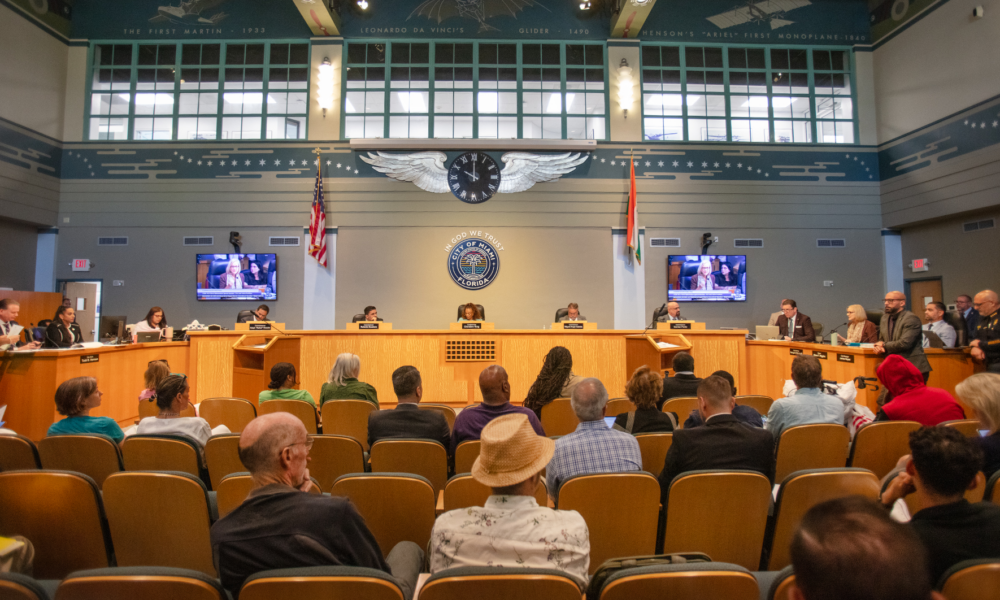
The city commission will cast its second of two required votes on the measure this Thursday.
The late substitution would mark the second time the ordinance has been substantially rewritten without advance public notice before a commission vote. A prior substitution memo, circulated before the April 9 first reading but not publicly posted with the agenda, added some of the proposal’s most consequential changes, including the 100% density bonus and parking exemption.
The recommendation comes after months of mounting opposition in Coconut Grove, where residents and neighborhood advocates have pushed for a complete carve-out from the so-called “receiving site” provisions of the program, which allow developers to purchase and apply density credits generated by affordable housing projects elsewhere in the city.
District 2 Commissioner Damian Pardo had publicly backed excluding all NCDs and historic districts from the legislation. But in an email sent Wednesday to community members, Pardo aide Javier Gonzalez said the commissioner’s requested carve-outs were now being challenged by city administrators.
“As you are aware, Commissioner Pardo requested that all Neighborhood Conservation Districts and Historic Districts be omitted from the proposed TTD legislation,” Gonzalez wrote. “But our City Attorney and the Administration is recommending substitutional language.”
Under the substitute language, projects in NCDs, historic districts and properties within 500 feet of single-family zoning would still be allowed to receive transferred density — but only up to a 50% increase above base zoning, preserving the cap already allowed under the city’s current program. Elsewhere in the city, qualifying projects would be permitted to increase density by as much as 100% above base zoning.
The substitute would also preserve parking requirements for bonus-density units in protected neighborhoods, while exempting such units from parking minimums elsewhere in the city.
Critics argue the broader ordinance would still dramatically expand the city’s affordable housing density transfer program by reducing minimum affordable housing thresholds in some cases from 200 units to 70 and expanding the geographic areas eligible to generate and sell density credits.













There’s a lot to unpack here in some ways, in other ways, it’s pretty simple… the developers run this town.
I would like to see an investigation as to why these changes are last minute, without proper notice.
As part of our City, County and States’ never-ending campaign to give more gifts to developers, this item would allow selling and transferring density from some building projects to others, causing even more overdevelopment.
This is being done under the currently trendy political camouflage / cover story of “Affordable Housing”.
Don’t be fooled, there are already ways to create affordable housing without this latest gift idea. This is all about pleasing the developers who make the campaign contributions to our elected officials.
Also, the mother of all developer gifts – and there have been many – is the infamous Live Local Act, which prevents local governments from enforcing certain zoning laws and allows enormous buildings with high density along any commercial corridor.
25 cities across the state have joined a lawsuit to stop the Live Local Act.
Miami has not yet.
What can you do?
Speak out at City Hall today (May 28, 2026, around 9:30 am) and ask the Commission to vote down PZ-3 and to join the lawsuit against the Live Local Act.
If you miss the meeting, send the mayor and commissioners an email. Let them know our quality of life is more important than enabling developer profits. Tell them affordable housing can be created without adding more density.
Ask them to have Miami join the 25 other cities in the anti-Live Local Act lawsuit.
The City you save might just be your own.