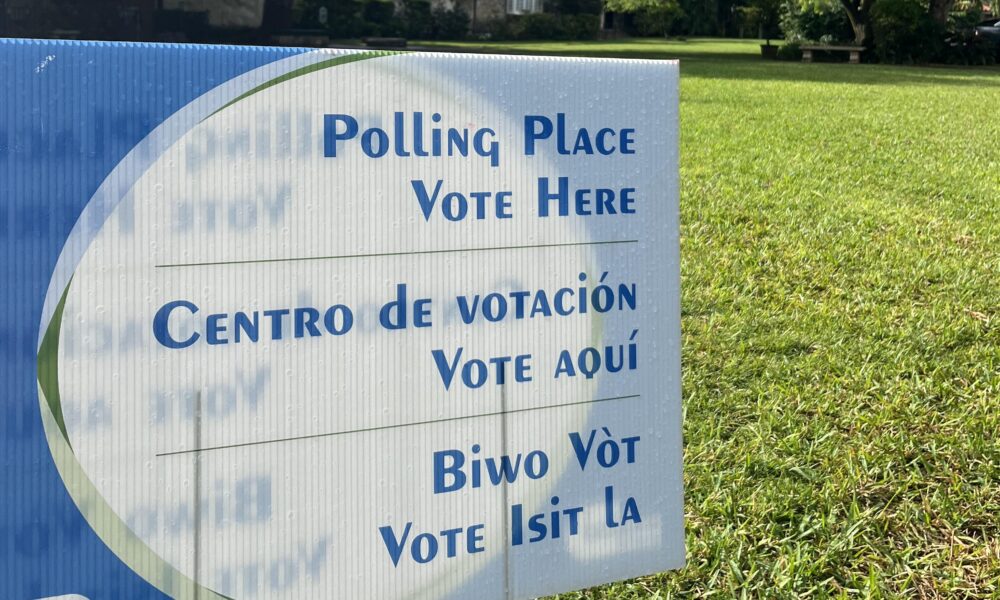
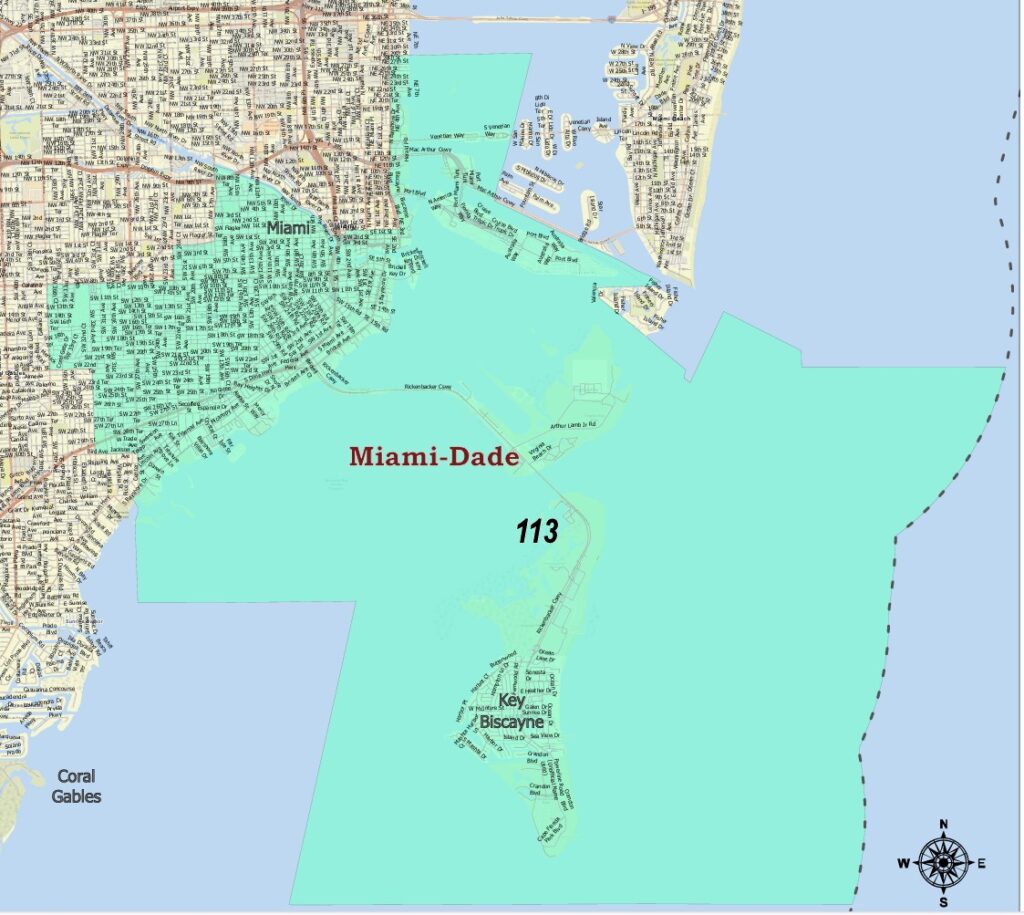
Three Republicans and two Democrats are running in the Aug. 18 primary election to represent the North Grove, Shenandoah, Brickell, and downtown Miami in Tallahassee next year.
There are five candidates running in next week’s primary election to replace Vicki Lopez as the state representative for House District 113, a seat that has remained vacant since Lopez resigned late last year to serve on the Miami-Dade County Commission.
Three candidates are Republicans and two are Democrats, in a district where nearly 40% of voters aren’t sold on either party, but where Republicans enjoy a slight edge.
Of the 77,022 voters in the district, 25,424 are Republican and 21,678 are Democrats. The district includes the North Grove, Shenandoah, Brickell and downtown Miami.
The Spotlight interviewed each of the five candidates ahead of the Aug. 18 election on major issues including the cost of living, overdevelopment, and the pending property tax amendment that could upend the City of Miami’s finances.
The Republicans
Name: Frank Lago
Age: 46
Lives in: Brickell
A commercial real estate advisor who worked as chief of staff for Sweetwater Mayor Manny Maroño between 2005 and 2011, Frank Lago (no relation to Coral Gables Mayor Vince Lago) said he’s running because he is tired of seeing locals priced out of the housing market.
“My best friend’s son said he is moving out because the average cost for a house in Miami is $800,000. He said, ‘my money can go way further someplace else like Tampa’,” recalled Lago, who now chairs the Brickell Homeowners Association’s government affairs committee.
To reverse this trend, Lago said he wants to encourage the lowering of insurance rates by improving infrastructure and find ways to encourage the development of housing that most middle-class households can afford to buy instead of rent.
“Incentivizing homeownership is the most important thing,” Lago said. “When you own your home you have skin in the game.”
He also wants to reform the Live Local Act that now grants developers extra building rights if 40 percent of the apartments are reserved for affordable or workforce housing. Lago said he would change the law to include condos.
“I don’t like that it doesn’t incentivize homeownership and that it is only a rental policy. That is a huge issue for me,” Lago said.
He would also lower the income threshold for developers to qualify for extra density.
As of May 1, a one-person household earning 120% of the area median income (AMI) for Miami-Dade County is equivalent to $114,480 a year, according to the Florida Housing Finance Corporation.
Lago would like to see those units priced within reach of people earning 60 to 80% of the county’s AMI ($57,240 to $76,320).
Lago said he is a fan of the proposed property tax amendment that would increase the tax exemption for homesteaded properties in Florida from the current $50,000 to $150,000 in 2027 and $250,000 in 2028.
“Our local government budgets have increased 110 percent in the last ten years and people do not see the return on investment. They don’t see extra police officers. Extra firefighters. Better parks,” Lago said.
He dismissed concerns that the amendment would force local governments to either slash services, raise fees, or jack up property tax rates.
The City of Miami has said its tax revenues would decline by $37.1 million in 2027 and by $53.9 million in 2028 if the amendment is approved by voters in November.
Lago has raised more money than his two Republican opponents. As of last week, Lago’s campaign had raised $197,500, including a $25,000 loan from the candidate himself, while his political committee, Friends of Frank Lago, had raised $28,500.
His major contributors include Miami-based Bluenest Development ($10,000), Doral-based Sunshine Gasoline Distributors ($10,000), Medley-based Miami Concrete Equipment ($10,000), and automobile dealership owner Norman Braman ($6,000).
On July 31, Lago won the Miami Herald’s endorsement. Lago is also backed by Vicki Lopez, who left the HD 113 seat late last year to join the County Commission.
Name: Bruno Barreiro
Age: 60
Lives in: The Roads
Bruno Barreiro said he is running because he wants to make sure the district has “proper representation” from someone who knows how to get things done. “I have the experience and we don’t need people that have to learn on the job,” Barreiro said.
He said he isn’t fazed by Lopez’s endorsement of Lago.
“Votes don’t transfer with endorsement,” Barreiro said. “At the end of the day people vote for the right individual they want to represent them.”
An executive of a home healthcare company, Barreiro was a state lawmaker from 1992 to 1998. He was then elected to the County Commission where he served until 2018.
If elected, Barreiro said he would fight against overdevelopment and defend the district’s quality of life. Barreiro said he can also be a rainmaker in Tallahassee.
“I can bring back the dollars that Miami-Dade generates, make sure we have clear transparent government, and I will work closely with the city and the county to get things done,” Barreiro said.
Barreiro isn’t a fan of the Live Local Act, calling it a “knee-jerk reaction” to the affordable housing crisis that only invites overdevelopment.
“There is a problem and we need to get more quality affordable residences, but it must be done properly with the proper infrastructure,” Barreiro said.
Barreiro does support the proposed property tax amendment, however.
“People need tax relief. It has become a very difficult thing, especially for retirees in Florida, to continue to afford living in their homes,” he said.
As of last week, Barreiro’s campaign had raised $146,700, which includes $125,000 in loans from the candidate himself. Since October, his political committee, Transparency in Government, raised $36,000, of which $20,000 were loans from Barreiro.
Name: Tony J. Diaz
Age: 31
Lives in: Silver Bluff
A former political consultant and print shop owner who runs a tree nursery, Tony J. Diaz said he was so dismayed by Gov. Ron DeSantis’ decision not to call a special election to replace Lopez that he created an office to meet district residents in his backyard.
“I was really upset,” Diaz said. That anger hasn’t gone away. Diaz noted that on Nov. 3 it will be a year since HD 113 has been without representation.
Diaz vows to push for a bill that would mandate a special election once a legislative seat goes empty. “This can’t happen again,” he said.
Other reforms Diaz wants to pursue include campaign finance reform to limit how much money candidates can raise from donors.
As of last week, Diaz had raised $64,000. Diaz’s single biggest contributor is himself. He loaned his campaign $16,500. The vast majority of his contributions were under $500. The exceptions were four $1,000 contributions from three attorneys and a retiree.
If elected, Diaz said he would sponsor bills to provide financial incentives for local governments to preserve or increase affordable housing. He’ll also try to either repeal or reform the Live Local Act, which Diaz said has allowed developers to “run amok.”
“I hate it with a passion,” Diaz said. “The Live Local Act gives overdevelopment a free pass. It does not lead to anything good.”
As for the proposed property tax amendment, Diaz said it doesn’t go far enough. “Start with a $600,000 exemption and then increase it to $750,000,” he said.
A higher exemption would provide much needed tax relief for retirees struggling to keep their homes and young people trying to acquire one, he said. It will also encourage local governments to slash waste, Diaz said.
Diaz said he would also make sure that the district receives grants for infrastructure and the environment. Diaz said he has even found some common ground with Democratic candidate Justin Mendoza-Routt on environmental issues, including the idea of using oyster beds in sea walls to help improve the health of Biscayne Bay.
“We met at one of the first candidate forums we did. He’s the only person who has been relatively nice,” Diaz said.
The Democrats
Name: Justin Mendoza-Routt
Age: 37
Lives in: Venetian Islands / Edgewater
An asset appraiser for Tiger Capital Group and the president of the Miami-Dade Young Democrats, Justin Mendoza-Routt said affordable housing is the primary reason why he is running to represent HD 113.
“Right now, the affordable housing system is not working,” he said, adding that most workforce housing is for households making 120% of the county’s AMI.
“That is leaving out a substantial number of people,” he said.
If elected, Mendoza-Routt would work to increase funding for affordable housing and provide incentives for builders to construct housing that is more attainable for the working and middle-class instead of developing “condos that no one can afford.” He also wants to overhaul the Live Local Act.
“In an ideal world we would get rid of Live Local, but being realistic, with Republicans in the super majority, it is highly improbable we will be able to overturn it, assuming we don’t have enough Democrats [elected] to get that done,” Mendoza-Routt said. “The backup plan is reforming Live Local to keep those apartments affordable.”
As for the proposed property tax amendment, Mendoza-Routt called it a rushed policy that was “shoved down our throats” by Gov. DeSantis. If passed, the new amendment would cost local governments in Miami-Dade County well over $1 billion each year, which would almost certainly impact vital services like police and fire, he said.
“To fill those budget gaps, they’ll need to cut services or raise fees somewhere else,” Mendoza-Routt said.
While property tax cuts are needed, Mendoza-Routt said the real way to make homeownership more affordable is taming insurance rates in Florida that are triple the national average.
“We need to fix the reinsurance market,” he said, referring to the system of insurance for insurance companies. One way to do that is to close a “combined reporting” loophole that allows insurance companies to mask their profits to support their rate hikes.
Two other issues important to Mendoza-Routt are public education and environmental resiliency. While he supports private school vouchers, Mendoza-Routt said they shouldn’t be made at the expense of funding public schools. And he wants to make sure Florida’s drinking water and air remain clean while also “expanding our stormwater drainage.”
Finally, Mendoza-Routt said he shares Republican candidate Diaz’s concerns about overdevelopment in Miami-Dade, special interest money in politics, and the health of Biscayne Bay.
“We have a lot of different views on a lot of issues, but I appreciate that Tony is authentic and an anti-corruption focused candidate,” Mendoza-Routt said.
So far, Mendoza-Routt’s campaign raised $126,000, most of which ($85,000) comes in the form of loans from the candidate.
Name: Gloria Romero Roses
Age: 55
Lives in: Brickell Key
A former assisted living facility owner who now invests in small businesses, Gloria Romero Roses said she is running to provide a strong voice to a community that has been without representation for several months.
“A lot of people are just craving solutions. They just want leadership they can trust again,” she said.
She feels she is the best person to deliver those solutions thanks to the connections she developed, and the experience she gained, as a businesswoman and as vice chair of Ruth’s List Florida, an organization that recruits and supports pro-choice Democratic candidates for local and statewide office.
If elected, Romero Roses said she would accelerate the development of affordable housing by collaborating with local government to accelerate the permitting process, thereby slashing costs for developers and renters.
She would also provide low-cost financing for developers that would allow them to build financially viable affordable housing projects, promote legislation that will enable the development of affordable housing on small “throw-away lots” that sit vacant, and lower the maximum household income cap for those qualified for workforce housing to $75,000 a year.
She also wants to make a “grand bargain” to improve the Live Local Act so that it can still speed up the development of workforce housing but without causing unneeded tensions with local governments.
Romero Roses is far more critical of the property tax amendment that she believes is little more than a political stunt.
“The process it was proposed under was insufficient. How do you make decisions for all 67 counties in this state, not to mention all the state’s municipalities, in a two-day (legislative) session?” she asked.
Voters in HD 113 aren’t very supportive of the amendment, she said. “I am talking to voters every day and I hear a great deal of skepticism,” she said. “They want to see their streets clean. They don’t want to see potholes in the road. They want safety. How is that going to be paid for?”
Romero Roses said she would rather see tax funds used in programs that would help harden infrastructure and homes to make them more resistant to hurricane damage, something that would lower insurance rates for homeowners.
Romero Roses’ campaign has been endorsed by the Miami Herald as well as politicians and organizations such as Miami-Dade Mayor Daniela Levine Cava, former state chief financial officer Alex Sink, SAVE Action PAC, South Florida AFL-CIO, and the United Teachers of Dade.
As of last week, Romero Roses had raised $305,000, including a $170,000 loan from the candidate herself and about $7,000 from entities connected to Gary Ressler, co-principal of Tilia and owner of the Alfred Du Pont building in downtown Miami.
Another $40,300 was collected by her political committee, Move Miami Forward-Pa’lante Miami, which received $20,000 from Lift-Off Florida Political Committee and $12,000 from Coral Gables retiree Barbara Garrett.