


A close examination of the zoning bonuses that allowed twin condominium towers in Coconut Grove to exceed base zoning limits by nine stories raises questions about how Miami’s public benefits program is interpreted, documented and enforced.
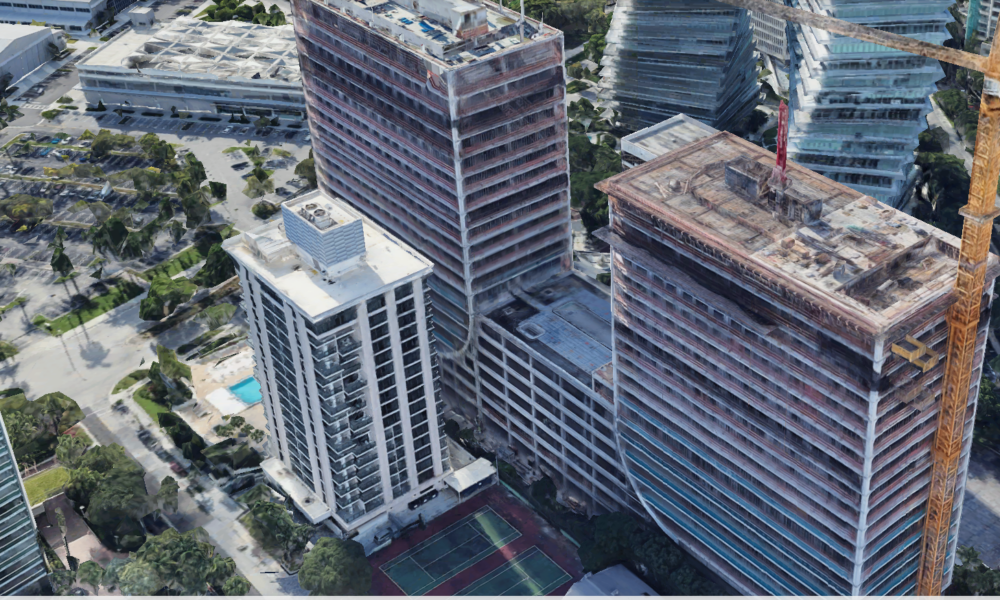
Six years ago, when a development group announced plans to demolish an aging seven-story, 1960s-era apartment building on a narrow, 1½-acre lot along South Bayshore Drive near Dinner Key, few could have imagined what would rise in its place: twin 21-story condominium towers nearly lot line to lot line, linked by a five-story parking garage.
All told, the project — Mr. C Residences, named for its Italy-based luxury lifestyle branding partner — spans more than three-quarters of a million square feet, more than seven times the size of the building it replaced.
Such dramatic increases in scale are not uncommon in Coconut Grove’s high-value real estate market, where developers routinely pursue every increment of height and density allowed under the zoning code.
But a close examination by the Spotlight of how those allowances were assembled raises questions about the City of Miami’s often opaque system of zoning incentives, interpretations and approvals — a system that ultimately shapes neighborhood scale, traffic, infrastructure demands and long-term precedent.
The Mr. C Residences project may offer a revealing case study.
When city leaders approved sweeping updates to Miami’s zoning code in 2009 — known as Miami 21 — they articulated a clear vision for the size and scale of development across the city.
Along South Bayshore Drive, a historically low-rise stretch of the Dinner Key waterfront, that vision was expressed through zoning limits allowing buildings no taller than 12 stories, with a maximum density of 160 living units per acre.
And those limits are still in effect today.
Sort of.
The zoning code, thanks to a steady stream of tweaks, changes and carve outs over the years, also allows exceptions, called “bonuses,” that let developers, under certain conditions, add extra stories, bulk and dwelling units — a measure of housing density — in exchange for contributions that function as a kind of civic trade-off: giving something back in return for building more.
The contributions, known as “public benefits,” are explicitly limited to certain tangible offerings: affordable or workforce housing; land donations or funding for parks and open space; cash payments to city trust funds; green-certified buildings; brownfield remediation; or the dedication of civic or public use space.
But when Coconut Grove-based Terra Group first brought its Mr. C Residences development plans to city zoning officials in early 2018, their proposal faced a problem: the site did not qualify for any height or density bonuses, under the city’s existing code, and was therefore limited to what the more modest base zoning allowed.
And yet Terra Group was undeterred, submitting plans that requested nine stories of bonus height and 75 bonus housing units.
City records reveal why: the developer expected to benefit, a city zoning officer wrote after reviewing the plans, from an unspecified “new amendment” to the city’s zoning code — needing city commission approval but “tabled indefinitely” — that would allow the extra height and density on the site.
Terra Group’s prescience was astute.
Four months later, in September 2018, the Miami City Commission passed an amendment to its code allowing certain properties within three-quarters of a mile of a Metrorail station to be eligible for the bonuses.
As a so-called transit-oriented development, promising, at least in theory, greater reliance on public transit, Mr. C Residences — despite its branding as a high-end, luxury product — would be among the new law’s beneficiaries.
Why Mr. C’s application was evaluated under the updated provisions, rather than the code as written when development plans were submitted months earlier, is unclear.
Zoning officials, including the officer who reviewed the plans, Jake Keirn, now the department’s assistant director, did not respond to multiple requests for comment.
In any case, eligibility alone, by way of its proximity to mass transit, does not unlock the bonus height and density. That requires a public benefit contribution. And what, precisely, constituted Terra Group’s public benefit in the case of Mr. C Residences remains unclear.
Although a provision in the zoning code requires the zoning administrator to certify that a project’s public benefit requirements have been met prior to the issuance of a building permit — spelling out the transaction that secured the bonus — a public records request by the Spotlight produced no such certification nor any documents detailing the scope or justification of the bonus height and density granted to Mr. C.
In a lengthy interview last month, City of Miami Planning Director David Snow confirmed that no such documentation appears to exist.

After reviewing the project file, Snow concluded that zoning officials treated as a public benefit something not expressly listed among the qualifying contributions: unused development potential purchased from historic properties elsewhere in the city and transferred to the Mr. C site.
The interpretation is questionable. The code appears to treat historic density and development transfer as a mechanism for filling the bonus height awarded, not for authorizing it.
The structure of the code reinforces that distinction: historic transfers do not appear among the public benefits that authorize bonus height, but only in the subsection that explains how to account for or allocate bonus floor area after the bonus has already been earned.
City officials said as much early last year in response to a similar bonus height proposal for The WELL, another Terra Group project just a stone’s throw from Mr. C.
“The transfer of [historic] development density is not used to satisfy the Public Benefits,” a city spokesperson explained by email on behalf of the zoning administrator.
While The WELL lies in a different zoning classification, or transect — and while density (living units) and floor area (total square footage) are regulated separately — the underlying code governing both is the same.
In an email exchange with the Spotlight, Terra Group CEO David Martin insisted that historic transfers alone, under the city’s rules, were sufficient to unlock bonus height and density increases. “Terra is 100% compliant with Miami 21,” Martin wrote.
Nevertheless, added Terra Group attorney Iris Escarra in an email, the Mr. C developers also made cash contributions to the city’s Public Benefits Trust Fund — a separate mechanism for satisfying requirements for earning the bonus allowance.
Neither Martin nor Escarra responded to repeated requests for payment receipts from the fund or for documentation showing that city officials certified compliance with the public benefits provisions of the Miami’s zoning rules.
Instead, they point to three city-approved Certificates of Transfer verifying that the historic “sending” properties are entitled to sell and transfer their unused development and density allowances.
But a look at Mr. C’s three transfer certificates, all from 2019, raises their own questions, irrespective of their acceptance as a public benefit contribution.
Under the city code, such transfers may be issued only after preservation officials document a specific improvement plan for the historic property — including proposed updates, repairs, additions, or other work — and verify that the plan is backed by either a valid building permit or a signed construction contract before the transfer is approved.
The rationale, spelled out in rules governing the transfers, is that the program exists to facilitate the restoration, enhancement, and long-term preservation of the city-recognized historic resources.
Such improvement plans would also require approval by the city’s Historic and Environmental Preservation Board (HEPB), a step that several current and former board members say they do not recall occurring, ever — for the Mr. C Residences project or for any historic transfer applications. HEPB’s 2025 annual report, approved by the board on Tuesday, likewise contains no reference to historic transfers.
Whether the Mr. C sending sites had verified improvement plans in place before the transfer certifications were approved — a key requirement under the city code — remains unclear.
What is clear is that without them, and without their completion, the transfers could be voided. Ken Kalmis, chief of the city’s Historic and Environmental Preservation Division, did not respond to detailed questions submitted in writing. A public records request seeking documents supporting the transfer applications has not been fulfilled.
The owner of the historic sites, a company controlled by real estate investor and developer Todd Leoni, did not respond to a request for comment.
But a visit to Leoni’s block and a half stretch of Biscayne Boulevard in Miami’s Upper East Side neighborhood that sold its development rights to Terra Group to supersize the Mr. C Residences projects reveals few signs of upgrades or improvements, even past ones.
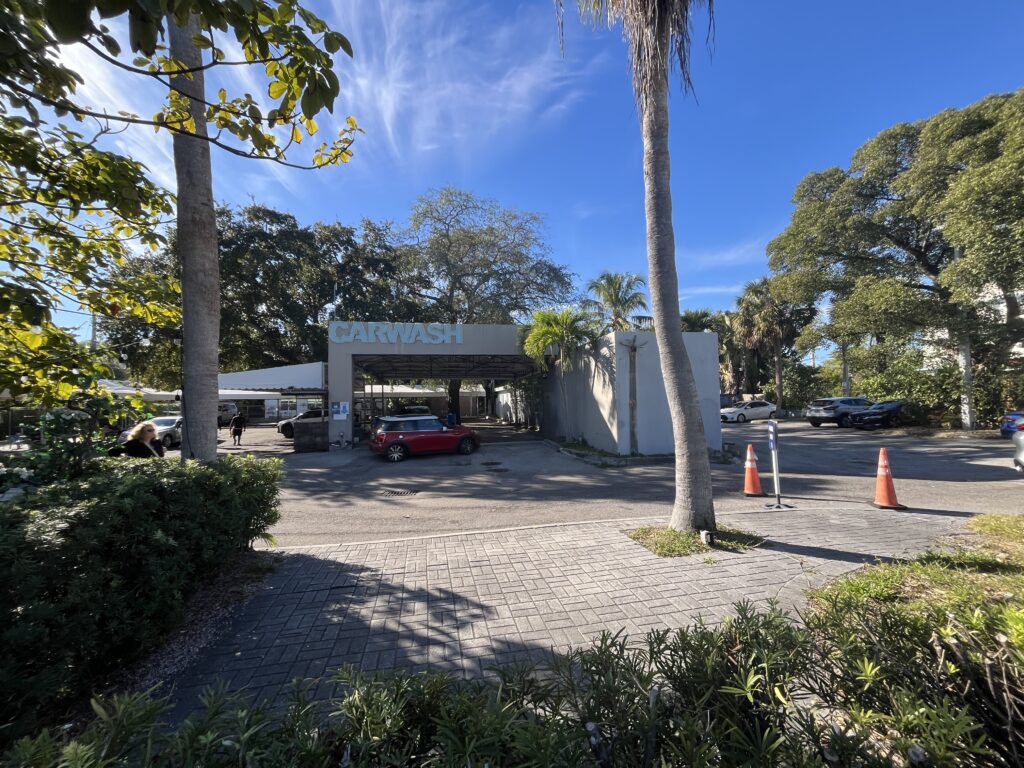
One of the sending addresses is essentially a vacant lot, part of an adjacent car wash operation housed in a nondescript structure built in 2006, according to city records.
Another structure, which houses a restaurant, was also built in 2006. City building department records show no permits for repairs or improvements at any of the five historic sending properties since their sale and transfer of development rights to Terra Group and the Mr. C project in 2019.
Mr. C Residences was completely sold out upon completion in 2024. The towers rise 304 feet, including a rooftop pool, patio, covered bar area, and other amenities bringing the story total to 22, according to City of Miami Building Department records. Units currently listed for resale range in price from about $1.8 million to $10.4 million.















Congratulations to David Villano on this detailed deep dive into the trickery that often happens in the City of Miami.
Mr. Villano is correct; historic preservation TDRs (transfer of development rights) require the seller to restore the historic property.
But Miami is not famous for upholding its own zoning code or covenants when there are developers to please.
Case in point, my lawsuit against the City for breach of a Settlement Agreement and Restrictive Covenant in the MiMo Historic District, which required the owner to preserve and rehabilitate a building.
Instead, the City let the owner demolish the building.
The City claimed “sovereign immunity”, so they don’t have to obey their own contracts. What liars.
The Third District Court of Appeals let the City know they absolutely have to abide by their own contracts.
But don’t take my word for it: https://caselaw.findlaw.com/court/fl-district-court-of-appeal/2176508.html
As for the very high floor-to-floor height of buildings that Mr. Villano mentions, that’s another gift to developers. The standard floor-to-floor height is 10 feet, but Miami 21 lets the first floor be 25 feet high, and upper floors can be 14 feet high.
Our City is a government of developers, for developers, by developers.
Another example: Earlier today Commissioner Damian Pardo sponsored an item to DOUBLE the density in Edgewater, despite the daily gridlock on Biscayne Boulevard, and the City Commission approved it.
It would be so nice if the City cared more about preserving our quality of life than enabling profits for developers.
Elvis Cruz, Morningside
Another head scratcher in the ongoing “development” of our city. I imagine that in 10 years, when Bayshore is a parking lot and US 1 is another parking lot and I-95 is another parking lot, we will have achieved what Miami 21 was set out to do with the help of Terra Group, or is that Terror Group? We should all be afraid of these folks.
EXCELLENT reporting! The height keeps morphing, but always higher. When Miami 21 was first passed around 2010, I recall T5 was “5 stories and 62.5 ft. max. That’s 12 ft each floor with 2 ft “extra” for parapet. At PZAB a year or more ago the discussion was to limit “Enhanced T5” to 96 ft, down from 124 ft max as per the City’s interpretation, after allowing the “1st floor” to be 25 ft high, as is Mr. C’s next to St Hugh.
It’s all arguably “legal” but still stinks. Look at the Intent section of Miami 21 (Article2) and you’ll see there are TWO No. 1 goals: Preservation of existing neighborhoods AND planned incremental accommodation of future development. The balancing of these two goals as envisioned by DPZ (creator of Miami 21) has been gradually erased by unceasing pressure from the development industry at City, County and State. The stink has been mostly camouflaged by the “Affordable Housing Crisis” which is made obvious by asking just one question: “What is the one thing developers of high rises–NOT those in poorer neighborhoods or next to Public Transit—don’t want. ANSWER: Poor people in their buildings.
Most citizens are oblivious to this, unless it’s happening right next door and too late to even protest. Just look at how Mr. C’s Two Towers bought the land just months before the bonus height was magically approved. As for Public Benefits, there has never been an audit of the millions supposedly paid for decades…ever.
Apparently in The City of Miami, Yellow Traffic Signals and Zoning Codes are merely a suggestion.
Does anyone else think Jake Keirn or someone should be fired? Where is the oversight?
Amazing reporting! Thank you for this well written, technical article, which highlights even more rabbit holes for people to continue looking into, auditing these items and with hope, holding our elected and appointed city officials accountable.
Excellent, albeit unsettling, reporting.
If you’re waiting for our new Mayor to put a stop to rampant over-development, you better not hold your breath.
After sitting through Public Comment, where residents spoke passionately against the Olympia theater and Watson Island giveaways, against double density, and the need for improved infrastructure, the Mayor’s only takeaway was that it was clear to her “that City services need delivered in a more rapid manner, especially as we heard today, around permitting”. Time stamp 10:42am
There was only a single speaker representing The Builder’s Association, who discussed the need for expedited permitting. The rest of us were apparently just white noise.
I Remember when the maximum height of a building in Coconut Grove was three stories.
It was only recently when high rises and condominiums, in the greater Miami area could be built with no green space at ground level.
Most all the new high rises placed their parking garage, with swimming pools and greenery on top of their parking garages, in what should have been ground level green space.
They were allowed to do this by giving a Measley $10,000 to the Homeless Trust.
I believe I’m correct in this information. If you don’t believe me, Google it or check with AI , if they’re home and will answer your call.