


The proposal would expand an existing program that allows developers to sell and transfer development rights from affordable housing developments to market-rate and luxury projects – even if no affordable units are added at those locations.
The Miami City Commission will vote Thursday on a proposal to expand a program that allows developers to transfer unused development density from affordable and mixed-income housing projects in certain low-income areas to market-rate or luxury projects elsewhere in the city.
Under existing law, developers of qualifying affordable housing projects who build fewer units than zoning allows may sell their unused development rights. Those rights can then be applied to other projects, enabling developers at those sites to increase unit count — regardless of whether the added housing units meet any affordability requirements.
City officials say the ability to monetize unused housing density can help make affordable housing projects financially viable by providing developers with an additional revenue source.
Currently, only affordable housing projects located within Community Redevelopment Areas or Opportunity Zones — areas targeted for economic revitalization — are eligible to sell unused density. The proposed amendment would expand eligibility to include projects in Neighborhood Development Zones, a designation that applies to less economically distressed areas.
Much of West Coconut Grove falls within an Opportunity Zone, a Neighborhood Development Zone, or both, making projects there eligible to participate under the expanded program as so-called “sending sites.”
The “receiving sites” — developments that can purchase and transfer density — must fall within a mile of transit hubs such as Metrorail stations and along high-volume transit corridors, which in Coconut Grove include SW 27th Avenue, Grand Avenue, Douglas Road and Bird Avenue, among others.
Thursday’s zoning amendment would also lower the eligibility threshold for projects in Opportunity Zones and Neighborhood Development Zones, reducing the minimum number of required affordable units included within a project from 200 to 70 before developers could sell unused density allowances.
The proposal would allow receiving sites to increase density by up to 50% over base-level zoning.
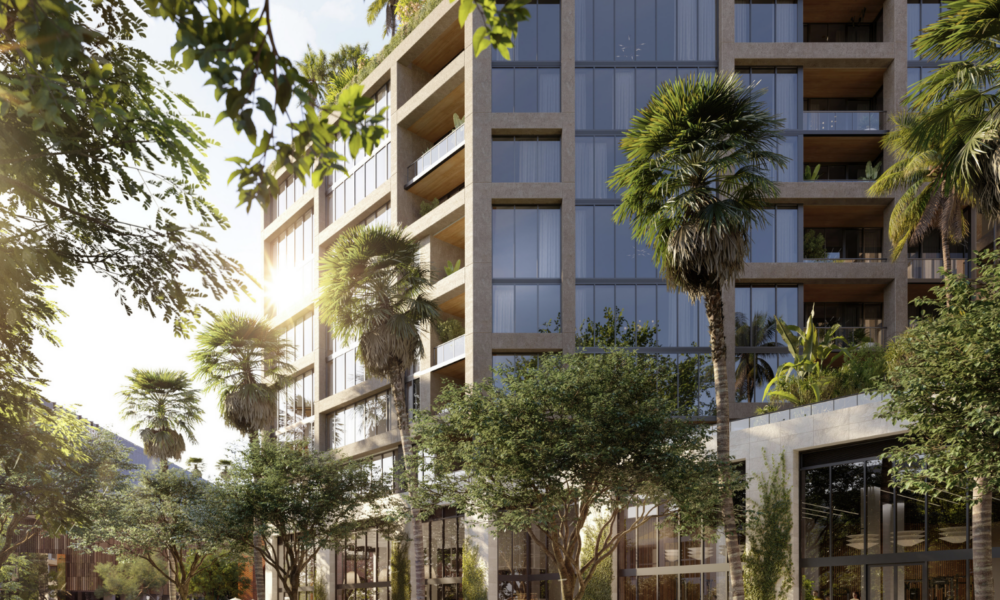
One project that could benefit from the transfer program is The WELL Coconut Grove, a 194-unit luxury condo on Tigertail Avenue in Center Grove. Under existing zoning rules, the site is limited to 129 residential units, but city officials have told the Spotlight that the developer, Coconut Grove-based Terra Group, plans to boost that capacity by the maximum allowable 50% by purchasing enough transferred density to build 65 additional units. Such transfers could occur through either the city’s affordable housing density transfer program or a similar program that allows development rights tied to historic properties to be bought and sold.
City zoning rules already provide a range of incentives to encourage affordable housing construction, including density bonuses that can increase allowable building height and, in some cases, double the number of permitted residential units within a given site.
Such projects typically include a majority of units priced at market-rate with a smaller percentage set at rates affordable to a range of lower-income buyers or renters.
The density transfer program — including the proposed amendment — reflects a calculated wager by city planners that, over the long term, the economic viability of building affordable housing in distressed areas will not be outweighed by the financial incentive to sell and transfer unused density to market-rate developments elsewhere in the city.
The proposal arrives as the city, and much of Miami-Dade, faces an escalating affordable housing crisis. Data from a Bankrate housing affordability study shows Miami’s housing market remains among the least affordable in the nation with fewer than 1 in 200 homes on the market within reach of a typical Miami household earning the median income.
And according to an analysis by the nonprofit Miami Homes For All, the county is short more than 90,000 units affordable to households earning below 80% of area median income, or about $69,400 per year for a single person or $99,100 for a family of four.
The measure is the latest in a series of city-sponsored zoning changes to allow greater building height and housing density throughout Miami. While most have been approved, city commissioners in recent months have begun questioning their effectiveness at easing the affordability crunch, noting that much of the new housing produced with the added density allowances are priced beyond the reach of most buyers.
Read More: Miami Poised to Approve Sweeping Zoning Overhaul
Indeed, while Miami has experienced a construction boom in recent years — leading the nation in multifamily development in mid-2025 — the vast majority of new units have been priced at market-rate or higher. According to an analysis by RentCafe.com, of more than 45,000 apartments delivered in Miami-Dade over the past five years, just 19% were income-restricted affordable units.
















Hell hath no fury, like a pissed off electorate. Based on a midnight change to language on an amendment that bypassed public comment, multiple projects got green lit surpassing building height regulations in Coconut Grove. Your paper just published the outrageous story of how Mr. C’s was able to cram two giant towers spanning the entire lot, from South Bayshore to Tigertail. In that story you explained how the developer (Terra) was able to purchase a historic Mimo structure on Biscayne Blvd (a structure that was supposed to be saved, but was demolished!). This creative loophole will be the demise of our cherished village. I urge Damian Pardo to forcefully push back against this developer give away. I implore those who can attend Thursdays’s commission meeting to do so!
Henrietta Schwarz is sooooo right. Voters are p—-d off. The citizen initiative Stronger Miami has now succeeded in getting the 20K+ petitions signed that to allow the voters to require there be 9 Commissioners instead of the current 5, making them all more responsible for each of their neighborhoods. And also making developers secure 5 votes instead of just 3 to override or pervert Miami 21’s Article 2 clear directive to protect and preserve existing neighborhoods while still allowing growth so long as it follows the Code’s successional zoning rules.
Breaking news: Citizen/warrior Elvis Cruz has filed a grievance with the Florida Bar against mega-development lawyer Melissa Tapanes for intentionally misleading the Commission about a street closing benefitting yet another huge project with development bonuses adjacent to Legion Park. The Commission is voting on that road closing tomorrow. This on top of white-hat lawyer David Winker’s request for a Temporary Restraining Order (TRO) to halt the WELL and other developments on SW 27th Avenue in the Grove. The developers are saying they are still entitled to the 3 additional floors in height under the short-lived and now repealed “Enhanced T-5” zoning change.
That change was passed by the Commission with a sneaky substitute amendment eliminating protection for the Grove. The City screwed up again, as that change to the Code wasn’t advertised as specifically required by State law. That law says such a defective change is null and void.
Are you listening, Commissioner Pardo? We are depending on you.
Henrietta and Andy are right on point, as usual. Please understand what the ordinance that is being proposed to be amended, again to weaken our zoning, already does. The “sending” sites are in areas of moderate or low income, where affordable housing is particularly needed. Instead of leaving alone generous limits on development of housing in those needy areas, the City allows for the transfer of the right to use them to developers of luxury apartments in more affluent areas such as Coconut Grove.
Does this contribute in any way to increasing affordable housing? Of course not. It is just another erosion of the character of our City and neighborhoods to the profit of developers.
This is bad enough, but the proposed amendment, which is facing very substantial opposition here in Coconut Grove, is even worse. It would increase both the areas from which density benefits may be sent (creating many more “senders” available to pluck) and the size of those benefits available for the plucking – the latter by more than 280%. Nothing about this proposed amendment benefits needy families or workers. It is just another gift to luxury apartment developers throughout our City. Its sponsor and the City manager (who supports it) should be ashamed.
Why is it that almost every change to the zoning code is a gift to the developers, allowing them to build more, build higher, build denser, often with less parking.
It’s because developers bribe our elected officials with campaign money – and it’s all legal.
Andy Parrish is right. I filed a bar complaint after developer’s attorney Melissa Tapanes violated the Florida Bar’s Rules of Professional Conduct by falsely testifying to City boards, on video.
It would be so nice if the City of Miami placed a higher priority on protecting neighborhoods and the public instead of
enabling developer profits.
With apologies to all readers, the size of benefits available for plucking from senders by the proposed amendment is increased by a mere 185%, not 280% as I earlier reported. This was done by lowering the threshold for inclusion of “senders” from those with 200 available units to 70 units. That is bad enough, indeed in fact worse, because it inevitably will discourage small scale development in needy areas of the City.
I hate this place.