



The Miami City Commission advanced a proposal allowing developers to double density in exchange for climate funding, even as commissioners voiced mounting unease with the pace, scale, and consequences of Miami’s ongoing development push.
The Miami City Commission on Thursday advanced a controversial new ordinance to double allowable housing density in some areas, but not before signaling its growing frustration over runaway growth – fueled by a cascade of new pro-development zoning laws – that many worry is reshaping the city faster than infrastructure or neighborhoods can absorb.
“We’re so slow at taking action,” said Miami District 5 Commissioner Christine King, urging fellow commissioners to push back against county and state laws now in effect that override the city’s less permissive zoning code. “We need to stand up for our residents… the electorate body should be able to decide what is best for our community.”
In a stinging rebuke, King, the commission chairperson whose district includes the majority-black neighborhoods north of downtown Miami, floated the prospect of suing the state – mirroring one against the county now working its way through the courts — to regain local control of zoning decisions.
Because of the county’s Rapid Transit Zoning provisions and the state’s Live Local Act, which went into effect in 2023, “We don’t have a say in what happens to our community,” King complained. “You can plop down a 55-story building anywhere you want.”
Thursday’s vote moved forward a new law that would allow developers to build twice as many housing units in some areas in exchange for making payments into a city fund for climate-resilience infrastructure – pump stations, elevated roadways, seawalls, rain gardens, and native tree plantings. The measure requires a second commission vote, perhaps as early as early December.
Critics, including a handful who spoke up at Thursday’s meeting, say the measure will encourage population growth in areas of the city most vulnerable to the effects of climate change.
Aaron DeMayo, chairman of the city’s Climate Resilience Committee, a citizen’s advisory group, expressed similar concerns. “Even though in general I really highly support this, I find it somewhat ironic that we’re incentivizing additional development capacity in an area that obviously is already flooding significantly,” DeMayo told fellow committee members at a hearing earlier this month.
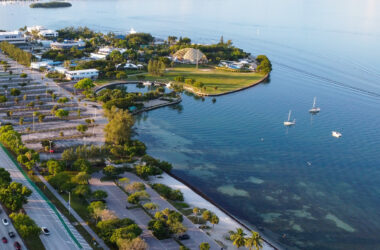
The new “Resilience Trust Fund” ordinance is being pushed by Miami District 2 Commissioner Damian Pardo. The program initially will apply to the Edgewater neighborhood, the Venetian Islands and Watson Island. But under questioning by commissioners, City of Miami Planning Directing David Snow did not preclude an expansion into other areas of the city – something King said she would vehemently oppose within her district.
“If this makes sense for [Pardo’s] district, that’s fine, but I don’t want it in District 5,” King insisted.
King and Pardo did not respond to the Spotlight’s requests for comment.
The measure is the latest in a suite of new city-sponsored laws and tweaks of the zoning code to allow far-greater building height and housing density throughout Miami. Such changes, city zoning officials argue, are necessary to better align Miami’s building allowances with those of the state and county.
Like many of the new laws, the Resilience Trust Fund ordinance will include incentives for affordable and workforce housing, in this instance offering a discounted fee for purchasing the higher density allowances.
But commissioners – again, led by King and with nods of agreement from all but Pardo – seemed to roll their collective eyes when Snow, the planning director, touted the program as yet another tool for addressing the city’s affordability crisis by specifying that some units be reserved for low- or middle-income buyers and renters.
“What’s your definition of affordable?” snapped King. “Because if you say (people earning) 120% of AMI (Area Median Income), no that’s not affordable. And 100% of AMI is not affordable.”
The AMI in Miami-Dade County for a single person is $86,800 and $123,900 for a family of four.
“Let’s be clear, we all deal with developers,” King said. “You might have two units at 60 [percent AMI], two units at 80 [percent AMI] and a hundred units that are not affordable.”
Asked if the new program was even worth the city’s trouble when developers could choose to operate under state and county laws that allow far greater density – but without the cost of paying into a resilience fund – Pardo nodded, assuring commission colleagues that given the option, developers will do the right thing.
“There are some developers that really care about the character of the neighborhood,” Pardo said. “And if they can make money that is reasonable for them, and still fit a model that works for the neighbors in the community, then they’re better off for it.”
















The reporters of “City Commissioners Signal Alarm Over Added Density
— While Approving Another Increase” [11.24.25], neglected to summarize
the actions of our Republican-led Legislature for several recent decades
by usurping local laws and referendums approved by voters as, FASCISM.
It’s just “follow the money.” The magic words since the Pandemic have been “affordable housing.”
And because the easiest, quickest and most profitable way to create “shelter” is high-rise rental apartment buildings, that’s been the path of least resistance. High-rise condos for both the wealthy and non-resident investors have tagged along even more profitably. If our local politicians had any backbone — so that the path of least resistance became harder — you would see developers begin to select a new target with a new mantra. Personally, I’d like to see the next magic words be “neighborhood quality of life through a mix of creative housing solutions” but that’s harder to do. Also, people might start calling me an optimist.
NIMBY. Not in my backyard! That was the response to Commissioner Pardo’s ordinance for Double Density from the other Commissioners. Despite residents speaking out passionately against his proposal, Commissioner Pardo stayed true to his belief, that somehow more is better when it comes to development.
Pardo’s district is the most NIMBY of all, including Coconut Grove and Morningside, each with their own unique character. And we’re proud of it. Our commissioner just consistently votes against the wishes of most of the people who voted for him. We’ll fix that in the next election.
Commissioner Damian Pardo has been such a disappointment to those of us who value our quality of life. He’s been a classic developer’s commissioner.
Doubling density is outrageous, especially in an area that is already overdeveloped. Biscayne Boulevard has been rated “F” by FDOT for at least 20 years, meaning it is congested and beyond capacity. Yet Commissioner Pardo has no qualms about making it worse.