
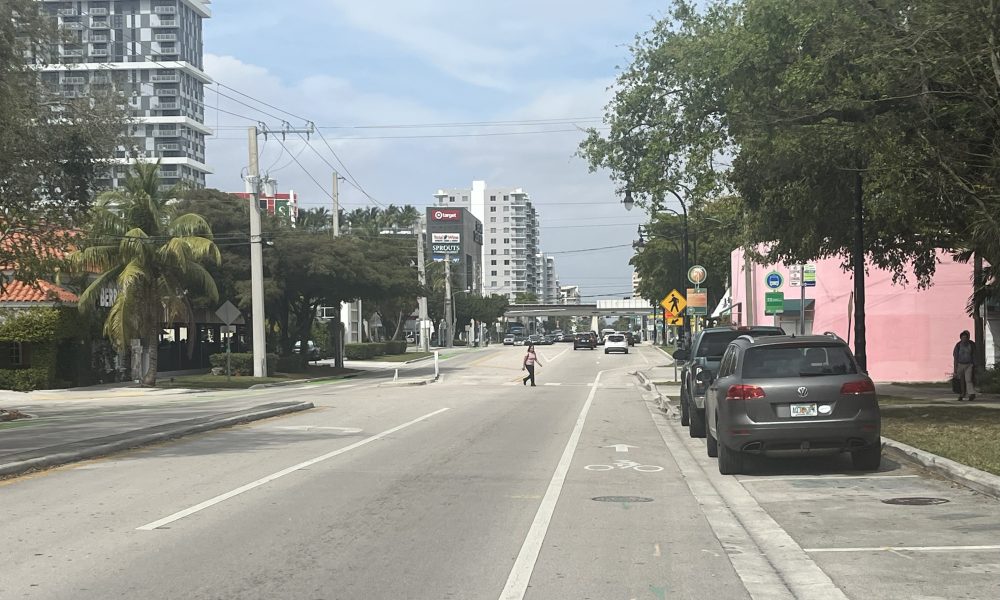


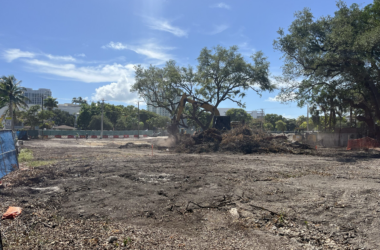
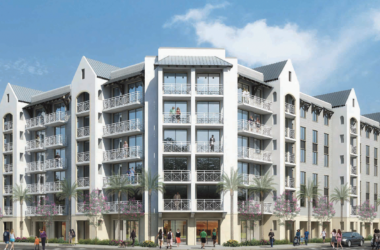
A trio of proposals headed to the City Commission Thursday could dramatically reshape development across Miami – doubling building heights and density near transit hubs and arteries, despite calls for more public input and long-term planning.
The Miami City Commission will vote Thursday on a far-reaching package of zoning amendments that promote taller buildings and far greater housing densities in neighborhoods surrounding transit hubs and the roadways that connect to them.
City officials say the changes – in the form of three separate legislative items – are a calculated bet that encouraging high-population clusters near fixed-rail lines, such as Metrorail stations, will encourage transit use – and reduce automobile reliance.
Roughly half of the City of Miami will be impacted by the new rules.
Thursday’s votes would authorize city planners to apply a new land-use designation — Transit Oriented Nodes – to properties up to a mile from fixed-rail lines; and would

approve a comprehensive program of development incentives – known as Transit Station Neighborhood Development – which would, in some instances, more than double both the allowable building height and housing densities.
The commission will also consider a separate proposal for these so-called “transit zones” that would incentivize workforce housing construction by allowing developers to build taller, denser buildings with far fewer parking requirements.
City planners say the goal is to transform Miami into a “15-minute city” — a place where anyone can reach all of their basic needs – work, shop, play – within 15 minutes, without an automobile.
“This is an idea that has been cooking around the nation for the past couple of decades,” City of Miami Planning Director David Snow assured residents last week during an online presentation on the proposed changes, describing a vision of densely populated neighborhoods throughout the city sewn together by a fabric of bike lanes, pedestrian infrastructure and greenspace. “It’s the compact walkability — walkable development that we’re looking for.”
The new rules – and the broader vision – come on the heels of both state and county laws enacted in recent years that allow developers to sidestep Miami’s more restrictive zoning codes. Snow calls the city’s proposed rules “competitive” with the county’s Rapid Transit Zoning ordinance.
But not everyone is sold on the vision, or the rollout, arguing that land-use and zoning changes as potentially transformative as those up for vote on Thursday should come with far greater scrutiny and resident input. Indeed, the proposed legislation, while years in the making, according to planning staff, had been under wraps until its mandatory review, in May, by the city’s Planning, Zoning and Appeals Board (PZAB).
City staff have acknowledged that the long-term impact of the proposed legislation is unclear. When a skeptical PZAB board member asked if the city had conducted modeling to predict population growth spurred by the changes — and its impact on traffic and infrastructure — Assistant Planning Director Sevanne Steiner shrugged.
“Right now, I have no tools to be able to do that,” Steiner told the board. “There’s nothing really within our comprehensive plan, other than a few pieces of goals, policies, and objectives, and there’s nothing really in the Miami 21 [zoning code]that allows me to do that type of analysis.”
Such uncertainty has not been lost on residents and civic groups, which have been pressing city officials to delay Thursday’s votes.
“Rushing through dense legislation of this magnitude — without true public participation — is simply wrong,” Coconut Grove Park Homeowners Association president and One Grove Alliance board member Marlene Erven wrote to Miami District 2 Commissioner Damian Pardo last week. “I urge you to support a deferral and to help implement a more deliberate and transparent process.”
Erven says she received no response. Through a spokesperson, Pardo declined to comment for this article.
But the pressure campaign has had some success. During an initial hearing on the Transit Station Neighborhood Development ordinance – the most far-reaching of the changes – commissioners agreed to exempt Coconut Grove and the nearby Coral Gate neighborhood from its provisions.
No such exemptions have been proposed for the separate workforce housing ordinance, which could apply to properties within a quarter mile of Coconut Grove’s principal arteries such as Grand Avenue, Bird Avenue, SW 27th Avenue and Douglas Road.
And while commissioners had also agreed to exempt locally designated historic properties and districts, that blanket exemption has been replaced with a requirement that redevelopment under the law’s high-density provisions could occur, but only with commission approval.
Thursday’s vote on the Transit Station Neighborhood Development ordinance includes one other significant alteration from the draft legislation presented to residents, and commissioners, last month.
The law’s enhanced zoning allowances will apply to properties up to a full mile from Metrorail stations or other transit hubs, rather than the originally proposed half mile.
Steiner, the assistant planning director, argues that only by expanding the transit-related development zone to a full mile — along with the sidewalks, bike lanes and other supporting mobility infrastructure – will Miami residents choose transit over their automobile.









Surely this is Exhibit A of city planning malpractice. If the City planners lack the right tools to develop a cohesive, well thought out plan, they should demand, as serious professionals hopefully, the right tools to develop a plan that considers all of the impacts of such a major transformation. Why simply fold their tent with a feeble excuse saying they lack the right tools and put forth a scheme — not really a plan — that is a developers’ dream of unlimited building height and local communities worst nightmare.
And if one reads the ordinance, one clearly drafted to specifically give one developer in Little River an end around on the city’s SAP planning and therefore very clearly draft led by their attorneys (if not with significant input), and not City Planning. Everyone can back into it by researching the developer…
Through a spokesperson, Pardo declined to comment for this article. Through a spokesperson, Pardo declined to comment for this article. Through a spokesperson, Pardo declined to comment for this article.
Time to make the rubber stamp!
Damian Pardo turned out to be to a wolf in sheep’s clothing. Why is he not protecting the Grove? These developers are eating away at everything Grove. Now high rises all over the Grove so that we can become the next Brickell, a concrete jungle. Shame on him! This is what he said when he was elected and somehow his actions do not align… “Our campaign began on the belief that we can do better. We wanted to highlight the corruption and lack of transparency, and undue influence of money that exists in the city. We showed how these moneyed interests are pitted against residents’ needs,” Pardo told Florida Politics by text.
Just like intersection yellow and red lights, Miami’s zoning codes seem to be more like suggestions then the law of the land. No matter what the zoning maybe or how many advisory boards are against a project, it only takes three Commissioners (coincidentally funded their election campaigns by developers) to approve of it. As soon as a developer receives title to a lot they instruct their law firm to lobby for up-zoning to build additional high and density. They are seldom unsuccessful unless citizens with standing are able to take the issue to court and be fortunate enough to have a law-abiding judge hear the case. Consider all the monies that Vizcaya and Grove Isle had to shell out to fight against the efforts of three former Commissioners and Mayor to rezone Mercy Hospital for luxury condos. Thank goodness a wise judge ruled that this was illegal spot-zoning and reversed those efforts. Perhaps it’s time to establish a Citizens Zoning Advocate to help level the playing field.