
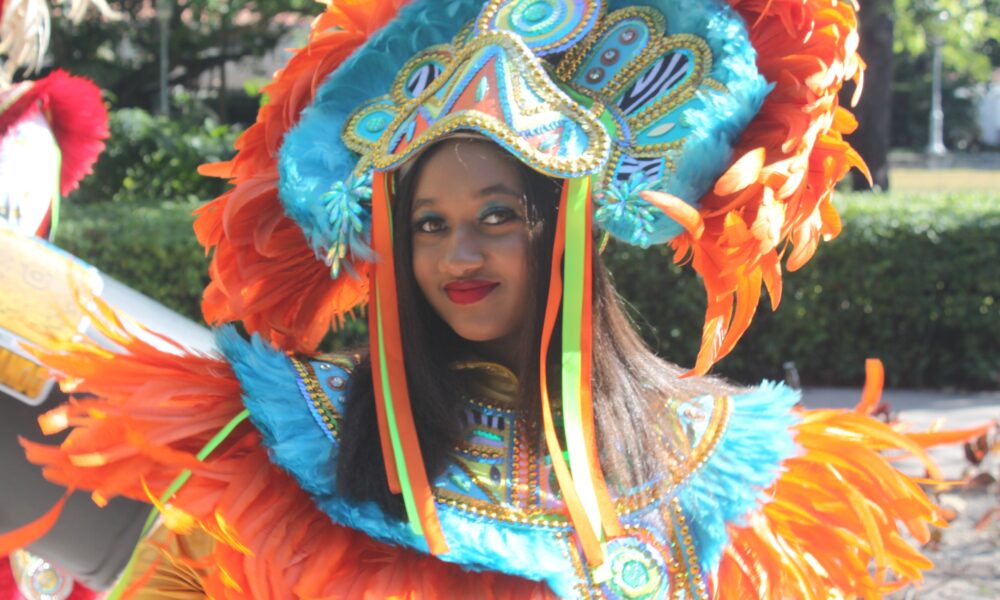



Fourteen-year-old Skai Gay and her 11-year-old brother Christopher will perform this weekend with Fatboi Junkanoo Entertainment at the annual Goombay Festival on Grand Avenue in Coconut Grove.
On a regular school day at Coral Reef Elementary, 11-year-old Christopher Gay looks like a regular fifth grader. He’s soft-spoken, a bit reserved, and an excellent student, in the gifted program and particularly interested in math and robotics.
At a class party, he might even appear shy. He says he would never just bust out dancing.
But put Chris on a pair of stilts, crank up some rhythmic Caribbean music, and he turns into what his mother, Telise Ingraham, calls “a super moko jumbie” – a towering high-stepper with uncanny acrobatic skill and terpsichorean grace.
“Chris has developed a real stage presence, with a talent for interacting with people,” says his mom. “When he’s on stilts, there’s an alter ego there that just comes out.”
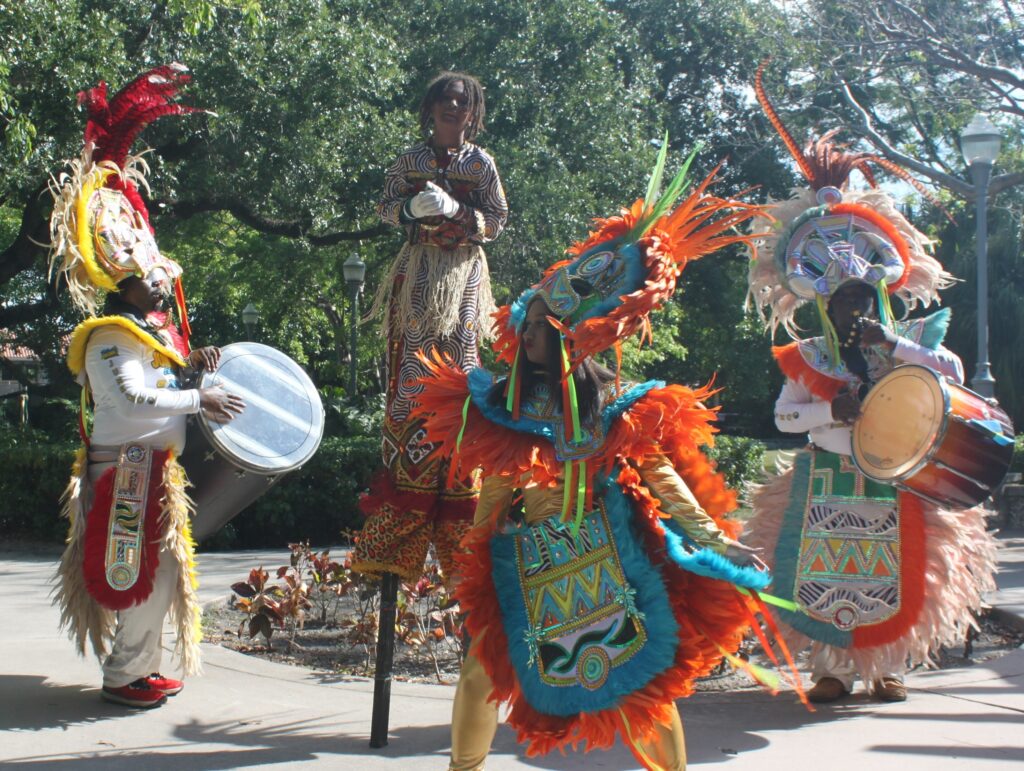
At this weekend’s Goombay Festival on Grand Avenue in Coconut Grove, Chris and his 14-year-old sister Skai – both moko jumbies, as stilt walkers are called – are sure to be stand-out performers in the colorful Junkanoo processions that highlight the street festival and put a spotlight on the neighborhood’s Bahamian roots.
The three-day party, which kicks off Friday, June 5, with Junkanoo performances in Armbrister Park at 6:30 and 8 p.m., features parades, music, elaborate hand-made costumes and favorite Bahamian foods like conch fritters, conch salad and guava duff, a pastry. The party continues Saturday, June 6, and Sunday, June 7, with what’s called a “rush” – Junkanoo parades on Grand Avenue between Douglas Road and Elizabeth Street at 2 and 5 p.m. both days.
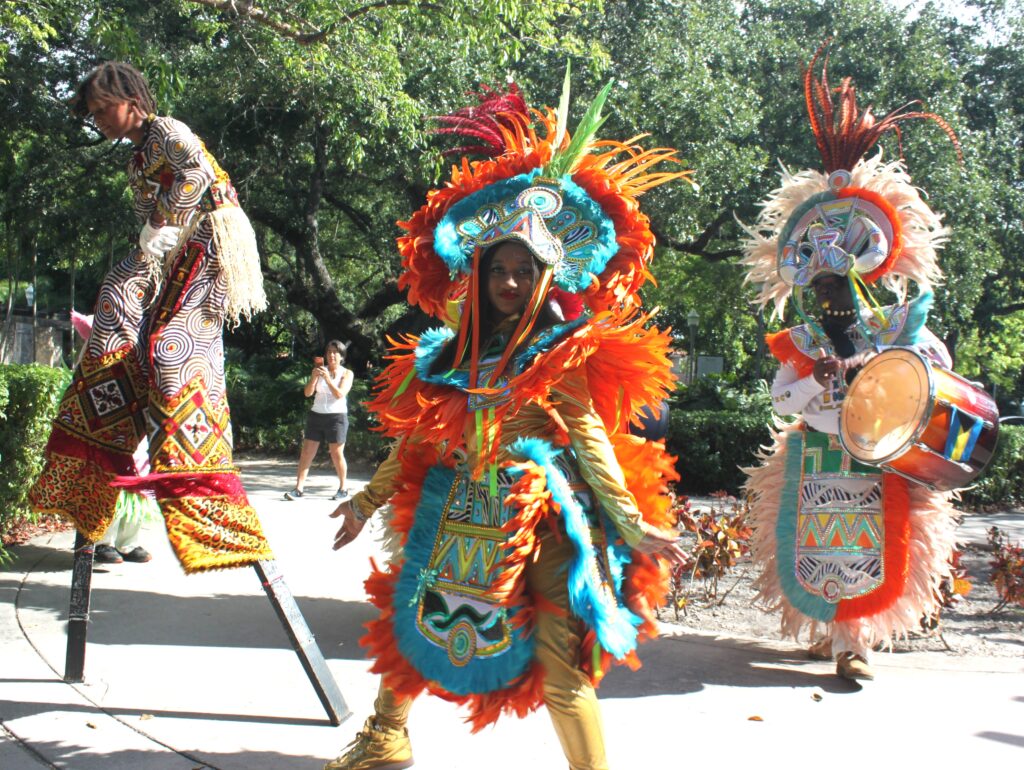
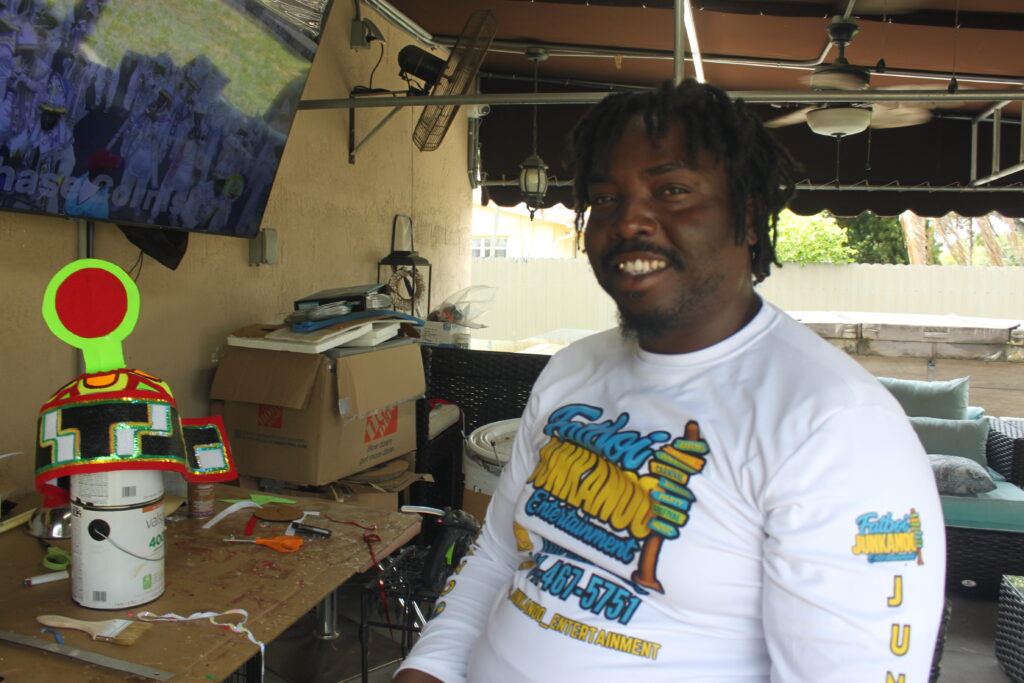
Chris and Skai are members of Fatboi Junkanoo Entertainment, a family business run by Ingraham and her husband Jamal Joseph, who is both a drummer in the marching troupe and the costume maker.
From his backyard workbench in Richmond Heights, he fashions colorful outfits that begin with cardboard and are finished with sequins, beads, stones and feathers. The theme for his Goombay creations this year: Japanese samurai.
Born in Nassau, Joseph, 42, grew up in a family immersed in Junkanoo performance, and was a long-time percussion arranger for the World Famous Valley Boys. The tradition continues with Joseph’s son, Jamaal, 22, also a drummer in the family business.
The engine that powers Fatboi is Ingraham, 52, who is of Bahamian descent and was born and raised in Coconut Grove. She attended Coconut Grove Elementary, Carver Junior High, Ponce Middle School and graduated from Coral Gables High School, where she was captain of the cheerleading team.
For the past 22 years, Ingraham has worked for the federal government at the Krome Service Processing Center, where she is now quality assurance manager.
But her passion is promoting Bahamian culture. “Events such as Goombay bring that culture to people in the diaspora who have never seen it, or are far removed from it,” she says. “It’s a part of Bahamian history to appreciate, to be proud of.”
The importance of Goombay seems particularly acute this year, as the Black population of the neighborhood now called Little Bahamas continues to shrink.
“In light of everything happening – gentrification, families being pushed out (by economics) – this is an occasion to come back and celebrate Bahamian culture. It’s a chance to reconnect,” says Aarti Mehta-Kroll, a Florida International University sociologist who has studied and written about the history of the West Grove.
And, she adds, “The festival is also a way of bridging the divide between east and west Grove.”
Vicky Rivers, who helps pick festival participants as secretary of the organizing committee, said she looks for groups that “show engagement, vibrancy, have that energy. So many people come to Goombay and want to see how well groups perform, hear music that captivates them.
“They want to hear something they haven’t heard before, have experiences they’re going to talk about,” said Rivers.
Stilt walkers always attract a lot of cheers and camera clicks, and, Rivers said, “I hope to see more of them.”
Moko jumbies (also known as “moko jumbi” or “mocko jumbie”) are part of a tradition born in West Africa and brought to the Caribbean by enslaved people. A dancer on stilts is considered a benevolent god able to ward off evil spirits.
In an essay published in Time Magazine in 2024, Bahamas native and FIU graduate student Sasha Wells wrote, “In 1849, Afro-Bahamians were reported stilt walking, which represented a manifestation of a West African spirit protector, and it was referred to as ‘John Canoe,’ a reference to an Akan warrior.
“While there may have been conflation between stilt-walking and rushing, it’s clear how time and time again, Junkanoo provided a space for the Black population to connect with each other, embracing their roots and blending African traditions with an emerging Black Bahamian culture.”
Yet stilt walking has not been part of the annual Junkanoo parades on Nassau’s Bay Street for many years.
That may be about to change.
Fatboi Junkanoo has been invited to take part in this year’s Nassau Junkanoo festivals, which take place on Boxing Day – the day after Christmas – as well as on New Year’s Day. “I am hoping to include stilt walkers this year,” said Ingraham.
Says Wells, “It would be more of an irony if stilt walking, not seen in the Bahamas for years, was to be revived in the diaspora.”
The Gay siblings learned to stilt walk from Vernon Brooks, a native of St. Thomas in the U.S. Virgin Islands, where stilt walking remains culturally central.
He teaches the skill under the banner of USVI Mocko Jumbie Stilt Dancers in Miramar. He does not charge for lessons, and he makes the students’ stilts out of Douglas fir. On his stilts, Chris Gay stands over eight feet tall.
“The individual must want to do it, to have that drive,” said Brooks. “And you have to be fearless. It’s a risky act.”
Part of the training is learning how to fall. “I did fall once,” said Skai, “but only sprained my wrist.”
Stilt walkers also practice keeping their balance in crowded festivals where they might get bumped by energetic dancers. But energetic dancers are what Skai and Chris are aiming for.
“I want to feel that same energy coming back that we’re giving them,” said Skai, who just graduated from Southwood Middle School. “That hypes you up. It feels good when everyone is looking at you in amazement.”
The chair of the Goombay Festival, vonCarol Kinchens-Williams, says she saw Chris, Skai and Fatboi Junkanoo perform May 2 at the opening of the redesigned swimming pool at Virrick Park. “They loved him,” said Kinchens-Williams of Chris. “He dances with the crowd. The kid just showed out.”
Chris has performed a couple of times at school during Black History Month events. He said his classmates were astounded at what he could do while standing on skinny 3 ½-foot sticks.
“They asked me, ‘How do you do that?’” he recounted. “I just say, ‘It’s magic.’”
Goombay Festival is three days of food, crafts, Junkanoo parades and live music to celebrate Coconut Grove’s Bahamian Heritage. Admission is free.
This year’s Junkanoo performances: Junkanoo Riddims at 6:30 and 8:00 p.m. Friday in Armbrister Park; Fatboi Junkanoo on Grand Avenue between Douglas Road and Elizabeth Street at 2 p.m. on Saturday and Sunday; and Miami Generation at 5 p.m. on Saturday and Sunday.
Parking is limited. Kinchens-Williams urges festival-goers to use ride share.
On the eve of the festival this year, the Goombay organizers honored four community members on Thursday at the Leona Cooper Baker Pioneer Luncheon: Dorothy Wallace, whose family is restoring the Ace Theater on Grand Avenue; Loretta Scippio-Whittle, a former public school teacher who helped launch the Freedom School summer program on African-American history at Macedonia Missionary Baptist Church; Bennie Cooper-Chapman, a former public school administrator who was one of the first African-Americans to integrate Jordan Marsh Department Store; and John Demeritte, a Grove native who attended Carver High School and worked as a building manager.
Miami Goombay Festival
Friday June 5 to Sunday June 7. Three days of food, crafts, Junkanoo parades and live music to celebrate Coconut Grove’s Bahamian Heritage.
Junkanoo Jump-Off: Friday 6 p.m. to 10 p.m. at Armbrister Park, 4000 Grand Avenue.
Street Fair: Saturday and Sunday, 11 a.m. to 8 p.m. on Grand Avenue (Douglas Road to Elizabeth Street)
Grand Avenue will be closed beginning on June 7 at 6:00 a.m. and reopen on June 8 at 11:30 p.m.
Admission is free.














The Goombay Festival, like King Mango Strut and Gifford Lane Art Stroll are all much loved events that help celebrate the uniqueness of Coconut Grove. They are truly local events that unlike the Grove Arts Festival are mostly for Grovites.
Glad that funds are still available to help support the Goombay Festival.
Perhaps next years it would be more prudent and possibly less expensive to reduce the event to just one day and just locate it in Armbrister Park, 4000 Grand Avenue, so as not to close Grand Ave, inconvenience drivers and block parking.