
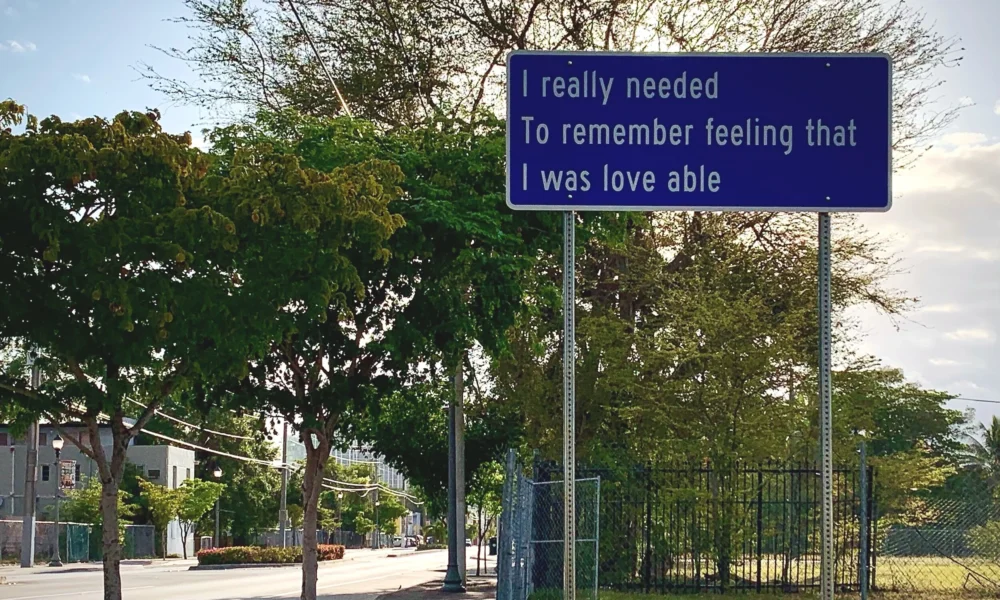



A vivid blue sign with three lines of poetry on Grand Avenue in Coconut Grove continues to puzzle drivers and pedestrians alike, five years after it popped up overnight along an empty stretch of boulevard.
For years as a student at Ransom Everglades, I parked on Franklin Avenue and drove home through the West Grove.
During those drives, I passed the same blue sign on Grand Avenue more times than I can count – a street sign with no obvious purpose, just three lines of text that read:
I really needed / To remember feeling that / I was love able
I never looked further. I just kept noticing it… and wondering.
Grove resident Susan Silver had a similar experience. For years she drove past the sign and never stopped turning it over in her mind. She asked her friends about it. None of them knew, and most had never noticed it at all.
“I knew it wasn’t an official town sign,” she said. “It doesn’t look like anything the town would put up. I kept thinking some random person came in the middle of the night and put it there.”
She asked about the sign at City Hall but never got a response. It wasn’t until she became a regular reader of the Spotlight that she decided to write in and ask if anyone could solve the mystery for her.
That’s when the Spotlight assigned me to the story. Here’s what I found:
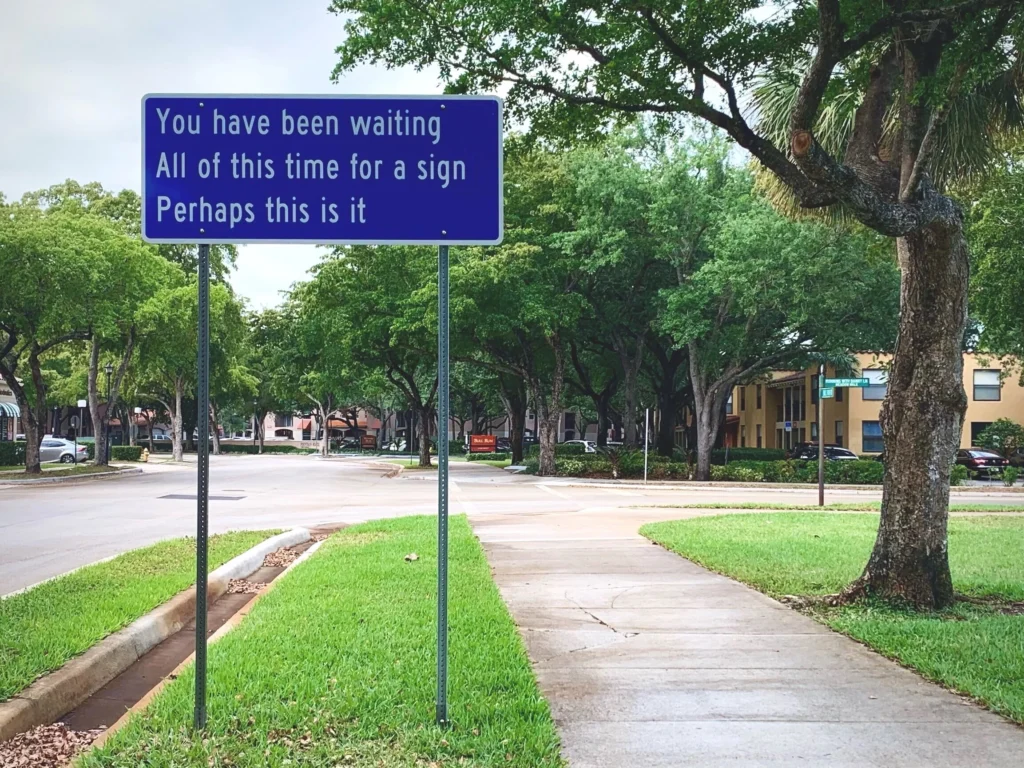
The sign belongs to a nationwide project called Roadside Senryu, started in the summer of 2020 by an anonymous artist who has never revealed their identity, even to the organizations that have commissioned their work.
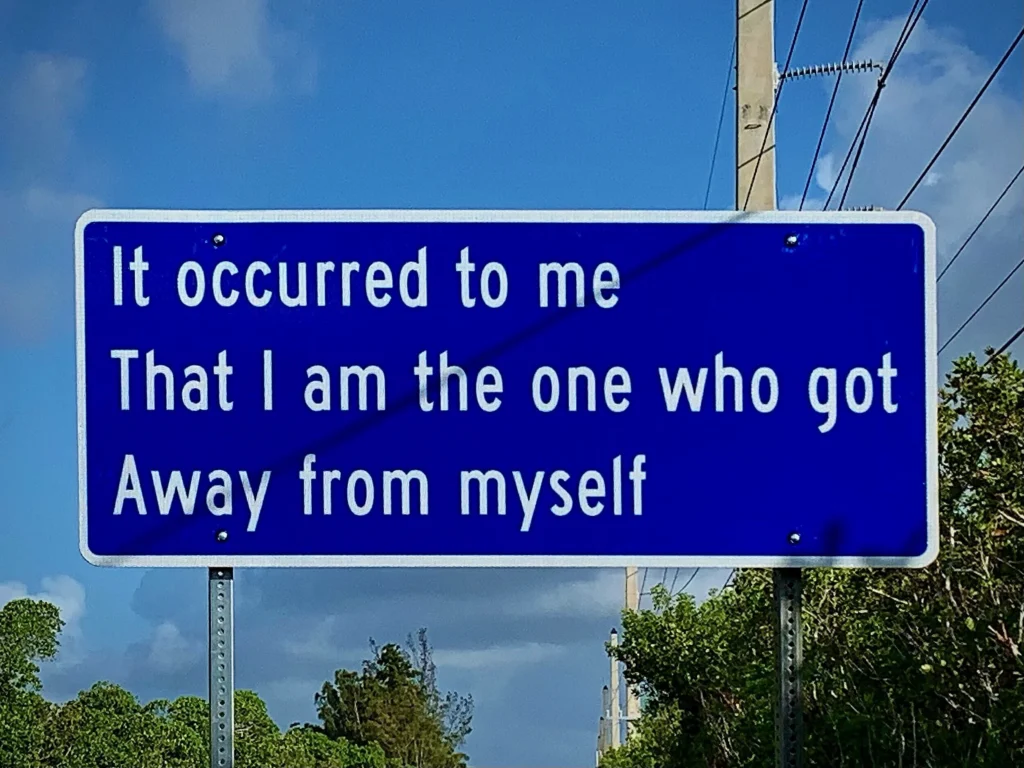
The cobalt blue signs are designed to resemble real highway signs, with white lettering and borders, and each one carries a different three-line poem in the style of senryu, a Japanese cousin of haiku that reflects on human nature rather than the natural world.
A web address on the back of every sign points to a website where each installation is logged with a photograph, the sign’s coordinates and a short recording of ambient sound captured at the site.
The project spread across the country largely through word of mouth and social media, with signs appearing overnight without a permit in dozens of towns and cities.
In April 2021, the Miami-based nonprofit O, Miami invited Roadside Senryu to bring the project to Miami-Dade County as part of that year’s poetry festival, which was still shaped heavily by pandemic-era social distancing.
“We did a lot of projects that were kind of putting poetry in public spaces where they could be viewed weekly,” said Caroline Cabrera, the artistic director of O, Miami.
“We’d become aware of an artist who calls themselves Roadside Senryu. They do this work nationwide, where they go to a place and put up these guerrilla street signs, and it felt really aligned with O, Miami’s mission of making poetry ubiquitous and unavoidable.”
The artist wrote a batch of poems and let O, Miami decide which ones felt right for which part of the county, and where they should go.
Five signs went up: one on Card Sound Road in Key Largo, in the far southern reaches of the county; one in Coconut Grove; one in Doral; one in North Miami Beach; and one in Miami Lakes.
The Card Sound Road sign in Key Largo lasted roughly two hours before it was taken down. As of this year, the sign in the Grove is the only one of the five known to still be standing.
Cabrera does not fully remember why the Grand Avenue poem was matched to Coconut Grove, but she remembers clearly the debate over how it should be punctuated. Some on the O, Miami team wanted the final word to simply read “lovable.”
“I was staunchly against that,” Cabrera said. “I love that you can read it as ‘I’m lovable,’ but also ‘I’m capable of love.’ That break in the word, that unexpected breaking of the word, was something that made it one of my favorites of the poems that went up.”
Silver reads the sign the same way, without having known any of this backstory when she first started noticing it.
“I think it makes me feel like the person who did it must have been going through something,” she said. “And this message is telling them: you know what, I can be [loveable]. I can matter.”
O, Miami describes its core mission as using poetry as a means of empathy and connection, and as a way of grounding people in the place they live.
“We’re as much about Miami and South Florida as we are about poetry,” Cabrera said.
The organization runs year-round programming that it calls “civic publishing,” placing poetry written by South Florida residents into public spaces, alongside education work both inside and outside of schools, and a traditional publishing arm that puts out books.
Its signature event is an annual festival that runs the entire month of April, built almost entirely from ideas crowdsourced from the community each year, including students, teachers and working artists.
The Roadside Senryu signs were one example of an artist-led project folded into that festival, but Cabrera said the heart of the organization’s work is finding occasions for residents to write poems, whether in a classroom or in response to an open call on public radio, and then putting those poems somewhere where people will notice them.
“You don’t have to seek out poetry in a book if you live in Miami,” she said. “You can just be at a stoplight and look aside and see there’s a poem on a sign, or on a storefront.”
That philosophy has extended into more overtly political territory as well. O, Miami is nearing the end of a project called Soy de Todas Partes (I’m from All Over), launched in response to immigration enforcement activity in neighborhoods surrounding the schools where the organization works.
The project pulled from O, Miami’s own archive of poems written by South Florida residents about the immigrant experience and placed them in public spaces across those neighborhoods.
“We were kind of like, well, what do we do in this moment? How do we best use the tools that O, Miami has?” Cabrera said. What the organization had, she said, was years of writing from the community itself, ready to be put back into public view.
Cabrera said part of what makes the Grand Avenue sign unusual, even among O, Miami’s other public poetry projects, is that it carries no branding.
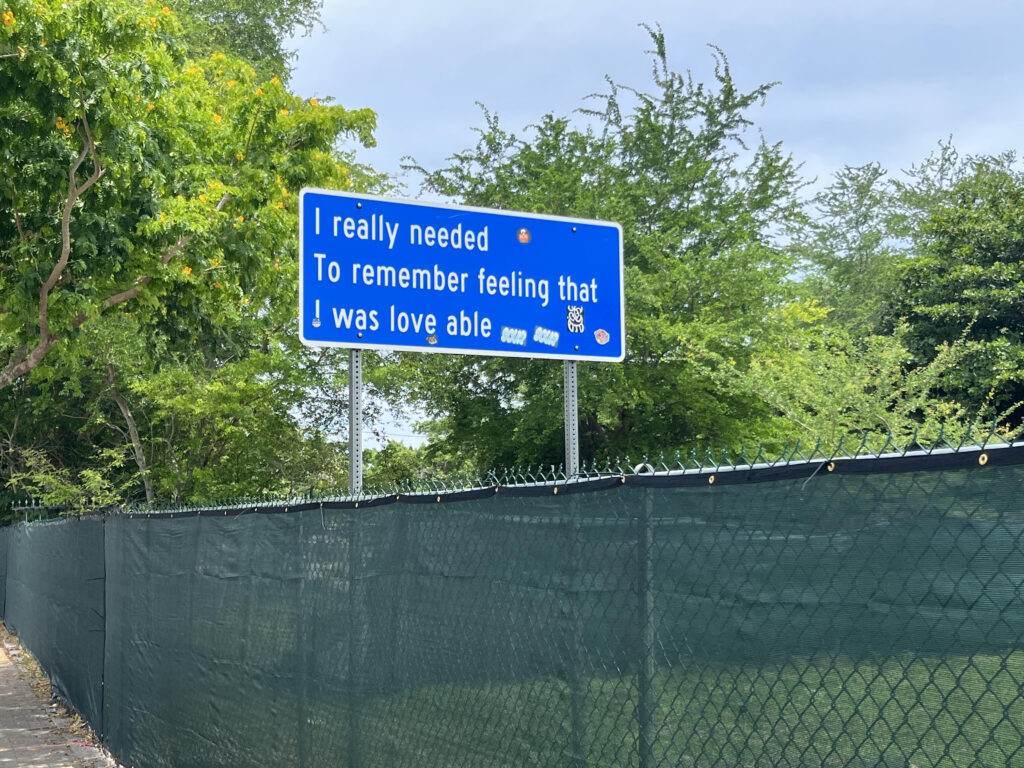
Most of the organization’s public work includes some kind of logo or marker connecting it back to O, Miami. This one doesn’t, which Cabrera thinks is part of why it still catches people off guard.
“When you see this sign in particular, it looks like civic architecture,” she said. “It looks like a traditional street sign, and then its mode of speaking is so different from those. It almost feels surreal. It almost feels like a gift just for you, that you got to have this unexpected moment of joy.”
She considers the whole project a success, including the sign that came down almost immediately. “The fact that it was taken down right away… is, to me, still a kind of success. It was noticed,” Cabrera said.
“But the fact that this one (on Grand Avenue) has had this longevity, that it’s five years out and people are still discovering it and asking questions about it, that’s incredible to me.”
Sofia Martin is a summer intern at the Spotlight. She graduated from Ransom Everglades in 2025 and currently attends Bowdoin College in Brunswick, Maine, where she is majoring in English (creative writing) and government and legal studies.







Thank you. This is why……..this is the reason for local journalism and how important it is.
A cup of coffee and this wonderful article: a beautiful way to begin a day
What a pleasant read! I’ve been curious about this sign for years and asking around never provided answers… now I will be able to share the story and continue the conversation. It would be such a shame if it was removed — but with the ruthless gentrification and development of West Grove, I won’t get my hopes up that it stays. Excellent journalism Sofia and thank you Spotlight for covering this story!
I truly appreciate your reporting; this particular piece was deeply touching.
For years, I have noticed and read that sign nearly every day, believing it might have always been there and that I had simply missed it before. I never spoke to anyone about it, and none of my neighbors ever mentioned it, but I always read it and wondered. The phrase “love able” is exactly what made such an impact on me.