
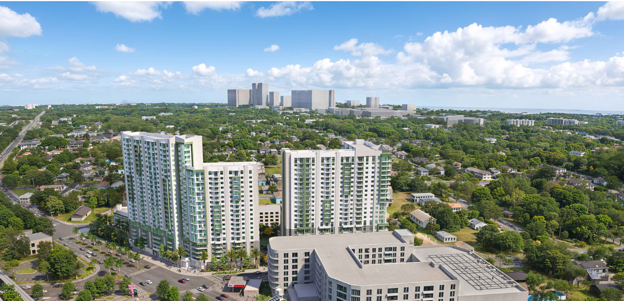




Community leaders sought answers over the weekend about a planned twin-tower housing development on Douglas Road that has doubled in size – without explanation – since it was first approved last year by Miami-Dade County.
Community leaders who were surprised to learn last week that a developer plans to build two massive apartment towers on Douglas Road in the West Grove sought answers over the weekend about the impact of development on their neighborhood.
“How much of this development is going to be done?” Carolyn Donaldson, the vice chair of GRACE (Grove Rights and Community Equity) asked during a meeting of the Coconut Grove Ministerial Alliance on Saturday at St. James Baptist Church.
“We could have 25-story buildings all up and down Grand (Avenue) and Douglas,” she added. “That’s the question: how do we slow that process down, or how do we intervene to make sure the community is being taken into consideration for all of this development that is happening.”
County housing officials, who are partnering with Related Urban Development Group to build two towers on public land at U.S. 1 and Douglas Road, were not on hand to respond, so Donaldson pressed State Senator Alexis Calatayud (R-38) for answers.
Calatayud, who represents Coconut Grove, takes credit for writing – and amending – the state’s Live Local Act, which allows developers to bypass local zoning controls to add height and density to their projects, if those projects include workforce housing.
The Douglas Road project was originally pitched as a single tower with 345 apartments, but the project has morphed – without explanation – into twin towers with 750 units, including an unknown number of subsidized apartments (workforce or affordable). An existing building with 68 units would remain, for total housing of 818 units.
Read more: Second High-Rise Tower proposed for Stirrup Plaza
Calatayud said West Grove residents should ask the county about preliminary plans for the Magnus Grove / Stirrup Plaza development, which reference Live Local and which would add a second 25-story tower with 402 units to the project’s footprint.
“It’s not my job to be an evangelist or apologist for any of these projects,” Calatayud told residents on Saturday.
“This is county-owned land,” she added. “The best thing about that project is your voice is very much a part that matters to the equation. This is not a random private developer. This is the county developing the county’s land, in partnership with a private developer.”
But county housing officials and elected leaders, including Commissioner Raquel Regalado, haven’t briefed residents about the change in plans, and they haven’t responded to multiple requests for information from the Spotlight.
Calatayud acknowledged that Live Local is not perfect. She noted that the law has been tweaked three times since it was first adopted in 2023.
Read more: Governor Approves Expansion of Live Local Act
Asked if the law should be amended again, to require developers who are proposing Live Local projects to come into the community, explain what they’re doing, and get input, Calatayud didn’t answer directly.
“We are going to be taking amendments from residents forever,” she said. “We are going to be amending Live Local forever.”
Calatayud did defend the law, however, saying Live Local is helping to address Florida’s housing crisis.
“What I hear when I’m knocking on doors in the community, whether I’m in the Grove or anywhere else… the No. 1 challenge families are facing is cost of living. And here in the Grove what I hear is that folks can’t afford to live in their homes,” Calatayud said.
“We need to find a way to create enough incentives to build affordable housing, and create a moderate-income housing bracket,” she added.
Live Local requires developers to cap rents for 30 years so at least 40% of a project’s apartments are affordable for working families earning up to 120% of Area Median Income (AMI).
In 2025, the AMI for a single person in Miami-Dade was just under $90,000 ($86,800), so someone earning 120% of AMI would be bringing home about $104,000 a year.
“I know you use this terminology about workforce and affordable, but affordable for whom? When I talk to people, their base salary is not $90,000,” Donaldson told Calatayud.
“If you’re saying workforce affordable, most of these folks still – the units you’re talking about building – are still not going to be able to afford to move into them.”















The Live Local Act is one of the worst laws ever passed in the state of Florida. Shame on Alexis Calatayud for writing and supporting that horrible law.
The Live Local Act is a gift to developers, under the political camouflage of “affordable housing”, at the expense of our quality of life. The Live Local Act should be repealed.
Alexis Clatayud is up for re-election. We have a chance to vote her out in November. Please vote for Richard Lamondin instead. Richard Lamondin opposes the Live Local Act.
You can see his position on the Live Local Act here:
https://www.instagram.com/reels/DaJYIUtBB36/
The Live Local Act is not going to be repealed. It passed the State Legislature 140-6. It is highly likely that the Hillsborough County case challenging the constitutionality of the Act will be dismissed. The Florida Attorney General filed a strong Motion to Dismiss in the case in April.
A better alternative would be for the City of Miami to lobby for an amendment to the Act to limit its application. The current Resolution pending at the City Commission to analyze whether a lawsuit challenging the validity of the Act is a total waste of time and money. That time and money could be better spent by the City Commission adopting a Resolution directing a lobbying effort at the State legislature to limit the application of the Act in its 2027 Regular Session.
Has anyone brought up the traffic issue when school’s in session? As it is, we only have 37th and 27th (and sometimes 32nd) to get out of the Grove proper. Bird is out because of Carver Elementary. 37th has no lead green light, and we all know that feeling. 27th has a lead, but cars back up to Bird sometime. The proposed hi rise on Matilda across from the school is a ridiculous concept. Are the residents gonna use the car-pool lane? You can’t get through the McFarlane intersection when school lets out. They need to hire off duty like Ransom/Carollton. Then we’ve got Tigertail/Mary/Oak debaucle which has become outright dangerous with Sadelles valet (? who ok’ed that?) and an Uber stopping every 3 minutes. What’s to be when the too high “Well” opens at that corner? We are a small village, with small infastructure. We were never platted for hi-rises. This unrestrained growth with no consideration for quality of life for newbies or longtime residents is out of control. Even when I voice my opinion it falls on deaf ears. suggestions very welcome.
This is my biggest worry, the amount of cars that are going to come out of all these buildings. Traffic is already terrible. Not all of the people that will live in these buildings will use public transportation. What a nightmare! Calatayud really has to go. I wonder what was in it for her when she wrote the law because the good the people in the Grove was not it.
Elvis Cruz is right. Calatyud has to go. She continues to avoid questions on the havoc Live Local wrecks on neighborhoods. Lamondin needs to get the votes to shove her out the door.
Senator Calatayud supports Live Local Act because of the “affordable housing” shortage.
Commissioner Regalado and the County do as well.
The State, the County and the City all believe the only cure is high-rise apartment buildings.
Massive high-rises are the fastest to build, and possibly the cheapest (we don’t know).
But will we be happy if we chose that path, and only that path for our City years from now?
How about, if instead of the 800 high-rise units now planned for the twin towers at Douglas and US 1, we build only one tower of 400 units and also 50 two-story 8-unit tree-covered “compatible” apartment buildings scattered throughout the entire Grove? That still comes to 800 new living units.
Impossible? Not if citizens choose that path and their elected representatives listen to them.