
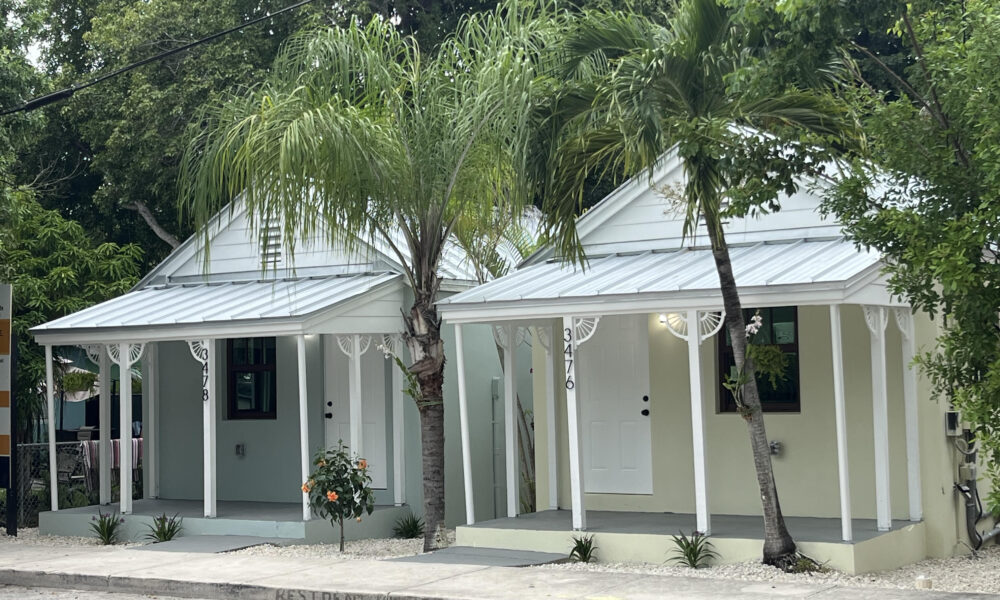



The City of Miami has adopted new rules to allow builders to create small, single-family houses in the style of shotgun homes that once defined parts of the Grove.
One of Coconut Grove’s oldest housing styles could make a comeback under new City of Miami zoning rules adopted last week.
The Miami City Commission voted unanimously on Thursday to allow the construction of stand-alone cottage houses – small single-family homes – on certain residential lots throughout the city.
“Cottages Houses are small, detached homes on narrow lots, designed to fit within existing neighborhoods while making better use of underutilized lots,” according to a staff report prepared by the city’s Planning Department.
In making the change, the city presented the new rules as a response, in part, to current construction trends, which favor the boxy two-story homes that critics call “sugar cubes” and that often clash with the style of the surrounding neighborhood.
“Overall, the amendment aims to reinforce the character of established neighborhoods by encouraging context-sensitive design and supporting a broader range of housing types at different price points,” the staff report said.
The measure also updates the code governing “lot coverage” — the percentage of a lot that can be occupied by buildings — and relaxes setback standards for front porches and porticos.
The new cottage housing standards require homes to be built on lots between 25 and 35 feet wide and between 2,500 and 5,000 square feet in area. Cottages may cover no more than 50% of the lot and must maintain minimum setbacks of 20 feet from the front and rear property lines and three feet from each side property line.
Amanda De Seta, head of development at Dragonfly Investments, spoke in favor of the ordinance during last week’s commission meeting.
Dragonfly, a Miami-based real estate investment group, has two active affordable housing projects underway in the West Grove — one restoring 10 homes with Greater St. Paul AME Church, and another building eight apartments on Mundy Street.
Read more: A Neighborhood Celebrates a Restoration Project
In an interview after the commission meeting, De Seta said the new cottage housing definition will allow developers to build small affordable dwellings much faster than large multifamily developments, which can take years to complete. With proper planning, she said, an affordable cottage project could be built in less than 18 months.
Marcelo Fernandes, a longtime developer and owner of Grove Properties, said he’s been advocating for cottage housing for the past five years, and has worked with the city’s Planning Department on the updated definition for the past year and a half.
“We need housing badly in the Grove, and we need housing badly in the City of Miami, period,” he said. “So how do you bring in housing without having a negative impact on existing residential neighborhoods?”
Cottages, Fernandes argues, offer a solution by creating additional housing options that fit comfortably within the scale of surrounding neighborhoods.
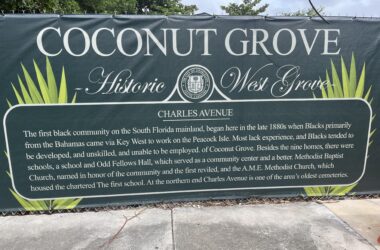
Fernandes also sees cottage housing as a way to honor the history of the West Grove, which was long defined by narrow shotgun-style homes built by Bahamian immigrants in the early 1900s.
“We’re bringing a modern version of the shotgun home back into this area,” he said.
According to the new code, cottages are permitted in two categories of T3 lots. The first includes lots zoned T3-O (permitting single-family homes and two-family duplexes) that are located within a Transit-Oriented Development (TOD) area or Transit Corridor and have access to a public sewer system.
The second includes “non-conforming” T3 lots that met the cottage lot size standards as of May 1, 2026. Those lots may qualify even if they are not located within a TOD or Transit Corridor, provided they have access to public sewer service.
De Seta said she is particularly excited about the new flexibility to develop cottages on non-conforming lots in the Grove, which have long sat vacant because they were too small to meet previous zoning requirements.
“These lots have just been sitting in these neighborhoods and making the neighborhood kind of seem blighted because they were non-conforming before,” she said. “So, I think you can get people into houses much more quickly if we’re activating all of the land that we have.”
Not everyone is on board with the zoning changes approved last week, however.
Morningside resident Elvis Cruz worries that the development flexibility created by the zoning change will give too much leeway to interests unrelated to cottage housing.
“Over the years, I’ve heard a number of City of Miami officials say they like to have ‘flexibility.’ And that’s one of the many games that they play: They purposely word stuff in a vague way so they can interpret it to their own benefit whenever they want,” he said.
Cruz said he’s particularly concerned with the relaxed rules on porches and porticos. Under the updated code, these features no longer count toward lot coverage in T3 transect zones, allowing builders to incorporate larger front porches without reducing the amount of enclosed living space permitted on a lot.
Previously, porticos could only extend up to six feet into the front setback, while open porches could extend up to eight feet. These features are now permitted to extend into up to 50% of the required front setback, provided they are at least three feet deep.
“With this, the developer is actually incentivized to put a front porch that can be 10 feet deep on the front of the house,” Cruz said.
Cruz said the new rules could encourage developers to maximize building footprints at the expense of green space — especially at a time when Grove residents are increasingly concerned about declining tree canopy.
The city states in the ordinance that the changes to the lot coverage definition and encroachment standards are meant to encourage “home designs with varied architectural features, such as changes in depth, materials, and detailing, that create a more visually appealing exterior instead of a flat, monotonous wall.”
Fernandes stressed that the ordinance is a step in the right direction for cottages but added that it will have only a modest effect on the city’s housing supply.
Since T3-O lots already allow for two single-family dwellings in the form of duplexes, Fernandes said that building two detached cottages on those properties simply replaces one type of housing with another, rather than increasing the overall housing supply.
The only new housing opportunities, he explained, would come with previously unbuildable non-conforming lots, which are limited in number.
He said the city should expand the zoning code to allow cottage developments on T3-R lots, which currently only allow one single-family home.
Allowing two small cottages to be built on those properties, he said, would meaningfully expand the city’s housing supply.
“That’s when you’re going to move the needle,” he said.
Fernandes hopes to eventually showcase that potential by building a row of six cottages on a West Grove property he owns.
He’s proposing a demonstration project on three T3-R lots on Plaza Street, where he would build two cottages per lot at what he believes would be a relatively affordable price point.
He said he has asked Miami District 2 Commissioner Damian Pardo and Mayor Eileen Higgins to endorse the demonstration project.
Sinclair Holian is a Spotlight reporter and Report for America corps member covering gentrification and development in Coconut Grove. She joins us through our partnership with Report for America, a national organization that places journalists in local newsrooms across the United States.


















Cottage Housing is a step in the right direction if we want to have any new housing built in our neighborhoods other than “sugar cubes” in T3 Single Family zones (aka transects), or, in T5 and T6 transects, where new Mixed-use commercial High-Rise rental apartments and condos are sprouting like weeds.
Mr. Fernandes is correct that this new ordinance will have limited effect since it is limited to T3-O that already allows duplexes. But Mr. Cruz is also correct that the ordinance could encourage developers to maximize building footprints at the expense of green space, since Miami’s residential realtors still tend to advertise “houses by the pound” like bananas. The more sq. ft, the more dollars they can sell for.
If the City could do it carefully, perhaps on a test basis in some community that agrees, I’d like to see more two-story apartment buildings of 8 to 12 units built among single-family T3-R residences. There are already at least a half dozen of these already scattered throughout Coconut Grove. They blend in nicely and are truly “affordable.”
The overall problem is that the City Commission is too timid to try anything new in single-family T3-R neighborhoods, and understandably so. Voting homeowners are afraid any change will make their homes worth less “per pound.” But they like what’s happening now even less with high-rises popping up everywhere and with more threatened to come closer every day.
Something’s got to give.