


In an effort to attract more affordable housing projects, the Miami City Commission on Thursday will vote on new rules allowing taller buildings, less parking and far more units than currently allowed.
The Miami City Commission will vote Thursday on a sweeping package of development incentives – including significant increases in allowable building height and density — to spur workforce housing construction within proximity to Metrorail stations and along the roadways that connect to them.
The provisions, if approved, would apply to a wide swath of Coconut Grove including much of Grand Avenue, SW 27th Avenue, Bird Road and Douglas Road. Single-family neighborhoods would not be affected.
Perhaps the most sweeping proposed change would allow developers to build twice as many housing units in any given project as current rules permit.
To facilitate the higher housing densities, maximum building height would increase and restrictions would be removed on the number of stories that can be built within that height limit — a significant departure from the city’s current Miami 21 zoning code. The new rules would also permit “micro” housing units as small as 500 square feet.
Using the industry rule of thumb – 10 feet per story – a property now zoned for five stories could rise to seven; one zoned for eight stories could rise to 12; and a site limited to 12 stories, with a proposed height limit of 240 feet, could reach as high as 24.
The proposal also would reduce parking requirements for new construction by as much as 80% over current rules.
City planners say that the higher densities and parking reductions are the carrots developers need to justify the tighter profit margins of affordable housing when compared to market-rate projects.
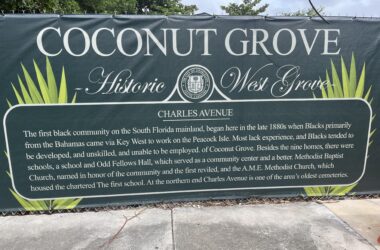
Two early-phase affordable housing projects that could benefit from the new rules are 3710 Grove Landing and Grand Bahamas Place, both in West Grove and both slated for five stories and around 50 housing units – a figure that could potentially double.
(Marcelo Fernandes at Grove Properties, one of the partners involved in Grand Landing, disputed this reading of the proposed change, saying Grove Landing would not be a candidate for bonus density. You can read his letter to the Spotlight at this link.)
Thursday’s proposal would create two separate development programs. Though the incentives for each are largely the same, one – the Attainable Workforce Housing Special Benefit Program – would require 25% of the units to be reserved for households earning 60 to 80% of Miami’s area median income (AMI) and the remaining 75 percent for families earning up to 100% of the AMI.
The other program – the Workforce Living Development Housing Program – would require at least half the units to serve households earning at or below 100% AMI. The rest could be sold or rented at market rates.
The area median income for Miami-Dade County in 2025 is $87,200, meaning an individual or family earning 80% of the AMI could afford to pay about $1,750 in monthly rent or pay $209,000 to purchase a condo unit.
For those earning 100% of Miami’s AMI, rental units would be priced at about $2,200 a month and condos would cost around $262,000.
Unlike other city and county transit-linked incentive programs, which are tied to fixed distances from Metrorail or other rail lines, these new proposals are based on more fluid designations: transit corridors, city-defined Transit Oriented Development (TOD) areas, and the location of transit-oriented developments themselves.
Properties can qualify for either program if within a quarter-mile of a transit corridor, which can be any roadway with high-frequency bus or shuttle service.
The Attainable Workforce program is also available to properties that fall within a city-designation TOD area which, according to city planning officials, is a highly variable overlay whose boundaries can extend up to a mile from transit hubs (virtually all of Coconut Grove) depending on current roadway and bike lane conditions.
But under the Workforce Housing program — which allows up to half of the units to be sold or rented at market rates — properties are not required to be located within a TOD area overlay. Instead, they may qualify if they are “within a half-mile of a transit-oriented development” — a term that, under city planning documents, can broadly refer to individual projects rather than designated zoning districts or transit hubs.
Thursday’s proposal is the latest in a flurry of activity by city officials to revamp its zoning code in the face of intense development pressure, brought on by recent county and state laws that preempt the city’s more restrictive planning rules.
Another proposed package of zoning changes – the Transit Station Neighborhood Development (TSND) program – would dramatically increase building height and density for properties within a mile of Metrorail stations. In some instances, under the new law, buildings up to 12 stories tall could be built on properties now limited to no more than five.
Late last month the Miami City Commission gave a preliminary thumbs up to the changes but with the condition that city-designated historic districts and so-called Neighborhood Conservation Districts – including all of Coconut Grove – would be excluded from the program’s development provisions.
A final commission vote on the TSND incentive program, initially scheduled for this Thursday, has been deferred to July 26.
















I am opposed to higher density of ‘affordable housing’ within the city neighborhoods that are considered premium real estate. These zones, such as Coconut Grove, are already far too over developed while City Planners routinely neglect all the other areas of the city that are in need of improvements simply because of lower profit margins to developers. The City is not even doing the work of representing the best interests of the citizens who pay their salaries nor following their own zoning rules set forth in Miami21, obviously acting solely for the commercial builders and real estate interests.
The State of Florida, Miami-Dade County and the City of Miami, in their never-ending effort to deliver government of developers, for developers and by developers, are now using “transit zoning”, “affordable housing” and “workforce housing” as political camouflage to push for more vertical concrete and density. It’s a Trojan Horse ploy.
Don’t be fooled. There are other ways to provide affordable or workforce housing without destroying neighborhood character and scale. Tax credits can be applied to buildings without up-sizing them. The zoning maps already allow for transit hubs.
Even so, does it make sense to pursue a goal of infinite growth?
Why don’t we hear our government speak of preserving our quality of life? Why isn’t that the rallying cry?
Will adding more and more housing units alleviate problems with traffic? Potable water supply? Sewage treatment capacity? Solid waste disposal capacity? Hurricane evacuation time?
It would be so nice if our government cared more about the people who live here instead of the developers who make campaign contributions.
Elvis Cruz
Morningside
Kudos are due to the Spotlight and Dave Villano for this brave attempt to inform us their readers before our eyes glaze over.
This article reminded me of the Jonestown Massacre of 1978 (Google it) wherein a cult leader induced over 900 people to drink poisoned Kool-aid to attain salvation, and they all died. Our Magic City planners are hawking “… higher densities and parking reductions…(as) the carrots developers need to justify the tighter profit margins of affordable housing when compared to market-rate projects.”
Our neighborhoods, where actual people live and raise their families, will die if we drink this.
Our City Commissioners will offer us 3 brands of poisoned Kool-aid: Attainable Workforce Housing Special Benefit Program, Workforce Living Development Housing Program, and Transit Station Neighborhood Development (TSND).
They’ll say any of these will taste better than the County’s Transit Station Development program or the State’s Live Local Act. They’ll also say “We have no choice but to drink.”
OR…3 of the 5 could stand up and say: “No we won’t do it. We are the premiere city in the State of Florida. We will fight this in the courts as long as it takes and however much it costs. If we lose, we will still win because the fight will take years and citizens in other cities will follow our lead against this insanity.”
Don’t drink the Kool-aid!
I highly recommend this article: “Welcome to Miami’s Housing Crisis
How Corporations Use Housing Laws to Serve Shareholders” by Sofia Scotti
The conclusion seems fair to all sides, NIMBY’s as well as to the likes of George Perez , a.k.a. ‘the king of affordable housing’: “If we are ever to resolve this housing crisis, it will not just be a matter of passing discrete policy, but of changing the way that we think about housing. Housing is not simply an investment mechanism or a way for corporations to turn a profit: It is a human right. As it stands, corporate law prioritizes the ability of corporations to make as much money as possible while offering little protection to community members who rely on the utilities that they provide. But the shareholders of large corporate developers are not the vulnerable people who need to be protected, low-income community members are. Community members deserve to be protected from the greed that will destroy their ability to stay in their communities if it is allowed to flourish. They deserve to be housed.”
Mr. Linn is right that ALL people require decent housing. However, what is being proposed now can well be deemed a gargantuan case of “spot zoning”—up-zoning outside the parameters of the Miami 21 zoning code which was approved by the voters 15 years ago.
“One size fits all” is not the way to go about solving the lack of “affordable” or “attainable” housing. The so-called “missing middle” should not be based solely on serving lower-income residents based on AMI, but also on creating a greater variety of housing types to serve differing usage needs. That could mean anything from Ancillary Dwelling Units (ADU’s), to “soft 2d” montage financing for homeownership, to allowing and subsidizing 3-story apartment buildings scattered throughout zoning districts currently restricted to single-family only, to mid-rise micro-units with communal kitchens and recreational spaces, to expanding the Section 8 housing program, to 12 or more (even much more) story apartment buildings. Even homeless shelters. But these must be carefully planned, situated and distributed throughout each and every neighborhood. And with community buy-in.
It would take time. Yes, NIMBYism (“Not in my back yard”) must be overcome, but cramming high-rise apartment buildings into low-rise neighborhoods cannot be the only solution to the “affordable housing crisis.” It is pure laziness to say that it is. In the short-run, it is merely the cheapest and fastest way. In the long-run, it may well turn out to be the most expensive and destructive.
If we want better, more livable units we should lobby the state and the city to legalized single-stair construction (AKA point-access blocks). A single staircase removes the need for an interior hallway that wastes space and prevents more appealing apartment layouts, not to mention that they’re more efficient. A single-stair floor can use up to 94% of a floorplate, compared to 87% for a two-staircase structure.
Florida’s Live Local Act and Miami-Dade County’s RTZ expansion have sent a clear signal: density is coming, whether or not it fits our neighborhoods. While the goal of addressing affordable housing is urgent and real, the current approach—allowing 12-story buildings to rise immediately beside single-family homes—risks destabilizing the very communities it claims to help.
By contrast, the TSND overlay is a measured, locally informed response. It focuses growth near Metrorail stations, where infrastructure already exists and transit use can be maximized. It builds density with clear guidelines, public input, and affordability requirements. This isn’t surrender—it’s strategy. We can’t keep sprawling west into the Everglades. We need smart density that: - Respects existing neighborhood patterns - Protects sensitive ecosystems and water systems - Creates truly affordable homes for working people - Reinforces our investments in public transit The TSND approach offers an intentional path forward—one rooted in planning, not politics; in community, not chaos.
I understand that change is uncomfortable, but we can’t afford to let fear or nostalgia override smart policy. Let’s make sure density happens in places that are already connected, already walkable, and already urban — not at the expense of the Everglades and other delicate ecosystems.