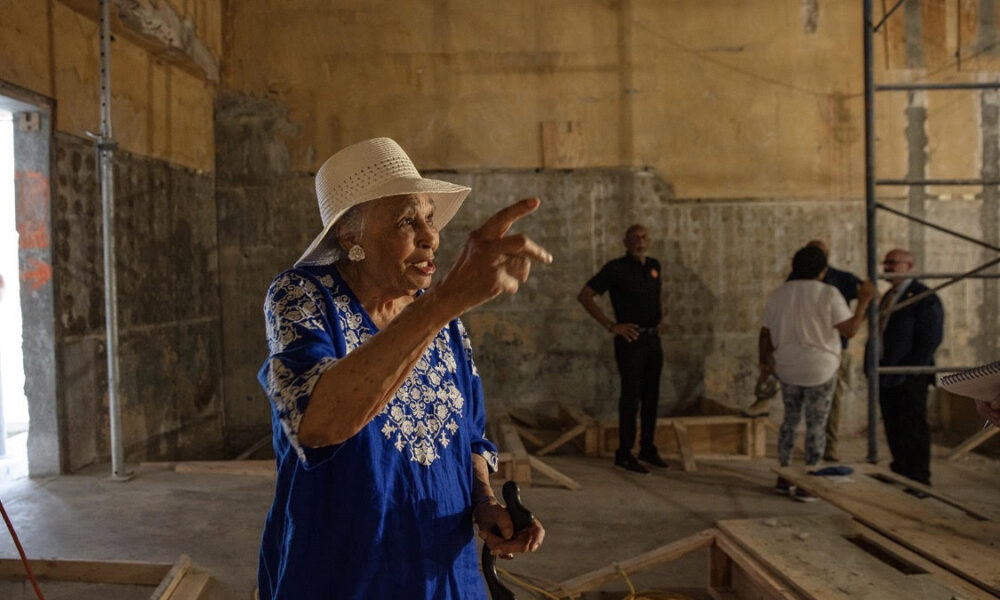

Wallace and her family are working to restore The Ace, the former “colored only” movie house and event space on Grand Avenue, with grant support from the City of Miami and the National Park Service. We caught up with her inside the Ace.
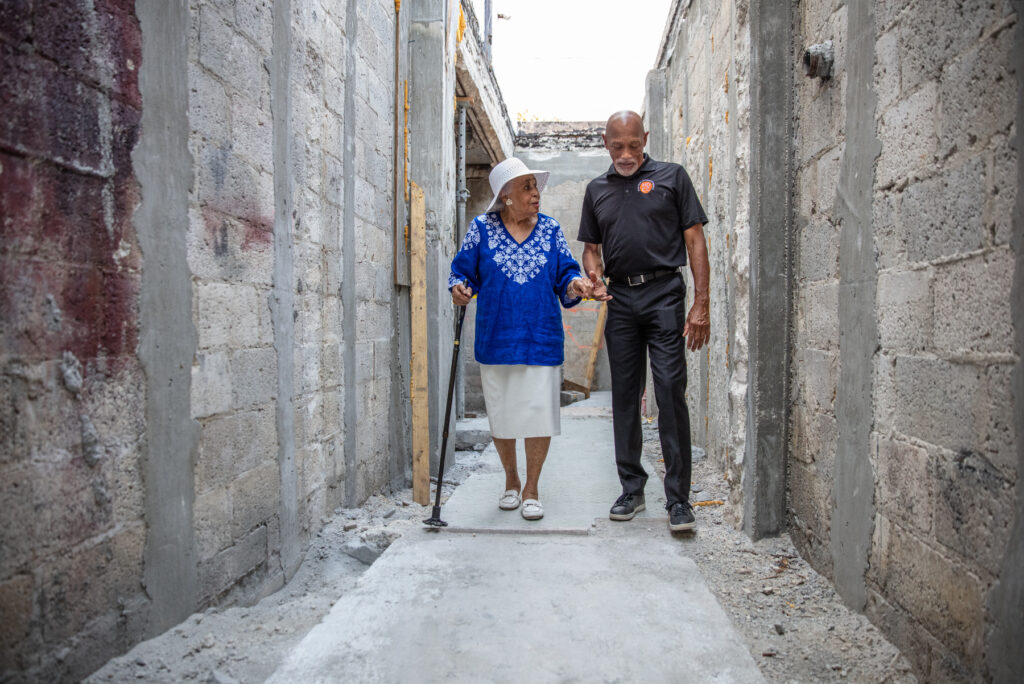
On a recent Tuesday afternoon, Dorothy Wallace walked confidently through a forest of roof supports and skirted mounds of concrete rubble inside the Ace Theater before pausing to recall one of the last times she attended an event in what was once the only movie house and most important event space in Coconut Grove’s Black community.
“It might have been the annual Christmas party,” said Wallace, remembering holiday festivities in the landmark building her family has owned for 47 years.
“Filled with excited kids, Big Ernest, who was the theater’s bouncer, dressed as Santa Claus – the first time many kids ever saw a Black Santa.”
A little more than a month after her 97th birthday, Wallace is not just reflecting on the past but envisioning a future in which The Ace, as the historic theater was known, is again a community center for film, graduation ceremonies, proms, concerts, gospel meetings and holiday parties.
“My hope is that the theater will be the legacy of my husband and my children, and used for the betterment of the community,” she said.
And, in a nod to her age, she added, “And that’s why I’m in a hurry.”
There are promising signs.
Earlier this month the Florida Trust for Historic Preservation named The Ace as one of 11 to Save, a list of threatened historic places designed to “highlight the breadth of Florida’s unique history, inspire unique collaborations and empower local preservationists and community groups…”
The theater, built in 1930, “served as the place for African American moviegoers in the Coconut Grove community during segregation, often running stage shows along with films,” reads the Florida Trust’s citation.
The theater had already been declared historic by the City of Miami in 2014, and by the National Register of Historic Places in 2016. Yet those designations do not guarantee the preservation of a community space that was once the cultural hub of a Grove neighborhood walled off by segregation.
Last month the Miami City Commission approved a $200,000 grant to support the restoration. That funding, along with a grant in 2021 of nearly $400,000 from the National Park Service’s History of Equal Rights program and several other private contributions, gives the Ace Theater Foundation about half of the estimated $2.5 million needed to complete the restoration, according to Denise Wallace, Dorothy’s daughter.
Up next, a fundraising campaign via the foundation’s website.
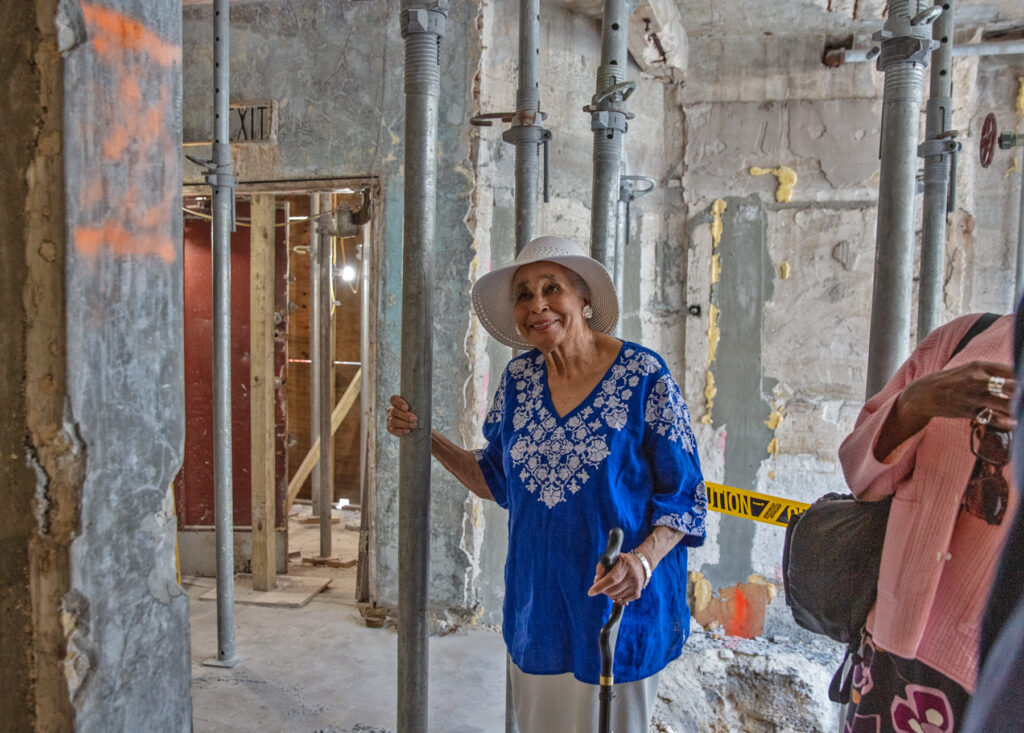
The reopening of The Ace is not imminent. The walls have been stripped to bare concrete, the sloped floor has yet to be leveled, and bathrooms and doors that meet the requirements of the Americans with Disabilities Act are to be installed. Plans call for the construction of a mezzanine and adding an elevator.
But work is underway and progress is visible.
Read more: “A” for Effort: A Restoration Project Advances, One Letter at a Time
After many years in which The Ace remained boarded up and deteriorating, Denise Wallace had an epiphany while working as vice president of legal affairs and general counsel at Dillard University in New Orleans.
In the aftermath of 2005’s Hurricane Katrina, she saw restoration of damaged buildings begin with federal grants aimed at the preservation of theaters through adaptive reuse.
“I told my mom, ‘Let’s think about it. Maybe we should look at preserving it as a legacy to dad and to Miami,’” Denise Wallace said.
Dad was Harvey Wallace, a local businessman who bought the Art Deco theater in 1979, a year after Wometco Enterprises shuttered the property at 3664 Grand Ave. The sale price was $50,000. The Ace had operated for years as Coconut Grove’s “colored only” movie theater serving the Black community during the Jim Crow era.
Harvey Wallace’s plan was to remake the theater into a five-story Bahamian marketplace, with retail shops on the ground floor and apartments above. He died in 1988 at 67, before his plans could be realized.
That’s when the Wallace women took over. They formed the Ace Theater Foundation and launched a campaign to have it recognized as an historical site.
In making the case for The Ace’s designation as historic, Denise Wallace, an attorney and a former co-chair of the Coconut Grove Village Council, called on her own memories of going to movies and graduations in The Ace, which she called “a beacon of pride for a community that has been plagued by dreams deferred.
“For Coconut Grove’s black community, the ACE signifies much more than an aged building,” Wallace wrote in a summary of its historical significance. “The ACE is a part of their lives and fetches good memories of a time when they did not have the mobility to go out and about as everybody else, good memories that kept this community united and strong to fight for equal rights and a better future.”
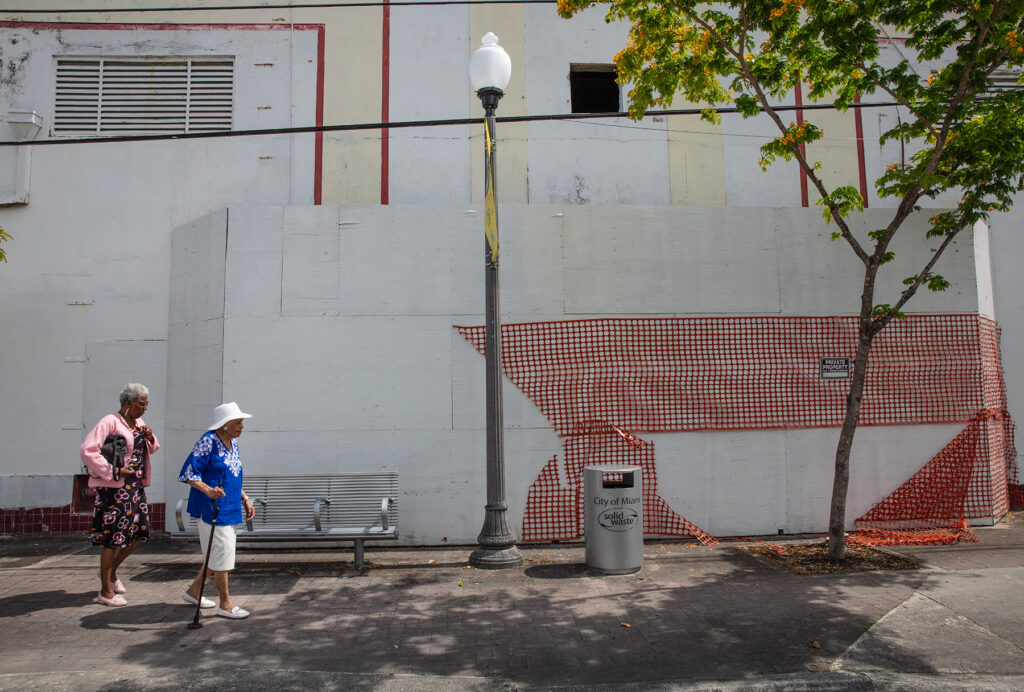
Among her most vivid recollections, said Denise Wallace, was seeing “The Blob,” the 1958 sci-fi classic starring Steve McQueen. “I was so scared when the Blob entered the theater that I left and went home,” she said.
The Ace is not just a construction site; it’s also an indoor archeological dig.
Since the restoration of an historic site involves breaking up the concrete floor and digging into the dirt underneath, local and federal laws require an archeological assessment. Discoveries so far include toys, coins and broken dishware.
“This is important because it is one of the few systematic excavations in the Black Grove,” said veteran archeologist Bob Carr, director of the Archaeological and Historical Conservancy, who is conducting the excavation. “It’s a slice of history – basically a snapshot of Bahamian life in the early 1900s – important in telling the story.”
Eventually, those recovered artifacts could be displayed in the theater’s lobby, Carr suggested.
Dorothy Wallace leaves day-to-day oversight of the restoration project to her daughter. But in a long life of accomplishment, Dorothy Wallace says the return of The Ace to a place of prominence in the lives of the West Grove residents would rank high.
Born into a farming family in Southeast Missouri, Dorothy Wallace attended school in Popular Bluff. She graduated from segregated Wheatley High School, where she was class valedictorian. In 1947 she enrolled at Lincoln University in Jefferson City, where she met her future husband.
Harvey Wallace, a World War II veteran who was born in Georgia and raised in Coconut Grove, was studying journalism on the GI Bill. He was smart, outgoing and ambitious, said Dorothy Wallace. They married in 1950.
Like his wife, Harvey Wallace taught school for many years, and also worked with the Episcopal Church to supervise programs to help troubled youth in Liberty City. He also became a recruiter for Eastern Airlines, and was credited with increasing the ranks of Black pilots, flight attendants, baggage handlers and maintenance workers.
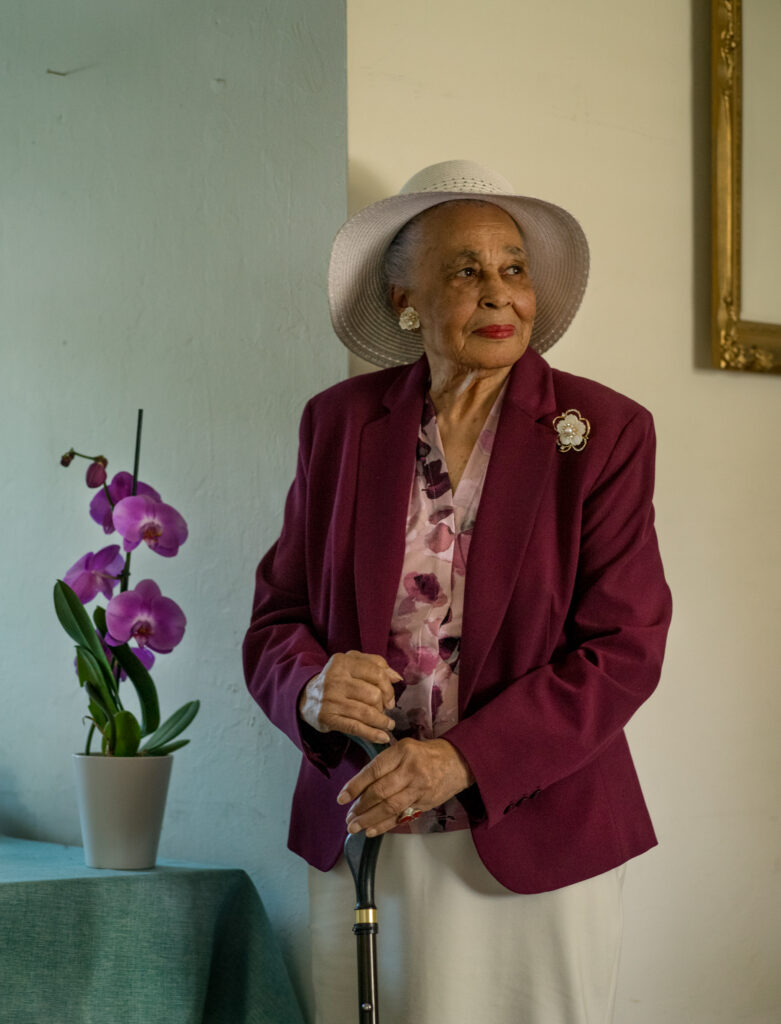
Wallace also possessed a vibrant entrepreneurial spirit. He was the first Black man to own a Burger King franchise in Miami. He bought and ran a liquor store. He expanded his business interests to Belize, where he opened a poultry farm, canning factory and nightclub. He built a house in Howard, a historic, predominantly African-American neighborhood in South Miami-Dade County.
When Wometco approached Wallace and offered to sell The Ace, Harvey jumped at the chance. “I was working in the school system, where we had the credit union, so I got the $10,000 he needed for the downpayment,” Dorothy Wallace said. “I thought it was a good idea.”
While Harvey Wallace concentrated on business, Dororthy blazed her own career path, all while raising seven children. She was one of several Black students to integrate the University of Miami in 1961 and one of two Black women to receive a master’s degree in education in 1963.
For many years, she served as the administrator of the COPE Center South in Richmond Heights, a school for pregnant teens and teen parents which was renamed the Dorothy M. Wallace Cope Center in her honor in 1997. She retired from the school system in 1996 after 43 years of service.
Dorothy Wallace has served on the Healthy Start Coalition of Miami-Dade, the Children’s Trust of Miami-Dade and was a founder of the Florida Alliance of Teenage Parenting, Inc.
Wallace was chosen Woman of the Year in 2026 by her sorority, Beta Tau Zeta, and will be honored again on June 4 along with three others at the Leona Cooper Baker Pioneer Luncheon at Christ Episcopal Church in the West Grove.
As Wallace nears the century mark, “every day’s a new day,” she says.
“I get up in morning and say, ‘Thank God.’ I look forward to some of these projects. To be frank, I could have sold (The Ace), made millions and distributed it to the children. But I have hung on. So, I would just hope to see something come out of that.”