
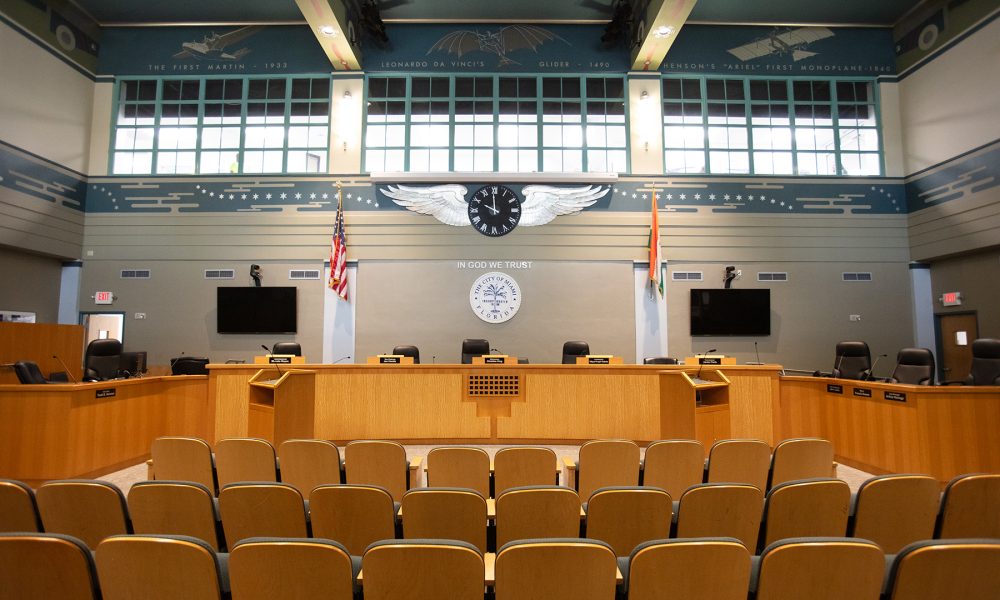


City commissioners on Thursday gave the green light to a major transit-linked development plan, but internal documents reveal last-minute amendments never disclosed to the public.
A sweeping overhaul of Miami’s zoning laws approved by commissioners on Thursday – which supersizes development on properties surrounding transit hubs – included a package of pro-development amendments not publicly disclosed prior to the crucial commission vote.
Over time, the changes could permit significantly greater building height and housing density across wide areas of the city previously excluded from the law — dramatically boosting their land and development value.
The commission’s unanimous vote on what’s known as a “substitution ordinance” could be a violation of state transparency laws, which require local officials to provide public notice of all pending municipal legislation, including additions and modifications that alter the impact of a law.

Thursday’s commission vote gave the go-ahead to a far-reaching program to remake Miami’s skyline by incentivizing dense, mixed-use, high-rise development in proximity to fixed-rail lines – such as Metrorail stations – and along the roadways that connect to them. For instance, new construction on sites once restricted to five stories may now reach twelve, while those capped at twelve could rise above twenty-four.
Roughly half of the City of Miami will be impacted by the changes.
Leading up to Thursday’s vote on what’s been dubbed Transit Station Neighborhood Development, or TSND, city commissioners sought to ease resident concerns over the law’s impact by instructing city staff to revise the ordinance to exclude the city’s Neighborhood Conservation Districts – including all of Coconut Grove – as well as locally designated historic areas such as the MIMO district north of downtown.
But those changes were not the only ones inserted into the legislation.
An internal memo obtained by the Spotlight reveals that two days before the vote, City Manager Art Noriega signed off on a request to add key amendments to the legislation – greatly expanding the inventory of eligible properties; creating a pathway for developers to sidestep minimum lot-size requirements; and allowing developers to modify the plans of large-scale projects without public notice or input, as existing rules require.
The changes also stipulate that the high-density allowances will apply to areas surrounding future fixed-rail lines, not just existing ones.
In a brief email exchange with the Spotlight, City of Miami Planning Director David Snow, who drafted the last-minute amendments, sidestepped the question of legislative process.
“The updates provided in the new substitution memo are reflective of updates requested by commissioners, public input and additional legal clean up,” Snow shared through a city spokesperson.

Noriega and City attorney George Wysong did not respond to detailed emails requesting comment on the substitution ordinance and on possible violations of state notification requirements.
Briefed on the last-minute changes, former District 2 City Commissioner Ken Russell, now a candidate for Miami mayor, says modifications as substantive as those directed by the city manager’s memo, at the very least, would require public notice, and could likely trigger a “reset” – essentially a legislative do-over that brings the ordinance back to the city’s Planning, Zoning and Appeals Board for review and public comment.
“Not good,” said Russell. “There’s a reason that we have ‘government in the sunshine laws’ – that ordinances can’t be crafted in the dark and snuck past the residents.”
This is not the first instance of city officials inserting 11th-hour amendments to pending legislation without public notice.
Two years ago, at the request of then-District 2 Commissioner Sabina Covo, city officials quietly altered the language of a pending zoning ordinance, thus opening up wide sections of Coconut Grove to increased building height and density that were meant to be off limits.
The legislative sleight of hand came to light through press reports earlier this year – fueling months of public outrage – prompting the City Commission in June to revisit the ordinance to remove the altered language.
But the fix came too late for at least one development in Coconut Grove: City officials say the revision will not apply to The WELL Coconut Grove on Tigertail Avenue, which filed paperwork to claim so-called “bonus height” and “bonus density” shortly after Covo’s pre-vote maneuver, and whose development rights are vested under the old law.
The TSND legislation was not the only “substitution amendment” approved by the city commission on Thursday.
Moments prior to the vote on a separate transit-linked zoning initiative that incentivizes workforce housing construction, the city clerk noted that the ordinance under consideration reflected changes authorized by a “substitution memo” signed two days earlier. City officials have declined the Spotlight’s request for a copy of the ordinance’s final draft approved by commissioners.
The workforce housing legislation passed unanimously.
Miami District 2 Commissioner Damian Pardo – a key backer of the transit-linked legislative package, who made the motion to approve the TSND legislation and seconded the motion to move forward the workforce housing proposal – declined to answer questions for this article.
But before casting his votes Thursday, Pardo explained to fellow commissioners why he supported the measures. While acknowledging residents’ concerns about traffic and other quality-of-life issues, he said of greater importance is the need to advance a pending project: “The reality is we do have [development] projects where we need to kind of move this forward.”
The comment mirrors an email, shared with the Spotlight, from Pardo’s community liaison, Alexandra Alexieva, explaining to constituents why the commissioner has rebuffed calls to table the TSND item pending an impact study and additional public comment.
“[Pardo] would have preferred to defer both items,” Alexieva wrote, one day before the vote. “However, there is a significant project requiring the creation of a rail station relying on some of these changes.”
Asked to clarify the statements, a Pardo spokesperson said Pardo and Alexieva were referencing a massive mixed-use development project promising, among other things, 5,700 mixed-income housing units on 63 areas of land in Miami’s Little River Neighborhood centered around an as-yet-built fixed-rail station.
“It’s one of the most impactful projects the county has seen,” wrote the spokesperson, sharing a link to an April 2025 news report.
The $3 billion project, led by Coconut Grove-based Swerdlow Group – will rely heavily on the newly enacted TSND provisions. To access them, commissioners, also on Thursday, approved a new transit-oriented zoning overlay for the Little River neighborhood, assigning values – known as Nodes 1, 2, 3 or 4 – that will dictate the high-density development incentives available to each property.
Among the previously undisclosed amendments approved Thursday was a doubling of the qualifying radius — from half a mile to a full mile — for properties in Node 2 and 3 to receive development incentives, significantly expanding the number of eligible sites and boosting their value.
Similar transit-overlay designations will be assigned throughout Miami. The one-mile radius qualification, specified in the substitution ordinance, will apply citywide.
The substitution also significantly expanded TSND eligibility by adding all properties within Miami currently zoned D1, or “Workplace” – typically warehouses and light industrial facilities. Little River has a high concentration of such properties. Existing laws generally prohibit residential construction on D1 sites but the revised rules would override those restrictions, greatly enhancing their value.
Much of Little River’s industrial neighborhood is now owned by investors and real estate companies, such as Miami-based MVW Partners and Nashville-based AJ Capital, which, through a partnership, have assembled a 27-acre portfolio of properties in the area, including a number of warehouses and industrial facilities, records show.
Thursday’s legislation becomes law if signed within ten days by Miami Mayor Francis Suarez.
Florida courts have invalidated municipal ordinances on the grounds of failure to comply with state public notice requirements. In 2011 a judge overturned a City of Key West law regulating transient rentals on the grounds of improper public notification. And in 2014, an appellate court sided with a St. Pete Beach resident, voiding a comprehensive plan amendment due to lack of proper public notice and related Sunshine Law violations.

















This horrible, far-reaching, greatly disruptive law was passed in a public-hearing period of only 36 days. The Commissioners did some tweaks hoping to lessen political blow-back, but this is still an enormous upheaval of the Miami 21 Zoning Code; a big fat wet kiss and wet dream for the developers who run Miami.
We can only imagine all the back-room meetings and emails between the developers, their attorneys and minions, and City of Miami officials.
Adding new language only two days before the commission meeting, and therefore not published in the agenda in advance – which is legally required – is another classic example of City of Miami malfeasance. I hope a pro-bono good-guy attorney will rise up and challenge this in the courts.
Especially galling is that a ONE MILE radius around a train station, or even an “approved future” train station, could allow 12 or even 24 story high-rises to ruin the character and scale of our neighborhoods!
And there’s a new twist to the story: The Miami Herald is reporting that Tri-Rail, whose “approved future” train station in Little River is the primary impetus / political camouflage for this horrible law, may be defunded by State budget cuts.
You can read those stories here: https://www.miamiherald.com/news/local/article311433820.html and here: https://www.miamiherald.com/news/local/article311490515.html
It will be interesting to see how the developers and the politicians they own will be maneuvering for tax money to keep Tri-Rail afloat.
Miami, wake up and make no mistake: This horrible law will have far-reaching consequences forever.
It would be great if our City Commissioners would face the facts and stop this evil, greedy madness. But that’s not likely to happen, as our elected officials weren’t even willing to postpone the vote so the public more time to study and respond.
We are living in bad times, as developers run rampant over our laws at State, County and City level.
= = = = =
Thank you, David Villano and CGS, for another excellent, insightful article.
Elvis Cruz
Morningside
When will we start telling the truth about all of the vacant luxury units and offices in Miami? Why do we keep buying developers’ made up arguments for development, affordable housing being the argument of the day. They created this mess and now we’re handing them the right to bury us in more concrete. They’re literally building our graves.
Rome has just as many inhabitants as Miami-Dade County and is the third most popular tourist destination in Europe, seeing as much as 35 million visitors a year, yet they have only 10 buildings 30 stories or higher. Miami has over 150. Rome has fewer than 100 over 10 stories. Miami has over 300, with 50+ stories being common. 4 – 6 stories in the Roman historic urban core is strictly maintained, which is most likely one of the reasons for the high tourism demand. Even around train routes, there are no higher than 8 stories right next to the train.
Miami has an overall vacancy rate of 11 – 14%, which is high, even for a seasonal city. Why are we allowing our city to be used as an ATM machine for developers?
Rome also has affordability issues, but they are caused by the same virus – investment properties that benefit investors, while leaving inhabitants stranded.
I’m not sure what the solution is, as landlords in Rome will often leave units vacant because of rent control. My guess would be rules tied to vacancy rates might be part of the solution, as well as caps on how many units one entity can own (and no shell companies, please).
I’ve just downloaded the Green Building Council Sustainable and Affordable Housing Report and will do some research. But, geez, you would think our elected officials would take some time to research the issue before willy-nilly approving massive zoning changes while we stare down a climate crisis. This stuff can’t be undone.
Thanks for covering this story instead of covering for the Development Cartel as does the major Miami newspaper. One must assume they and the TV stations are on the payroll.