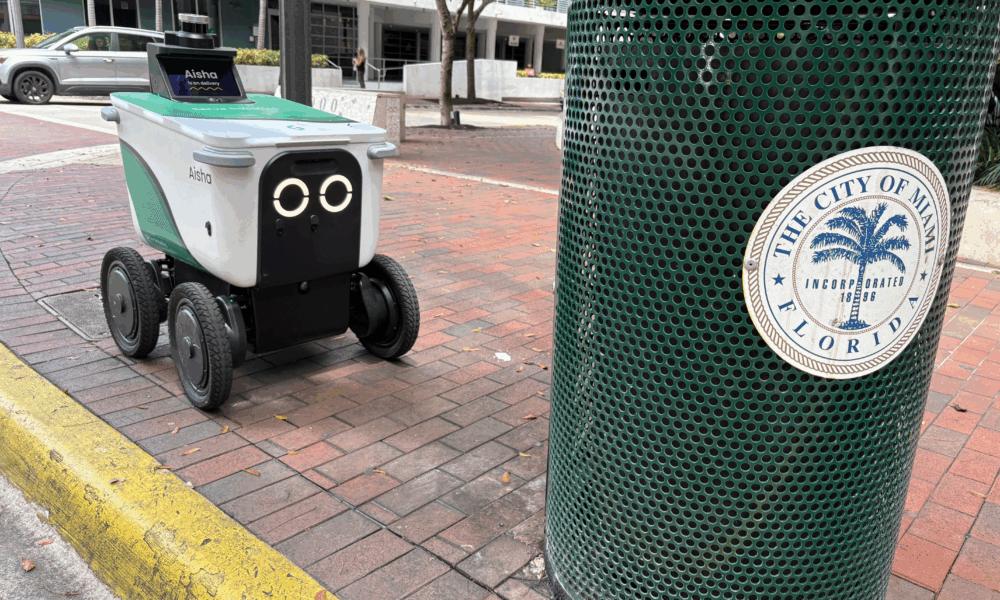



With AI brains, cartoonish looks and relentless energy, food delivery robots are zipping past pedestrians and turning heads in the Grove — and perhaps offering a glimpse of the future for takeout meals.
Alfred Rios had seen food delivery robots before but never in Coconut Grove. That changed early this month when the four-wheeled, autonomous meal containers, with large headlight eyes, zipped along the sidewalks of Center Grove.
“It was one of those weird things where they just showed up randomly and started driving, moving around and delivering whatever they deliver,” recalled Rios, manager of Salt & Straw ice cream parlor at Cocowalk. “We don’t know how they got here or where they came from.”
With little fanfare – and plenty of doubletakes from startled bystanders – robot delivery has arrived in Coconut Grove.

Since late July, San Francisco-based Serve Robotics’ delivery robots have been maneuvering the crowded streets of the Grove’s central business district on behalf of its principal client, Uber Eats.
Yariel Diaz, director of government affairs for Serve Robotics, said the company rolled into Coconut Grove following talks earlier this year with the Coconut Grove Business Improvement District (BID) and Miami District 2 Commissioner Damian Pardo’s office, both of which expressed support for the technology.
Serve Robotics, once an Uber Eats subsidiary that was spun off in 2021 as a publicly-traded company, entered the Miami-Dade market in February, operating mainly in the Brickell-Downtown area of Miami and on South Beach.

In addition to Coconut Grove, the company has launched service in Wynwood, Little Havana and several other Miami-area neighborhoods, according to Aduke Thelwell, Serve Robotics’ vice president of investor relations. (While Thelwell did not mention the City Beautiful, a Serve Robotics robot was recently spotted in Coral Gables as well.)
The company’s entry into Miami-Dade neighborhoods is part of a major ramp-up as the company aims to operate 2,000 robots nationwide by the end of 2025. Other major markets include Los Angeles, Dallas-Fort Worth, Atlanta and Chicago.
“We are under contract with Uber Eats to bring robots across the United States and we have deployed around 400,” Thelwell told the Spotlight. “So, we are at 20% of our contract. That literally means there will be more robots across multiple cities.”
Serve Robotics is not the only food delivery company active in Miami-Dade. Pinkbot (formerly Tiny Mile), which recently relocated its headquarters from Toronto to Miami, has operated its pink, boxy robots with heart-shaped eyes in Downtown Miami and Brickell since 2023.
In a LinkedIn message to the Spotlight, Pinkbot CEO Ignacio Tartavull said the company is pushing into Wynwood, Miami Beach and the northeast corner of Coconut Grove
Other autonomous robot delivery companies with connections to Miami include Kiwibot, a Miami-based company that mainly operates on college campuses.
And press reports have linked California-based robotics company Cartken – another Uber Eats partner – to a delivery service launch in the Dadeland area. Neither company immediately returned inquiries to the Spotlight.
Mark Burns, executive director of the BID, said as far as he knows only Serve Robotics operates in the Grove’s central business district. “I personally like the concept, as it keeps cars off the road and relieves congestion,” Burns told the Spotlight via email.
Serve Robotics delivery robots are about the size and dimensions of a large ice chest. The tech-laden carts are equipped with cameras, sensors, GPS, 360-degree laser imaging, and advanced AI capabilities that allow them to coast along sidewalks with minimal problems.
In more complicated situations, such as crossing busy intersections, they are helped by remote human intervention. When not in use, the robots stay perpendicular to the sidewalk in a spot where there is plenty of room for humans — including those in wheelchairs — to pass by, Thelwell explained.
The robots are purposely made to look cute, cartoonish, and adorable. And it works, Thelwell said. People will often call the company when they think a robot is in trouble. “Children will run up to the robot and want to be friends,” she added.
Serve Robotics robots – which are each given a name – successfully complete 99.8% of their deliveries, Thelwell insisted, which she says is far better than their human counterparts.
And they don’t accept tips, meaning a delivery is cheaper with robots than with humans.
Will the robot invasion mean the end of food delivery jobs? Thelwell argued the opposite, explaining that increasing the affordability of food deliveries will boost job creation in the restaurant and food service industries.
The robots, Diaz said, are limited to a 1.5-mile delivery range. “There will still be couriers,” Thelwell said. “They probably will have more far distance and complex deliveries.”
And because the robots must be maintained, cleaned, up-graded and overseen by a team of humans, their existence creates jobs in places where Serve Robotics operates, Diaz added.
Regardless of their cost efficiency (and cuteness) some complications do arise.
Luis Wakabayashi, manager of Sushi Maki at 2550 S. Bayshore Drive, recalls the first time a robot came a-knocking to pick up a delivery.
“[Uber Eats] notified us on the tablet that a robot was waiting for us,” Wakabayashi recalled. “The robot was not able to go up the stairs, so we had to handle it by going over to the neighboring Starbucks.”
Since then, Wakabayashi said he has had a half-dozen dealings with the robots and there haven’t been any complaints about the deliveries from customers. “They are more patient than the [human] delivery drivers,” he said.
Monty Graves, manager of Fireman Derek’s Bake Shop & Café on Main Highway in Center Grove, was startled by his first robot encounter.
“I was like, ‘What does it mean that a robot is here?’ We went outside and it was ‘okay, cool it’s a robot,’” Graves said.
The human-robot interface is simple: Just walk outside with the food, insert an access code, and the robot takes it from there, Graves explained. “It does a little turn and off it goes.”
Except one time, perhaps the rare 0.2% incident, an autonomous robot got stuck, Graves said. So, the delivery had to be completed by a human.