


For decades a fixture in Coconut Grove’s parks and village streets, the colorful, melodic devotees of Hinduism’s Hare Krishna tradition have faded from view. But a new temple leader hopes to revive the sound and spirit that once defined the Grove’s bohemian counterculture vibe.
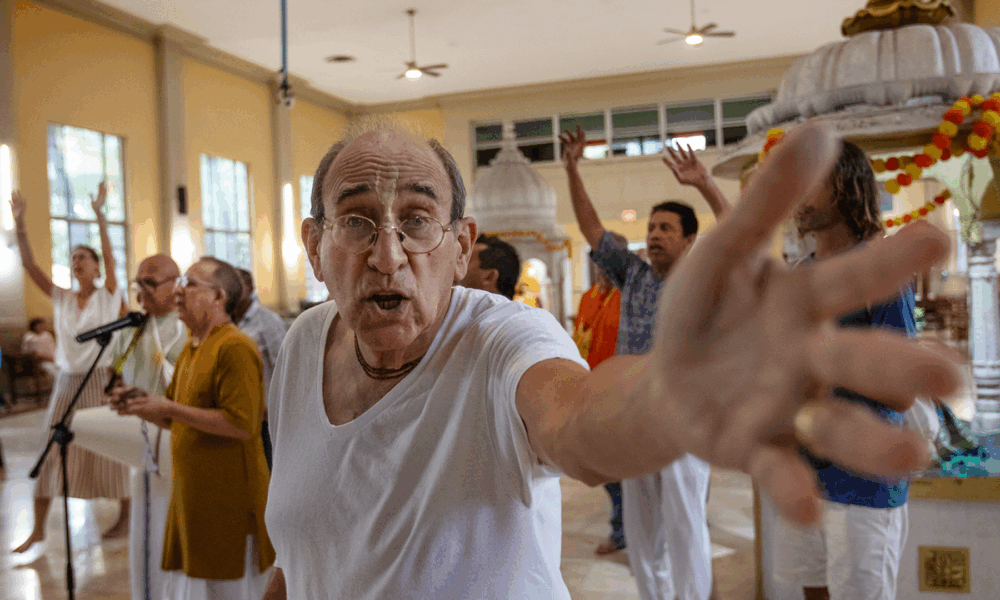
Once they were as visible on the streets of Coconut Grove as traffic, tourists and peacocks are now. In flowing saffron robes, devotees danced to the rhythmic sound of drums and chiming hand cymbals, chanted “Hare Krishna” and handed out religious literature while inviting the curious to discover yoga and meditation.
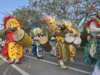
Worshippers pulled a colorful “chariot of gods” down Main Highway each year in the King Mango Strut, and on Saturday nights showed up regularly at CocoWalk and Peacock Park, where they provided free vegetarian food and sold copies of the Bhagavad Gita, a holy book of Hindu scripture.
But then the dancing stopped, and the Hare Krishnas seemed to fade into the Grove’s vibrant, tie-dyed past. Some members moved away, priced out as the Grove gentrified. Others who lived outside of Miami found places of worship closer to home, went online to find classes and ceremonies, or relocated to a burgeoning community in Alachua, northwest of Gainesville.
Under local leadership that emphasized in-house worship over public outreach, the Hare Krishnas’ visibility in Coconut Grove – and its active membership – dwindled.
“They were all over the Grove,” said Alan Cohen, of A.C.’s Icees, the food truck he’s been operating in Kennedy Park for more than 45 years. “I didn’t realize they were still around.”
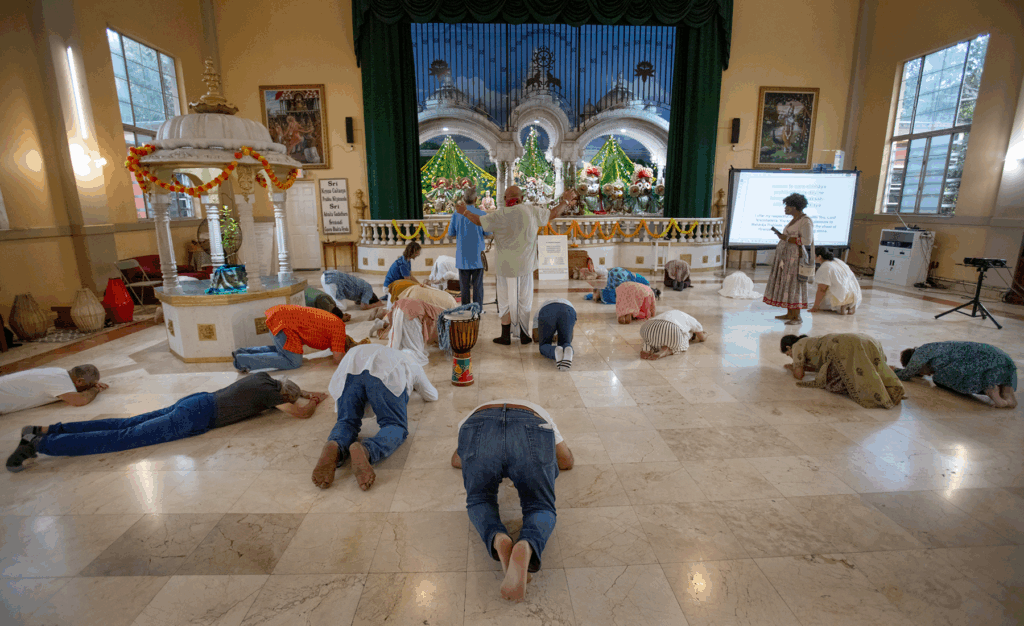
They are. So too is the Hare Krishna temple — a spacious, one-time Baptist church on the corner of Virginia Street and Day Avenue – home to a devout group of adherents with plans to revitalize the local community by returning to the streets with chanting and literature sales, pump up its profile on social media and appeal to young people with programs on college campuses.
Tapped to lead the revival is Edwin Rivera, a 70-year-old native of Bolivia, who dropped out of medical school to become a Hare Krishna devotee in 1976. Known as Govinda Priyah Das, he came here from the Alachua Hare Krishna community and took up his duties as president of the five-person Miami temple board in late May.
“We have this situation in Miami,” Rivera recalls being told by the movement’s Governing Body Commission. “We need to look for something different because it’s not working. Membership was down. The last administration was not reaching its goals. Some standards were not being followed. It was time to make a change.
“You want to try it?” Rivera said he was asked.
Rivera said yes.
The International Society for Krishna Consciousness (ISKCON) was founded in 1965, in New York City, by Indian immigrant A.C. Bhaktivedanta Swami Prabhupada, a chemist and Sanskrit scholar from Calcutta. In the 1970s and 1980s the movement spread around the globe, attracting tens of thousands who agreed to give up alcohol, drugs and extramarital sex, and in some places live communally in ashrams.
Devotees, including men who shave their heads except for a long hank of hair called a shikha, were conspicuous chanting on the streets of major U.S. cities and proselytizing at busy airports.
Funding came from book sales and donations from wealthy devotees, including Henry Ford’s great-grandson Alfred Ford, and ex-Beatle George Harrison. The lyrics of Harrison’s 1970 hit “My Sweet Lord” include the Hare Krishna mantra.
The Miami community formed in the early 1970s, at first gathering in a house on Mary Street. As membership increased, the temple moved to other Grove locations, on Kumquat Avenue and on Center Street, before migrating to the Traymore Hotel on Miami Beach for several years.

The Hare Krishnas returned to the Grove in 1989 after buying the Coconut Grove Baptist Church for $800,000.
(More photos inside the Miami Hare Krishna Temple in Coconut Grove can be viewed in this slideshow.)
“In the 1960s and 70s, ISKCON was one of the biggest faces of Hinduism in America,” said Jonathan Edelmann, a scholar of the religion and a former professor at the University of Florida. But after Prabhupada died [in 1977], some leadership left, and membership fell, he said.
“There are new people coming in, but it’s more of a trickle than a flood,” said Edelmann, a fellow of the International Society for Science and Religion who runs his own consulting service in Gainesville. “They’ve been at a plateau since the late ‘80s.”
Among those who have a decades-long association with the Hare Krishna movement in the Grove is Gary Tanis, known in the community by his initiated name Dharma Dasa. (Devotees take a spiritual, Sanskrit-based name when initiated.) Tanis was studying electrical engineering at the University of Florida in the early 1970s when he, like so many other young people searching for a spiritual home in those days of countercultural upheaval, heard a Hare Krishna disciple on campus.
“I grew up in a Christian background, but there were questions I had,” recalled Tanis, now 73. “If God loves everyone the same, why was there so much inequality in the world? It didn’t make sense.”
The disciple spoke for only 10 minutes, Tanis said, but his words about karma, reincarnation, and Krishna resonated. “He was answering my questions,” he said.
Tanis was sent to Miami as a pujari — a Hindu priest — to care for the temple’s deities, considered other manifestations of the one supreme god, Krishna. He has served as president of the local board of directors and remains a board member.
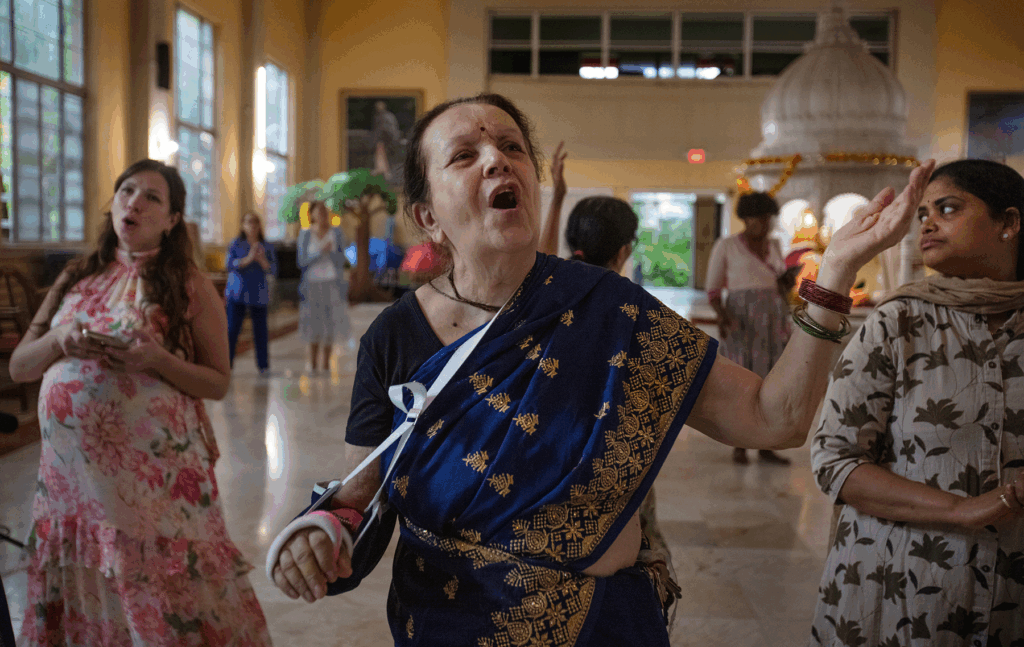
The Grove temple – in need of refurbishing – is open daily, and visitors are welcome. On Sundays, beginning about 6 p.m., devotees gather for an hour of chanting and dancing, and then sit for a lecture, before gathering in a dining hall on the grounds for dinner. About 40 men and women turned out on a recent Sunday when the Spotlight stopped by. Most were middle-aged or older.
“I don’t see a lot of growth lately,” said Ramdeo Gokhulsingh,75, who joined the movement in his native Trinidad in 1979. “We need to get out and chant and focus on bringing people in.”
Another member who has grown impatient with the temple’s retreat from public events in recent years is Oscar Sanchez. Five years ago, he founded ISKCON Miami Outreach with the aim of taking part in the festivals and parades that Grove leadership shunned. Sanchez has already announced on his webpage that he would again enter a float in next year’s King Mango Strut, scheduled for Jan. 4. He said up to 300 devotees could take part.
“We had some people there [at the temple] who were not up to what they were supposed to be doing,” said Sanchez, 70, of previous leadership. “They did not want to participate in the Mango Strut parade. Membership was down to 15, 20 people. We used to have 80 to 100.”
Tanis says he agrees the Grove temple needs to expand its appeal, especially to young people. But he does not support taking part in the King Mango Strut, which began in 1982 as a parody of the Orange Bowl Parade. The annual event attracts thousands of people who delight in laughing along with what organizers call “the weirdest parade people in the universe.”
“I prefer not to bring our deities to that parade. You get invited because there is something strange or weird about you,” says Tanis. “People are making fun. I personally will not go there, but many will go. It’s individual choice.”
Many longtime members of the Grove temple are encouraged by plans to grow membership. “We have open house every Sunday,” said Naima Bradman, who became a follower in 1978 and handles communications for the temple. “We are available to everyone who stops by. We explain the scripture, show how the average person can apply the concepts of Krishna consciousness, the spiritual goals.
“If we greet curious people, identify their needs, then they can decide.”
There are no current plans to reopen the restaurant the temple once operated on its grounds, but there is a well-stocked gift shop that is open daily, said Rivera.
The International Society for Krishna Consciousness (ISKCON) Miami Temple is located at 3220 Virginia St. in Coconut Grove. The temple’s website, iskconmiami.org, remains partially under construction. For more information see the temple’s Facebook page.
For more photos from the Miami Hare Krishna Temple in Coconut Grove view our slide show here.