
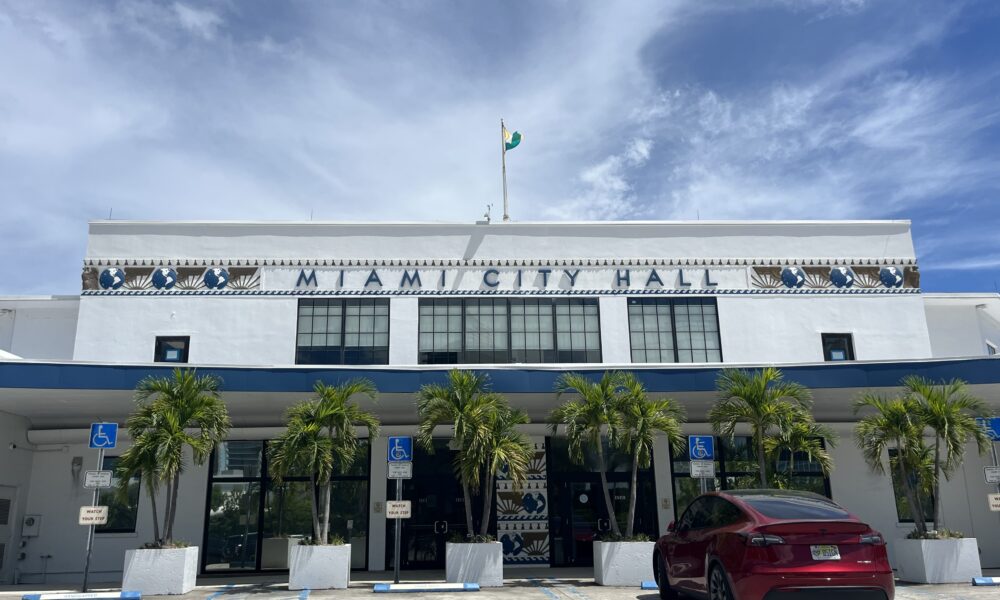




Newly released payroll records show Miami City Manager Art Noriega’s salary has skyrocketed, far outpacing union raises and helping drive a surge in city spending that Miami Mayor-Elect Eileen Higgins has vowed to scrutinize.
On the campaign trail, Miami Mayor-Elect Eileen Higgins repeatedly called for a “deep-dive” to determine “what the heck is going on” with city spending that has nearly doubled in the last five years despite mostly flat population growth.
Higgins, who will be sworn in next Thursday after a landslide victory earlier this week, may want to start with the take-home pay of the very person who oversees the city’s $3.8 billion budget: Miami City Manager Art Noreiga.
Over the past two years, city records show, Noriega’s annual salary has jumped a whopping 38% to just over $525,000. Since taking office in 2020, his pay has increased 69% making him far and away the highest paid municipal employee in Miami-Dade.
The next highest-paid, Miami Beach City Manager Eric Carpenter, earns $375,000 a year, followed by Coral Gables City Manager Peter Iglesias at about $295,000 and Key Biscayne Village Manager Steve Williamson at just under $253,000.

Under Miami’s charter the mayor appoints the city manager, with approval by a majority of the City Commission. Higgins has said she plans to replace Noriega, but not until January at the earliest, to ensure an orderly transition.
Noriega is not the only employee of the 13-person City Manager’s Office to receive sizable pay bumps. Executive secretary Ofelia Gonzalez is due to take home $178,516.71 this year, 31% more than in 2023.
In the same period, Chief Financial Officer Erica Paschal’s salary jumped 44% to $285,935.35. Deputy City Manager Natasha Colebrook-Williams did even better with a 47% increase to $312,641.70.
Noriega and city communications staff did not respond to multiple requests for comment.
The Spotlight obtained 2025 payroll data through a city public records request. Payroll figures for 2023 were sourced from publicly available government employee databases such as OpenPayroll.com.
While overall employment rolls have increased 6.6 percent over the past five years, salaries and wages have jumped 54% to $591.5 million. Employee benefits have increased even further, 62%, to $356.2 million this year.
Together, salaries and benefits for the city’s roughly 5,000 employees account for more than half of the city’s $1.8 billion operating budget and roughly 77% of the General Fund, the city’s primary account for day-to-day government operations.
An overall city spending plan is adopted annually by the five-person City Commission. Such budgets include salary allocations to each city office or department, and Noriega, as city manager, enjoys wide latitude to set administrative pay for about 1,200 non-union workers — including himself and his staff.
In the current fiscal year, pay raises for union employees are set at five or six percent, depending on employee classification.
In what might be a made-for-Miami twist, Noriega was appointed to the city manager’s seat by departing Mayor Francis Suarez after the abrupt resignation, in 2020, of Emilio Gonzalez — the losing mayoral candidate in this week’s runoff election. On the campaign trail this fall, Gonzalez called for spending cuts and budget restraint.


















Growing up, my father used to joke that “the richest guy in Miami, is the maitre d at Joes Stone Crab”
Apparently, he was wrong. It’s the City Manager.
I for one am very concerned that some sort of virus has been unleashed at City Hall that has had deleterious effects on the vocal chords of our esteemed cadre of officials. Perhaps Eileen Higgins should consider some sort of mold remediation as her first order of business!
How do we stop spending ¾ of City property tax revenues on salaries and pensions and start spending more on those things we’ll need for “quality of life” in the years to come, like infrastructure?
The State is proposing a “forced diet” of reducing or eliminating property taxes state-wide.
We shall see if that “one size fits all” idea gets to referendum. Meanwhile, sometime in 2026, Miami voters will get to vote on a Charter amendment increasing the number of Commissioners from 5 to 9.
We need that increase, even though it will mean four more salaries and possibly pensions, too, but only IF the 9 get re-elected. That would mean they are getting approval from the people they represent and know them locally because their offices would be in their districts and not out at the new Freedom Park. New Mayor Higgins said she’ll work to force that.
Staff size for each office could shrink proportionally. Just divide the current budget allocation by 9 instead of 5 remembering how former Commissioners eliminated the 5 NET offices and appropriated that funding for themselves.
Could we get 9 “bad” Commissioners? Maybe. But it’ll be a lot harder for Developer lobbyists to corral 5 votes (and 6 for a super-majority) than just 3.
It’s worth a try.