
Editor’s Note: This story was published on April 23 by WLRN Public Media. The Spotlight is re-publishing this story under a partnership agreement with WLRN.
This August, City of Miami voters might or might not have the chance to decide whether the city should take out $450 million in loans to address what public safety officials and Mayor Eileen Higgins call “deteriorating” conditions at fire and police stations due to a lack of maintenance.
The decision of whether to put the proposed bond funding on the August ballot was supposed to take place at last week’s commission meeting. But after heated debate by residents and first responders, Higgins asked to defer the decision until the next commission meeting on May 14.
The mayor’s call to spend big on public safety went public on April 15. Since then, the mayor and the city administration have been rapidly making the case for why the bond is needed.
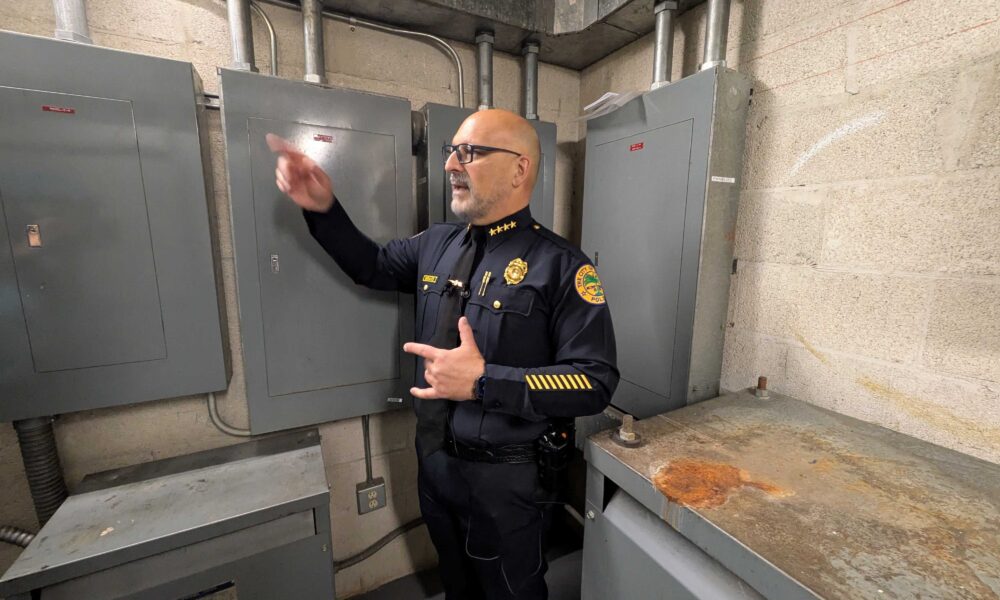
In advance of last week’s meeting, Police Chief Manny Morales walked WLRN and other media outlets through the police headquarters and pointed to evidence of water leaks and flooding damage.
“ Without this bond, there is no ability to replace the police headquarters and build a new public safety facility. It’s simply too costly,” Higgins told WLRN.
“We have the ability to issue the bonds at our current bond rating to repair all of our fire stations and build a modern police headquarters, fire headquarters, emergency operation center, and 911 center all in one building,” she said.
At the commission meeting Thursday, a police labor leader said issues date back years.
“For years, every one of you and those who came before you have known the condition of police headquarters, you have seen it, you have heard about it, and we cannot allow this to continue,” Felix Del Rosario, president of the Miami Fraternal Order of Police, told city officials. “We have documented cases of mold exposure affecting employees’ health.”
“This is nothing new. The only question is whether the city is going to fix it,” said Del Rosario.
But the sticker price left many residents wary of forking over the cash, and it is unclear how willing the public might be to approve the bond.
Some residents spoke of a general distrust of city government after years of scandals, even with new faces on the commission and in the mayor’s office.
If approved, the bond would be the largest since 2017, when voters approved the $400 million Miami Forever bond program to fix stormwater drainage, improve resilience to flooding and sea-level rise, improve parks and address affordable housing needs.
While running for office in 2025, Higgins called for a full accounting of how the city is spending the Miami Forever bond money. “We don’t know where that money has been spent, how it’s been spent,” she said. “All of that needs a deep dive.”
Read more: Miami’s Forever Bond Program: Sinkhole or Solution?
Residents echoed the mayor’s concerns last week.
“Now is not the time to saddle the city (with) $450 million worth of more debt, particularly when we haven’t gotten a full accounting of the money left in the Miami Forever Bond,” said Thomas Kennedy, an immigration activist and city resident.
Others joined the chorus. “It’s way out of the ordinary,” said Coconut Grove resident Christopher Lunding. “Conceding [that] all the firehouses get replaced, they could be gold-plated and it wouldn’t cost this amount of money. So, something else is going on here.”
Mercedes Rodriguez, who works at the Community Emergency Response Team program with Miami Fire Rescue, said first responders in the city deserve every dime of the bond money, saying that conditions have been horrible.
“ This is our 911 call. This is our siren,” she said. “They deserve these buildings, the new fire stations, police stations to be built.”
The longstanding issues at the stations impact firefighters every day, said Raul Cernuda, a district chief in Fire Rescue and labor leader with the International Association of Firefighters Local 587.
“ After a challenging fire or a traumatic medical call that will likely stay with us for the rest of our lives, we return to fire stations that are literally falling apart,” he said.
“At Fire Station one, my home station, water leaks from the second floor onto our dinner tables. When I go and take a shower, water from the drain backflows onto my feet. Mold and vermin are common.”
Cernuda said that Fire Rescue “outgrew these facilities 20 years ago,” and credited Higgins and the city manager for responding quickly once they became fully aware of the longstanding issues.
The vast majority of the proposed money for the public safety bond — $300 million — would go towards building a new public safety headquarters at Miami Freedom Park, close to Miami International Airport.
The new building would replace the current police headquarters. The police department, fire department and 911 operations would share the building.
Higgins told WLRN that the current headquarters downtown would be sold and the revenue would be used to buy a new fleet of solid waste trucks.
The remaining $150 million would pay for seven new fire stations and renovations and repairs at a dozen other fire stations citywide.















The City of Miami has a long history of not maintaining our fire stations and police station – and most every other City building, except City Hall and the MRC building.
Our firefighters and police officers should have well-maintained facilities. But rather than maintain the buildings, the City blames the buildings themselves for being poorly maintained, then wants to tax the residents an average of $1,000 for every man, woman and child to demolish the buildings, then build new buildings that they also won’t maintain properly.
Please watch my appearance at the last City Commission meeting on this topic:
https://www.youtube.com/live/6LE8Qsc1pK4?si=ualfgk7eRl1d4m3W&t=3775