



As Miami debates a proposed $450 million public-safety bond, the ever-escalating cost of policing — driven by rising salaries, pensions and overtime — has climbed to levels few major U.S. cities can match, even as crime reaches record lows.
As city commissioners weigh Mayor Eileen Higgins’ proposal for a $450 million bond — borrowing against future property tax revenue to rebuild police and fire facilities — they may want to consider this: Miami’s per capita spending on policing is already among the highest in the nation, far outstripping national benchmarks despite a crime rate that is among the lowest — and still declining — among major U.S. cities.
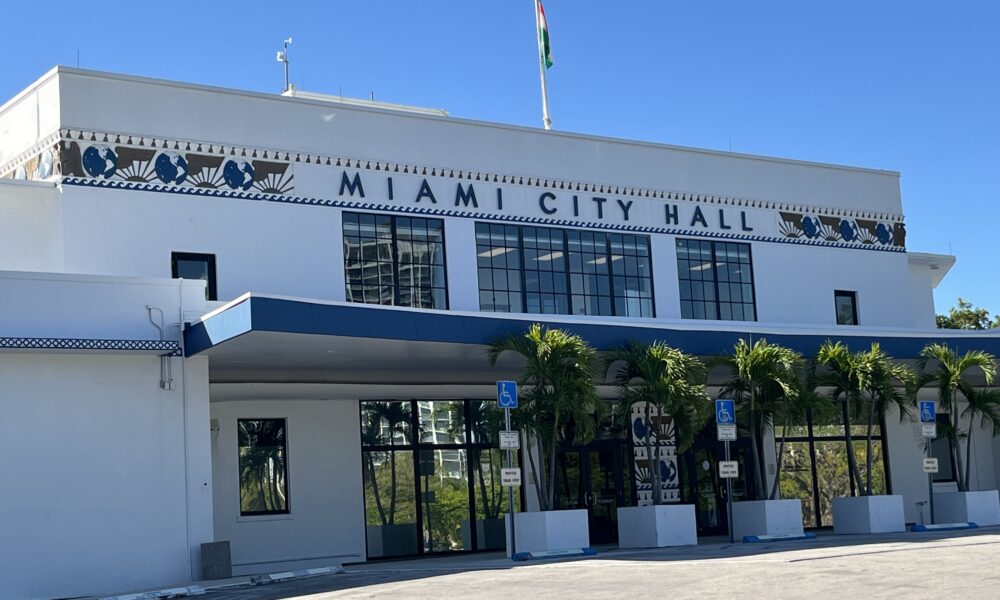
The bond, up for a commission vote next Thursday, would fund a new public safety headquarters and overhaul aging facilities citywide.
“Without this bond, there is no ability to replace the police headquarters and build a new public safety facility,” Higgins said last month, arguing that the current infrastructure is too deteriorated to repair incrementally.
Read more: Miami Delays Vote on $450-Million Bond Proposal
But even before taking on new debt, Miami is already spending far more on policing than it did a decade ago — and significantly more per resident.

A review of city budget records shows that Miami’s police spending has more than doubled in the past decade, rising from roughly $208 million in fiscal year 2015–16 to nearly $426 million in the current budget, accounting for roughly one quarter of all city operating expenses.
Population growth explains only part of that increase.
In 2015, with about 441,000 residents, Miami spent roughly $472 per person on policing. Using the U.S. Census Bureau’s most recent population estimate of 487,000 in 2024, that figure today rises to roughly $875 per resident.
Since 2015, inflation has risen about 33%, but per capita police spending has more than doubled that pace, increasing roughly 85%.
The increase is not tied to a larger police force. The number of sworn officers has remained essentially flat over the past decade.
In 2015, Miami spent about $158,000 per officer. Today, that figure exceeds $326,000 — more than double in nominal terms and roughly 55% higher after adjusting for inflation.
The data suggests that the rise in spending is being driven less by staffing levels than by the price of salaries, pensions and benefits attached to each position.
And those costs may soon climb further.
City officials are simultaneously advancing a plan to expand the police force by roughly 300 officers — an increase of about 20% — over the next several years.
The proposal, first outlined last year by Police Chief Manny Morales, is expected to cost about $161 million over five years. When fully onboard, the new officers are expected to cost the city roughly $40 million per year in additional salaries, benefits and expenses.
Read more: With Crime Falling, City Poised to Add 300 Police Officers
The officers would be added gradually, bringing the total force to roughly 1,700 sworn personnel.
Police officials say the expansion is needed to keep pace with a growing city and increasing demands on the department.
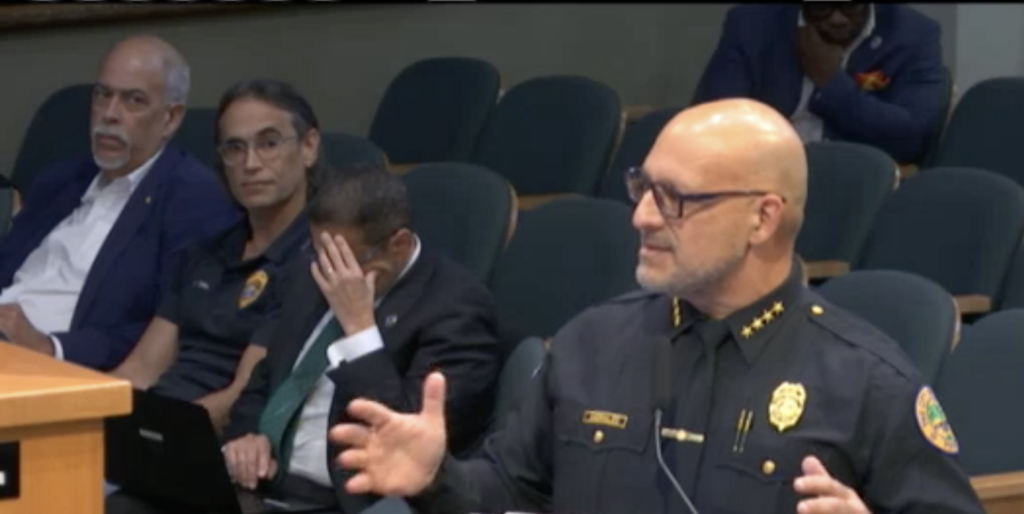
“It’s not that there is a need for now, but there is a need to prepare for what Miami is to become,” Morales told city commissioners when the plan was introduced.
The proposal would reverse a decade-long trend in which staffing levels remained largely unchanged even as costs climbed.
At the same time, crime has been moving in the opposite direction.
City data shows that major crime categories — including violent and property offenses — have declined over the past decade, with recent years approaching some of the lowest levels on record. In recent reporting periods, officials cited double-digit declines in homicides, robberies and aggravated assaults.
Miami now ranks 78th for violent crime among major cities nationwide; within Florida alone, regardless of size, it ranks 31st.
Those trends are reflected in the city’s own budget narrative, which highlights “proactive crime prevention efforts” and improvements in quality of life.
Personnel costs for Miami’s police department — including salaries, overtime, pensions and benefits — account for the overwhelming majority of police spending and have grown at nearly the same pace as the overall budget. Over the past decade, personnel expenses have roughly doubled.
By contrast, operating expenses — covering equipment, fuel, contracts and services — have increased far more modestly, rising by about 57%.
That imbalance suggests that Miami is not spending significantly more on policing inputs such as technology or equipment, but rather on the workforce itself.
And those costs are compounding.
Higher salaries lead to higher pension contributions. Expanded benefits increase long-term obligations. Overtime — often tied to special events, staffing gaps or operational demands — further drives up total compensation.
The city expects to spend about $9.6 million on police overtime this year.
(City officials have declined repeated requests for a detailed breakdown of employee salaries accounting for overtime and other bonus pay.)
Read more: Inside City Hall: Miami’s Salary Secret
The proposed addition of 300 officers would help fuel ever greater spending commitments, locking in tens of millions of dollars in new recurring costs annually. In the current budget, city spending on police retirement benefits alone this year will top $100 million.
Miami’s per capita spending on police is now among the highest of any large city in the U.S.
The most recent national survey of police spending, conducted by the Vera Institute of Justice using 2020 data, ranked Miami 10th among 72 major U.S. cities, spending $564 per resident.
But Miami has likely climbed in those rankings. If police spending in the cities above it had increased only with inflation, Miami’s current spending — about $875 per resident, according to this year’s budget documents — would rank roughly fifth nationally, trailing only Baltimore; Wilmington, Delaware; Washington, D.C.; and Newark, New Jersey — all cities with historically higher crime rates than Miami.
Across the 72 major U.S. cities analyzed in the 2020 study, the median police spending level was about $379 per resident — well below Miami’s $564 at the time. Among closer peer cities, the gap is narrower but still notable: Tampa spent about $450 per resident, Atlanta about $412.
Adjusted for inflation, that median would rise to roughly $455 per resident today, based on an increase of about 20% since 2020 — still far below Miami’s current level of about $875 per resident.
But as police spending on salaries, pensions and other personnel costs has skyrocketed in recent years, city officials say infrastructure spending has lagged, creating a critical backlog of repair and replacement projects that could be funded through the proposed $450 million public-safety bond issue.
Indeed, of the Police Department’s current-year $426 million budget, only about $3 million — less than 1% — is clearly identified for capital improvements.

















David Villano’s several articles on the City of Miami’s spending habits are eye-opening and troubling. The numbers speak for themselves.
City employees should be properly paid. The big question is how is that determined, by whom, and using what criteria?
City facilities should be properly maintained. The big question there is why haven’t those facilities been maintained, and will the City change it’s long-standing bad, expensive habit of “deferred maintenance”?
A common thread in Villano’s investigative articles is the City’s lack of transparency and their aversion to providing public records.
The five city commissioners and the mayor have a fiduciary responsibility to the taxpayers. They are elected to be guardians of our tax money.
It will be interesting to see how they respond.
The mismanagement is staggering. I know it’s not easy to run a city with half a million residents and 28 million visitors a year, but the decision making is just so poor. And the secrecy and obfuscation don’t help. How are we supposed to run a city without transparency? Good Lord.
Perhaps the statistics above are why residents get the shaft. 28 million people come through here every year with no roots here. We’re not maintaining goods and services for us. We’re maintaining good and services for the resort owners. I guess it makes sense. Miami has always been a tourist town (once the railroad went in). Although just 15 or 20 years ago, it still felt like a small town.
I took a sustainable tourism course through Cornell. There’s a curve for hot spots. Demands quickly ramps up, the market gets saturated and then falls off a cliff. A quick google search yielded this ai summary with 11 sources:
“Right now, Miami is in a late Consolidation stage transitioning into Stagnation, while aggressively trying to push itself into a Rejuvenation cycle.Unlike a newly “hot” trend, Miami is a mature, world-class destination. However, it is exhibiting classic signs of a market reaching its volumetric peak, forcing local authorities to reinvent its appeal to prevent a downward decline.”
The Mayor’s proposed $450 million bond authorization proposal includes $300 million for a new public safety/police headquarters — for our 1,400 person police force. Even New York City, with 31,000+- police officers and a bloated local budget, does not need or have such a large, expensive police HQ building.
What actually is going on here is a plan to tear down our repairable current police HQ building to free up another lot in Brickell for the City to sell on favorable terms to some connected private developer/political contributor to build more 60+ story luxury condominiums. Public safety is not involved.
And when does the Mayor want our 174,000 registered voters to vote on this? In the August primary election, when history tells us about 25,000 voters or fewer actually may vote, but all 1,400 police officers and 900 firefighters surely will be in town and vote in favor. This is a complete affront to representative democracy and mimics Chicago, where municipal employees control the local government and that city is circling the fiscal drain.
The Mayor’s bond authorization proposal should be tabled for now, modified and not brought forward for a vote until the November general election.
Eileen Higgins has lost the confidence of many who voted her into office. She is behaving like a puppet. If one were to guess who is pulling the puppet strings, look no further than James Reyes. He has deep roots with developers and law enforcement – AND LIVES IN BROWARD, SO HE WON’T BE AFFECTED BY A BOND. ! Quelle surprise our mayor’s first official act is to request more debt for Miami to abandon (and sell or, shall I say, give away) the Police HQ, and build a new facility – where? Ms. Higgins no amount of social media can help dissipate the stink of political machinery all over this request. I truly thought you were going to be different. You still have time to prove you are no one’s puppet!