
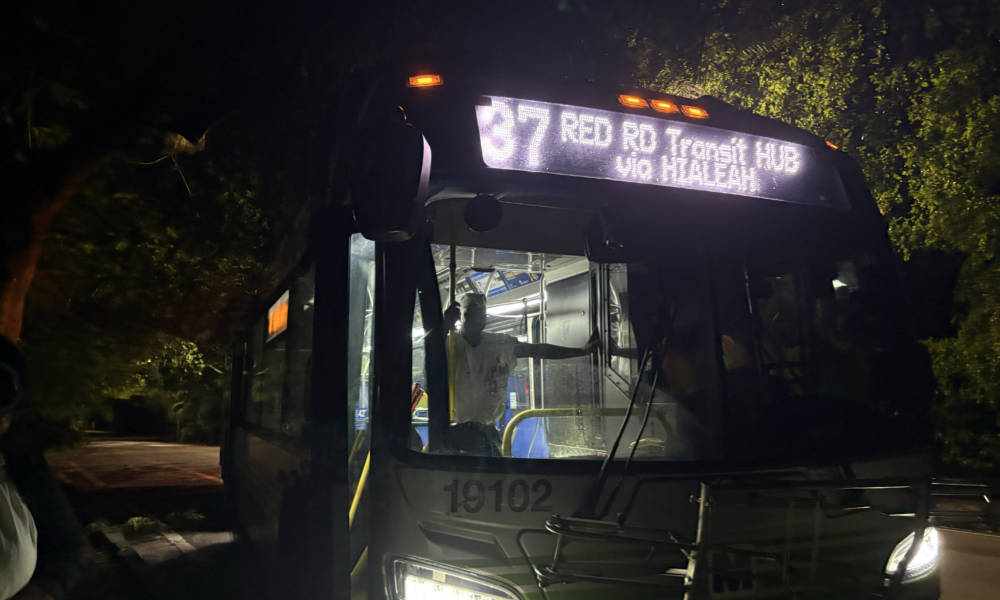


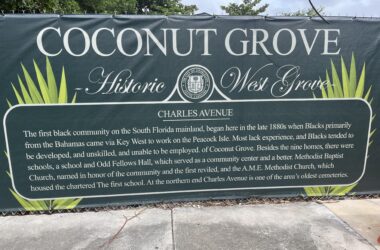

Proposed Miami-Dade budget cuts would eliminate one Coconut Grove bus route and curtail early-morning and late-night service on three others, disrupting commutes for workers who depend on transit.
When Rosa Crawford leaves her West Grove home at 5 a.m. for work, she packs everything she’ll need for the next 13 hours — including four hours spent navigating public transportation.
Crawford walks from her home at Kingsway Apartments on Charles Terrace to a bus stop on Douglas Road, where she boards the Route 37 bus at 5:22 a.m. The route runs between South Miami and Miami Lakes, largely along Douglas and LeJeune roads.
The bus quickly fills with familiar faces. After riding the same route for years, Crawford has gotten to know many of the regulars, chatting and cracking jokes with many of the commuters, regardless of language barriers.
By the time Crawford gets off at the Hialeah Metrorail station nearly an hour later, more than 20 people have gotten on and off the bus and the sky is still dark.
Then she waits about 40 minutes for another bus to take her to work.
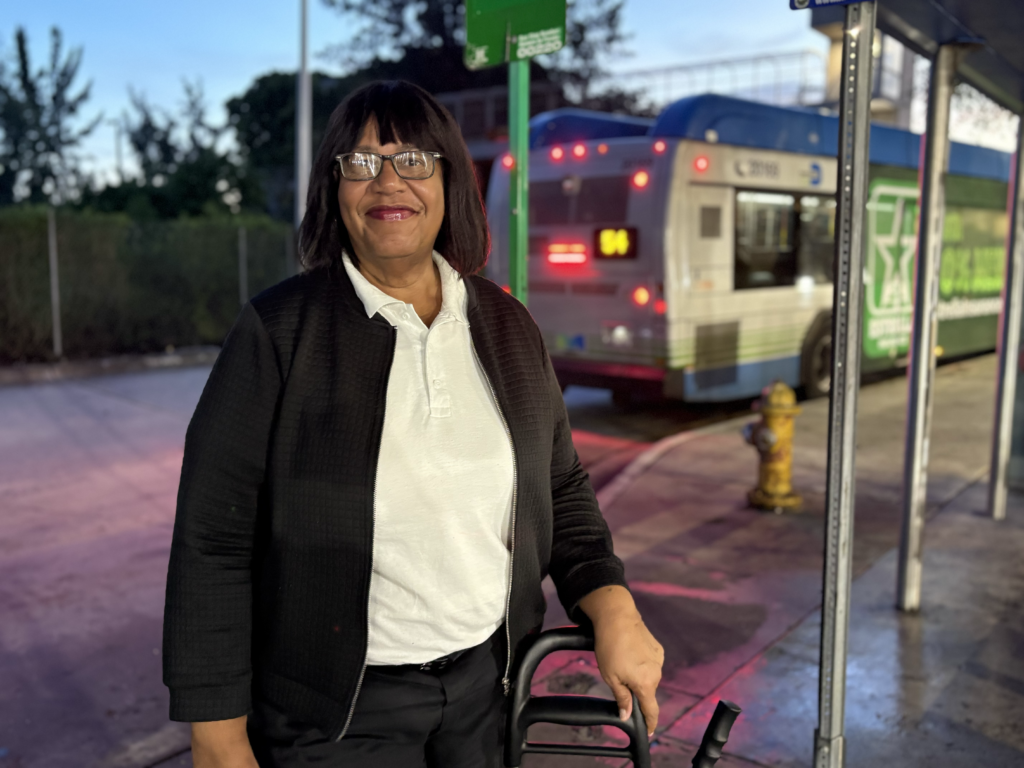
Crawford, 63, is a job coach at a Hialeah school, which she declined to name, where she works one-on-one with students with learning disabilities, teaching them skills they need to work in grocery stores. Afterward, she commutes more than an hour to a second job at another school. She doesn’t get home until after 6 p.m.
Despite the grueling routine, Crawford said she isn’t complaining.
“I love working with the students,” she said. “I’m very happy to know that I contribute to their lives where they’re able to build a more productive life.”
But a proposed round of Miami-Dade County bus cuts could make Crawford’s commute harder.
Under the county’s proposed budget, 12 bus routes would be eliminated, 45 would no longer operate before 6 a.m. and 41 would stop running after 10 p.m. The reductions, which would take effect next July, are expected to affect more than 14,000 weekday riders.
County commissioners are scheduled to take their final vote on the budget Thursday.
For Crawford, losing early service on Route 37 would mean the bus she now takes to work would no longer be running. The next bus would not arrive until an hour or more later — too late for Crawford to get to work by 7:20, when her shift starts.
“It’s the only way I can get to work. I have no car,” Crawford said. “Just to ride the Uber would cost me nearly $50 [one way].”
Her alternative would be to walk about 20 minutes to the Douglas Road Metrorail station before dawn, a prospect she worries would be difficult because of dark streets, bad weather and other hazards.
“I’m already up at 4 a.m. every morning, just trying to get to work,” Crawford said.
Three other routes serving Coconut Grove would also be affected.
Routes 22 and 27 would lose early-morning and late-night service. Route 22 runs from the Coconut Grove Metrorail station to Miami Dade College North Campus along 22nd Avenue, while Route 27 runs from the Grove station to Miami Gardens along 27th Avenue.
Route 42, which connects the Douglas Road Metrorail station with the Opa-locka Tri-Rail station via Miami International Airport, would be eliminated entirely.
County officials say the cuts are needed as Miami-Dade confronts slowing revenue and rising costs.
The Department of Transportation and Public Works faces a roughly $90 million shortfall, meaning more spending reductions are necessary even as transportation funding overall would increase by $66 million under the proposed budget, according to a department spokesperson. The bus reductions would save an estimated $31.5 million.
County officials estimate the changes would affect 14,498 weekday riders, many of them workers commuting during early-morning or late-night hours. The department said it targeted routes with lower ridership and estimates 91% of bus riders would be unaffected.
For those who are affected, however, the consequences could be significant.
Transit Alliance Miami, a transportation advocacy nonprofit, says many are nurses, custodians, security guards, construction workers and school employees.
Among them is Yader Gonzalez, a dishwasher at 1986 Steakhouse near CocoWalk.
When Gonzalez works the late shift, he walks nearly a mile to the Coconut Grove Metrorail station and catches a Route 27 bus around midnight to his home in Little Havana.
If late-night service is eliminated, Gonzalez said he would have no public-transit alternative. A rideshare trip could cost nearly $20 each way.
“I’ll have to keep working, and pay more than what I’m making in this country,” Gonzalez said. “I’d have to buy less food because I’ll have to spend more money on Uber.”
At the county’s first budget hearing on Sept. 3, residents and transit advocates spoke against the proposed reductions. But Gonzalez and other riders interviewed by the Spotlight said they had not known their routes could be affected.
Miami-Dade District 7 Commissioner Raquel Regalado also opposes the reductions and said she hopes commissioners can find other ways to cut costs or raise revenue.
“There’s a lot of money that’s being misused inside the transit department,” Regalado said. “We have been systematically cutting buses every single year in the county. … It’s kind of a dysfunctional system.”
Regalado has suggested reducing funding for MetroConnect, the county’s on-demand transit service, which she said costs more per rider to subsidize than conventional bus service. She has also proposed charging passengers to ride the currently free Metromover.
“I think my colleagues need to be cognizant of the fact that our core service is to run the Metrorail, Metromover and buses, not this private chauffeur service,” Regalado said. “Eliminating the bus routes for working people who have no other way to get to work strikes at the heart of what we’re supposed to be doing as a county.”
The proposed cuts come as county officials are also preparing for the possibility that voters will approve a statewide property-tax amendment in November. The mayor’s office says the measure could reduce Miami-Dade property-tax revenue by an estimated $385.8 million in its first year.
For Crawford, though, the budget debate comes down to something much simpler: whether a bus will be running when she leaves home for work before dawn.


















Improving Mass Transit Passanger Experience
Will Help To Keep Us Rolling Along
Mayor Cava insists that Bus transportation fares need to be increased or routes reduced for further budget constraints.
Transit Alliance Miami estimates that at least 7,000 early morning bus riders will be forced to find another way to get to work, if routes are cut due to reduction.
There is a third alternative.
Instead of increasing transit fairs or reducing bus routes, how about improving Bus, MetroRail and MetroConnect Passenger Experience to increase ridership and revenue!
Improve bus shelter comfort, clean Bus and MetroRail filthy windows, clean MetroRail filthy Skylights and Elevator Windows, reduce out of service MetroRail Elevators / Escalators, help Unhoused find safer shelters, increase MetroConnect connectivity to Transit Links.
Making improvements to benefit Passengers Experience will motivate more citizens and visitors to take advantage of mass transit, reduce highway traffic and increase revenue for better maintenance and future expansion.
Our county has the responsibility to provide clean water, removal of trash, safety from crime and adequate mass transit, for those unable or on willing to drive.
This may be the only time I will agree with Comm. Regalado. It’s beyond criminal for the county to tell municipalities they have to accept RTZ upzoning and supersizing developments around transit hubs – and then to eliminate the very mode of transportation they are telling us we need to accept a 30+ story building next to a residential neighborhood. Add in the “gift” they are giving developers, by not making them have the regulated number of parking spaces! Either bring back those buses OR STOP DEVELOPMENT OF THESE OUT OF SCALE DEVELOPMENTS!