

As tree removal permits accelerate across the City of Miami, tree advocates are urging residents to challenge proposed removals by filing appeals – a time-consuming process that reflects the public’s growing concern about the loss of tree canopy.
Chris Pruett, a certified arborist of 15 years, grew up under the lush tree canopy on Irvington Avenue – a narrow, close-knit street in the South Grove lined with palms, oaks and strangler figs.
“For the most part, people valued the trees and designed their homes around them,” he said, remembering the Coconut Grove he knew 40 years ago.
Pruett recently moved back to Irvington Avenue where he watches over many of the same trees he got to know as a child – only now with the eye of an arborist.
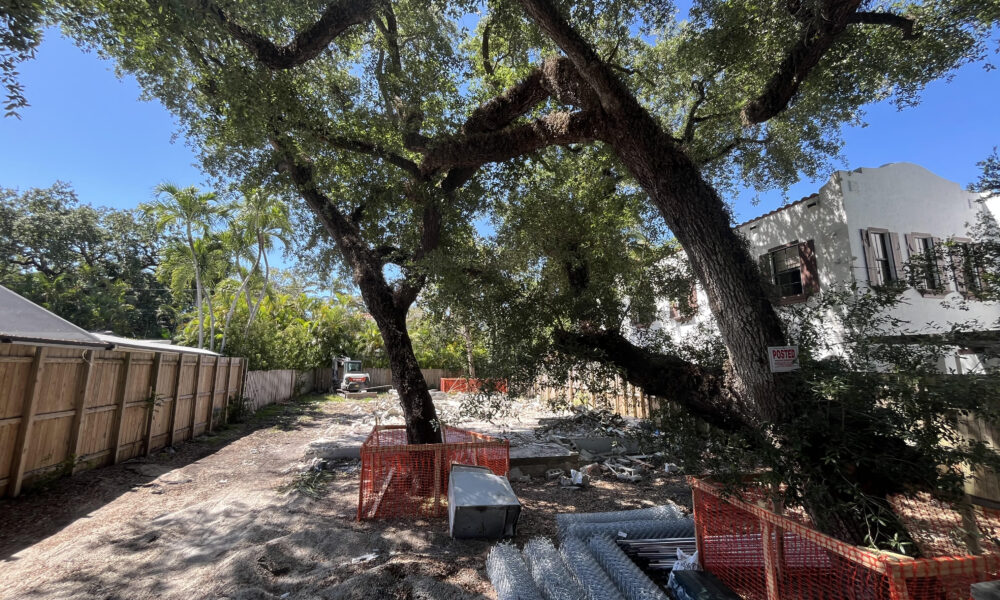
So, when a mature live oak on the street – 52 feet tall and 30 inches in diameter – was judged to be in poor condition and flagged for removal to accommodate a new home, the developer’s decision to strike the tree struck a nerve with him.
The “sickness” attributed to the tree was “bullshit,” he told the Spotlight. “You don’t have to be an arborist to look at the tree and say ‘the tree looks fine’,” Pruett said.
Up until this past month, Pruett says he had steered clear of the politics of tree removals in the City of Miami.
He had not spoken on the record on the issue nor followed the decisions of the Miami’s Historic and Environmental Preservation Board (HEPB), which holds a hearing when a neighbor challenges the city’s decision to allow a property owner to remove a tree.
Pruett said he always thought his passion for trees was best channeled through the work he does with his company – Garden Grove Tree Service. But no longer.
“The thing that happened on Irvington really got me going,” he said.
“I’ve seen too many trees fall since this value shift took place due to bottom lines and profit,” he wrote in a group chat with his neighbors on Irvington, who collectively decided to challenge the city’s decision to allow the developer to remove the tree.
Pruett is one of the hundreds – if not thousands – of concerned residents who are now speaking out against what some say is a “war” on trees in the city of Miami.
“What I have seen happen to my neighborhood, in my home, in real time is devastating. I used to look out over majestic trees… and now I am sandwiched between concrete walls,” Linden Street resident Amy Hertzig told the Miami City Commission last week.
Over the past month the battle to preserve Miami’s tree canopy reached an inflection point – brought on by a series of documented tree cuttings and anticipated removals in Brickell, Morningside and the Grove that drew widespread attention on social media.
“Miami is in a full-blown tree crisis, and the city’s response cannot be another delay, another consultant process, another committee used as political cover, or another attempt to shift responsibility away from the elected officials and administrators who are already allowing the destruction of our urban canopy,” Sandy Moise of Sierra Club Miami wrote to Mayor Eileen Higgins and other city officials over the weekend.
Moise and others are urging residents to take matters into their own hands, teaching them how to file appeals on intended tree removals, and encouraging them to show up en masse at public meetings when trees are on the agenda.
“We’re at war,” Albert Gomez, a former member of the city’s Climate Resilience Committee, said last week at a community meeting on trees at FIU’s International Center for Tropical Botany at the Kampong in Coconut Grove.
“I’m starting to see it emerge now in just sheer anger, some sort of convergence with regards to the public starting to stand up and realize that the city doesn’t necessarily have the trees in mind,” he added.
The meeting, hosted by Moise and Chris Baraloto, associate director of the center, walked more than 70 attendees through the city’s tree ordinance and its appeal process – effectively training them to challenge tree removal permits granted by the city.
As of Friday, the city’s website listed 35 properties with proposed tree removals or relocations subject to appeal – a narrow 10 to 15-day period during which residents can challenge the pending permits. The list of “intended decisions” by the city offers a two-week snapshot of the pace of tree removals in Miami.
There are five intended decisions listed in the Grove, including one permit that would sanction the removal of 13 trees at 3301 McDonald St., including two specimen trees — a Norfolk Island pine and strangler fig. Specimen trees are afforded the highest level of protection under city code because of their age and size.
Activists say the volume of proposed tree removals is far higher than in years past, with the number of permits steadily increasing over the last two years and surging in recent months.
Read More: Tree Policy Delayed as Removal Permits Rise, Advocates Warn
As the pace of tree removals has grown, so has pushback from the community.
“I can’t remember having seen three tree appeals on one HEPB agenda,” civic activist Elvis Cruz said, referring to the board’s May 5 meeting when three appeals were scheduled to be heard. “It is indeed a sign that residents are fed up, communicating and collaborating to save trees.”
At least one tree appeal will be heard in each of the next two HEPB meetings, a city official has confirmed.
To be sure, the fight to save Miami’s trees is not new. Last year, activists successfully mobilized in opposition to a proposed rewrite of the city’s tree ordinance.
But filing and winning tree appeals can be more difficult, time-consuming and expensive, especially for residents who not familiar with how the system works.
“It is quite a difficult process and it’s frustrating that this is the only avenue we have to go,” said Miami resident Lindsay Cain, who started a GoFundMe page to raise funds to cover the required tree appeal fee. “This is essentially a full-time job.”
Once the city posts an “intended decision,” residents have 10 days to file an appeal with the HEPB, and the applicant must have “standing” — a designation that was called into question when Nicole Gazo’s appeal to block the removal of 57 trees was dismissed because she was neither a City of Miami resident nor an abutting property owner.
Read more: City Board Tosses One Tree Appeal, Grants Two Others
Filing an appeal also comes with a fee of $315 – reduced to $157 for non-profits and property owners within 500 feet – which along with other required city fees, totals about $650. Up until last year, the fee was set at $1,500 – its reduction was a rare victory for environmental activists.
Hiring an attorney adds another layer of expense. David Winker, who represented the successful appeal against a permit to remove 15 trees and relocate five others on El Prado Boulevard, charges a $5,000 flat fee for tree appeals — relatively affordable by legal standards, he said, but still a substantial cost for residents.
“A big ask for people that just don’t want you to kill a tree,” said Grove resident Genevieve Block, who filed the appeal to save the oak on Irvington Avenue.
Despite the hurdles, however, Block and others are putting in the effort, filing appeals, and hoping they prevail. Pruett, the arborist, says the effort is worthwhile.
“The way you destroy a forest is to cut down a tree one at a time,” he said. “The way you save a forest is to save one tree at a time.”
Tree advocates like Moise say the public pushback is making a difference.
On Thursday last week, the Miami City Commission established the Miami Tree Ordinance Advisory Committee, nearly a year after the move was first suggested by District 5 Commissioner Christine King.
In advance of last week’s meeting, Moise and Sierra Club Miami launched an action alert that motivated concerned residents to send more than 1,200 emails to city officials urging action and demanding a moratorium on tree removal permits.
“We’ve been hearing a lot from residents,” Mayor Eileen Higgins said at the start of Thursday’s commission meeting.
The 10-person tree advisory committee – which will include Baraloto and arborist Ian Wogan as District 2 representatives – is empowered to advise the commission on potential changes to the city’s tree ordinance and facilitate public feedback.
With the committee in place, tree activists circled back over the weekend with an updated list of demands: reinstating construction-site tree monitoring, requiring independent arborist reviews, more transparency for the Tree Trust Fund, and environmental resources reviews to be conducted before construction planning is finalized.
Pruett pointed to the tree assessment process as a problem, saying many arborists operate under a “wink-wink” system with developers and the city, labeling healthy trees as diseased or recommending removal before exploring possible treatments.
“The thing that bothers me is the precedent that’s being set. If that tree is sick, then they are all sick. Does this mean we take out all the “sick” trees in the Grove?” he asked.
Much will depend on the HEPB, which hears the tree appeals filed by residents.
Five years ago, when the HEPB overruled a city-issued tree removal permit for an El Prado Boulevard property, the ruling made the front page of the Miami Herald as a “surprising decision.” At the HEPB meeting in May, however, the board upheld two permit challenges brought by residents.
Pruett hopes that trend continues. Otherwise, he worries about what Coconut Grove could become. “If we keep on this track, we’re going to have to rename the town because there’s not going to be a tree left,” he said.








The debate between “property rights” champions, most of whom seem to sit on our City Commission, and those like myself who are watching the destruction of Coconut Grove in real time, is truly remarkable. When citizens like David Villano and Ken Russell attempted to change the residential zoning to stipulate more green space they were labelled “communists.” But what does it mean to live in a city or in a civilized society? Can anyone do whatever they please on their own property? Obviously not. Unfortunately, many of our city officials have a sour taste in their mouths because of Castro, and that is understandable, but this not Cuba, and what my neighbor does affects the quality not just of my life but of many people. There are restrictions on freedom and those things are called laws and ordinances and they are there, one would hope, so that we all can live happily together. To look at a gigantic block of concrete that takes up 70% of a lot and then observe a developer installing a miniscule swimming pool and plastic grass where there once was a lovely garden with giant avocado and mango trees is shocking to me and my neighbors, and yet this is what the City of Miami has legislated. We now live in a city so choked with traffic because of unregulated development, that many are considering leaving or simply staying home after 3pm. Let Freedom Ring!
The only way we can fight the development cartel is to stop electing their ‘legal representation’ in the City, County, and State. Sorry for all caps here, I’m thinking of making a yard sign saying DONT VOTE FOR ANY CANDIDATE THAT TAKES A DIME from developers, builders, or land use attorneys.
As a resident building a new home in the South Grove, it’s simply easier to remove trees than to preserve them, and if the City is serious about protecting our canopy, they need to flip that script.
Our property has several stunning mature trees, including two specimen Live Oaks squarely within the buildable footprint of the lot. We were determined to keep them, but doing so required remarkable design acrobatics to fit our desired one-story house and all required elements — septic drain field, driveway, underground utilities — around the trees and their root zones. The result is a special home for our family, but preserving those trees reduced our interior square footage, substantially increased construction costs, and lengthened the entire process. It would have been more efficient and far less expensive to remove the trees, pay into the tree fund, and build a more conventional house that the market values for its size.
Developers take this route not because they don’t care about trees — they do it because it’s easier to build into a pro forma. It’s hard to quantify the market value of a mature tree but easy to quantify an extra 1,000 square feet of interior space delivered eight months faster. A few suggestions:
-Fast-track zoning variance applications for mature tree preservation and be extraordinarily lenient in approving them.
-Penalize illegal tree removal more punitively and use those funds to compensate property owners who preserve specimen trees that reduce the market value of their new structure.
Property owners who preserve specimen trees that reduce the market value of their new home are to be lauded for their superlative efforts… but they are never going to be compensated for such efforts by the City of Miami. That’s never going to happen.
I hear what you are saying Barry, but that’s a fairly pessimistic take. If we have a Tree Trust Fund that was created for the explicit purpose of protecting our tree canopy, I’m not sure why it couldn’t be used to preserve existing trees instead of planting new ones. I recognize our fair City may not have a reputation for logical policy deployment…but hope springs eternal.
But my point remains, the Carrot is sometimes more effective than the Stick when it comes to altering behavior patterns.