

A growing coalition of environmental advocates, civic leaders and residents is calling for a moratorium on tree removals, warning that canopy loss across Miami appears to be accelerating as a long-promised overhaul of the city’s tree protection policies has stalled.
The group is also demanding an update on the status of a citizen-led “Tree Committee” to guide the policy review, along with a broader public engagement process — outsourced to a civic mediator last year by city officials — which has yet to materialize.
In a letter sent April 20 to Mayor Eileen Higgins and the City Commission, more than 160 signatories — including former Miami-Dade Commission candidate Cindy Lerner, former South Miami Mayor Philip Stoddard, and climate leaders such as Yoca Arditi-Rocha of The CLEO Institute and Sierra Club Miami President Noel Cleland — called for action.
More than two dozen civic and environmental groups are represented in the coalition.
“This lack of transparency and delay is deeply concerning, particularly as tree removal activity continues across the city,” the letter states, warning that “developers and city staff are operating within a ‘gray area’… resulting in the rapid and irreversible loss of Miami’s tree canopy.”
The coalition’s demands come nearly a year after a much-criticized plan to rewrite the city’s tree protection code was abruptly tabled by city commissioners, who then promised a comprehensive, city-led review of its rules and policies in advance of any future legislation.
In July, commissioners called for the creation of the Tree Committee and allocated $180,000 for outreach services from Florida State University’s Florida Conflict Resolution Consortium to help the city reach communitywide consensus on the changes. At the time, officials described the effort as a “transparent, inclusive, and community-driven process.”
Read more: City Offloads Public Outreach on Tree Ordinance Rewrite
But nine months later, the process has yet to begin.
According to the letter, the city’s Tree Committee has not been publicly announced, a list of appointees has not been released, no application process has been opened, and no stakeholder engagement has been launched — even as tree removal permits continue to be issued across the city.
“Most concerning are the ongoing tree removals during the policy vacuum,” the letter states. “While the City has yet to implement the very process it funded to guide tree policy, tree removal permits continue to be issued at an increasing pace.”
The concern is not limited to environmental groups. The list of signatories spans neighborhood associations, environmental organizations, professional planners and dozens of residents from Coconut Grove, Morningside, Buena Vista and other neighborhoods — suggesting a broad unease about how tree protections are being applied.
The letter also highlights a recent Spotlight report documenting internal changes within the city’s Building Department that appear to streamline tree removal approvals.
Read more: Tree Overhaul Returns as Quiet Changes Take Root
In comments made earlier this month, City of Miami Building Department Director Ed Santamaria, who oversees the city’s tree protection function, said the department is interpreting portions of the code “in a way that doesn’t slow down things and just speeds up processes,” emphasizing responsiveness.
While Santamaria has said the city’s tree protection ordinance remains in place, advocates argue that changes in how the code is interpreted are accelerating canopy loss, with removal applications approved with less oversight and review than under previous internal policy guidelines.
Concerns have also been raised about staffing changes, including the reassignment of longtime Environmental Resources Division head Quatisha Oguntoyinbo-Rashad, who had overseen tree permitting and enforcement for more than a decade.
Higgins has yet to respond to the letter, coalition organizers told the Spotlight.
The only response from the five-member City Commission came from District 4 Commissioner Ralph Rosado, who in an April 21 email to the coalition acknowledged the delays in establishing the Tree Committee and in launching the FSU center’s community workshops.
“My larger concern is that almost a year ago we approved creation of a resident body to help address concerns associated with tree planting and removal,” Rosado wrote. “But they have yet to convene and begin their work, while we continue to receive questions and concerns on this contentious and important matter.”
Rosado added that he had already nominated his two allotted appointments to the committee and would like to see it begin work “expeditiously.” City Building Department officials, who are overseeing the code rewrite, have told the Spotlight they expect the committee and community workshops to take shape within the coming weeks, with proposed changes making their way to the City Commission for approval by the end of the year, at the earliest.
Meanwhile, advocates say, Miami’s tree canopy is giving way to a combination of development pressures and changing city priorities and policies.
Chris Pruett, a certified arborist who lives in South Grove, said in an interview that while tree removals have been a longstanding issue, the pace appears to have increased in recent years and even more so in recent months.
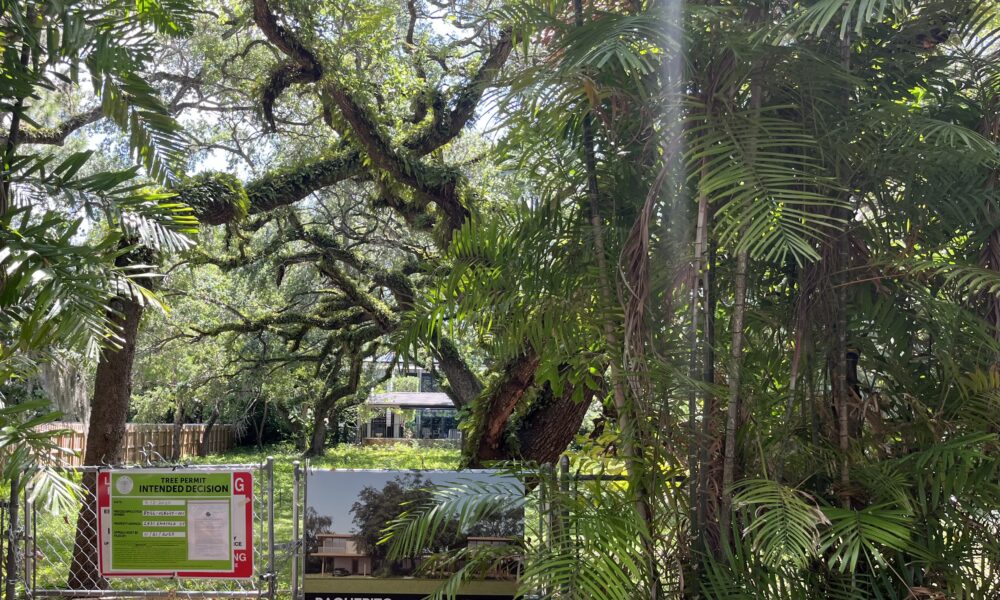
“It’s definitely escalated,” Pruett said. “You just see more and more — more intended decision signs, more lots getting cleared quickly. Trees are dropping like flies.”
Pruett attributes the trend to a combination of factors, including enforcement challenges, financial incentives tied to development, and what he described as evolving practices within the city.
“The city makes the rules, but they don’t always enforce them,” he said. “And when enforcement is weak, it creates an environment where people push the limits.”
Pruett believes evolving city policies and inconsistent enforcement have created a “Wild West” mentality among developers and some licensed arborists, who he says are eager to overstate or misstate the condition of trees in hopes of securing removal permits.
He said he routinely encounters recommendations from other arborists — and from city inspectors — to remove trees he considers perfectly healthy and not interfering with development plans.
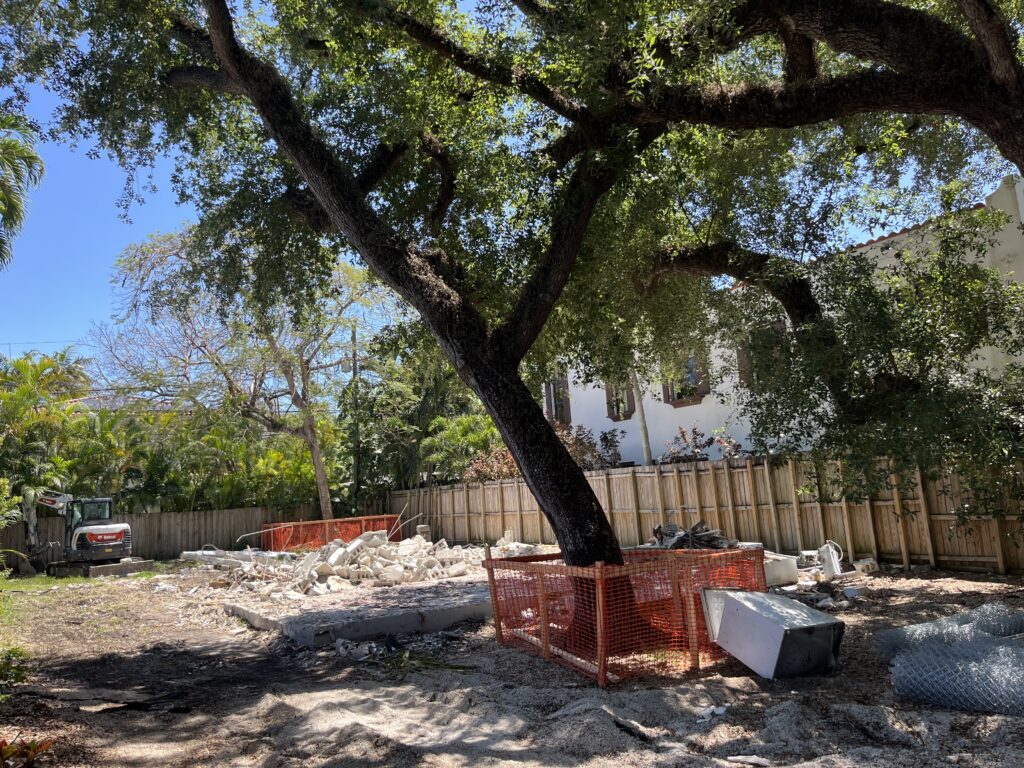
Among them: an oak in South Grove and, in North Grove, a poinciana in the city’s right-of-way and an adjacent golden shower. All three are classified as “specimen” trees due to their age and girth and sit on residential lots being prepared for development.
Residents have appealed the city’s decision to authorize their removal — among three tree removal appeals scheduled to be heard May 5 by Miami’s Historic and Environmental Preservation Board.
The letter sent to city leaders cites other specific cases that they say illustrate the problem, including a recent proposal to remove four specimen-sized mahogany trees in the public right-of-way at a development site near NE 4th Avenue.
The stated justification — that the trees conflicted with construction — falls short of the threshold required under city code, the group argues, particularly for protected trees located on public property.
The coalition is also calling for full transparency around any changes to permitting procedures, and an explanation for recent staffing decisions.
They are also urging the city to impose a temporary moratorium on non-emergency tree removal permits until the committee is in place and the public engagement process is complete.
Miami’s tree canopy, they note, plays a critical role in mitigating heat, improving air quality and supporting climate resilience in a city already facing rising temperatures. Allowing it to erode during what they describe as a policy “gap” risks not only environmental impacts, but also public confidence in how decisions are being made.
Mayor Higgins did not respond to a request for comment from the Spotlight.





Cutting trees faster than we update the rules is like tearing off your roof before the storm, once the shade is gone, you don’t get it back.
Thank you for this comprehensive examination of this issue, which has been ongoing since at least 2017. I do not understand the vendetta Miami developers have against trees. It’s as if Sauron himself were controlling them with the one ring.
For goodness sake, all the money they must be wasting on lobbyists and lawyers, they could spend on reworking plans and reducing a square foot or two, and act like partners in the creation of a world-class climate resilient city of the future rather than carpetbagging grifters. I wonder what the threshold in cash is to turn your conscience off and literally set a neighborhood back by 80 years plus, which is how long some of these trees will take to be replaced. I wonder what the next realm they’ll wake up in will look like. I hope for their sake it’s not full of angry trees and animals.
And the same goes for the public officials who help them. One could (almost) forgive developers for just doing what they do. But local officials are tasked with creating the environment under which we build the most comfortable, safe, enjoyable living situation for the humans and other earth inhabitants in the area. They’re falling far short in both the City and the County.
The one thing they’ve done that is a major improvement to civic life is the Underline. But it doesn’t make up for the ongoing destruction of our ecosystem everywhere else. This insanity needs to stop.
Joyce Kilmer, idealistic Catholic poet and journalist, wrote his famous poem “Trees” in 1913 before his early death in WWI. Although it is often parodied, this Spotlight article made me recall it from my high school days, and to wonder what it might look like if written by a Coconut Grove “white box” developer today:
I never have and never will see
Something as disposable as a tree.
Trees that squat in “buildable space”
Requiring permits for removal: What a disgrace!
Now our commissioners and their staff have all found common sense.
Permits can be expedited, notices waived, without undue expense.
Chapter 17 can be ignored, the promised review delayed.
Forget the birds! Forget the beauty! Never mind the shade!
It’s “Property Rights” that matter. Houses by the pound!
Max the square feet, ignore the rules, and never mind the sound
Of chainsaws on the weekends, or better yet, a storm
When cutting down a century-old oak just becomes the norm.
Poems are made by foolish tree-huggers,
My God is Profit –all that’s green be buggered!
It is deeply disheartening to watch what is happening in Coconut Grove.
The Grove is not simply another neighborhood—it is defined by its magnificent canopy, its lush tropical landscape, and the rare sense that nature still holds dominion here. That verdant character is not incidental; it is the very soul of the community. Yet, piece by piece, tree by tree, that inheritance is being sacrificed.
What is most troubling is not merely the loss itself, but the apparent willingness of those entrusted to protect this place to accommodate the interests of those with the means and influence to reshape it for profit. Too often, it feels as though private ambition is permitted to override public stewardship—at the community’s expense.
Joni Mitchell lamented this impulse more than half a century ago—“They paved paradise and put up a parking lot.” Today, the parking lots have become oversized white boxes, towering high-rises, and developments that strain, circumvent, or exceed the spirit—if not the letter—of zoning meant to preserve Coconut Grove’s unique character.
Once a canopy is lost, it cannot simply be replaced by ordinance, nor recreated by landscaping plans or glossy renderings. It takes generations to grow what can be erased in a day.
And that is what makes this so horrifying: we are not merely losing trees—we are dismantling, in real time, the very thing that makes Coconut Grove extraordinary.