

Miami will pay $180,000 to a team of facilitators from Florida State University to engage residents in a controversial effort to revise the city’s tree laws. Some watchdogs see the move as a political smokescreen to deflect criticism—and weaken protections.
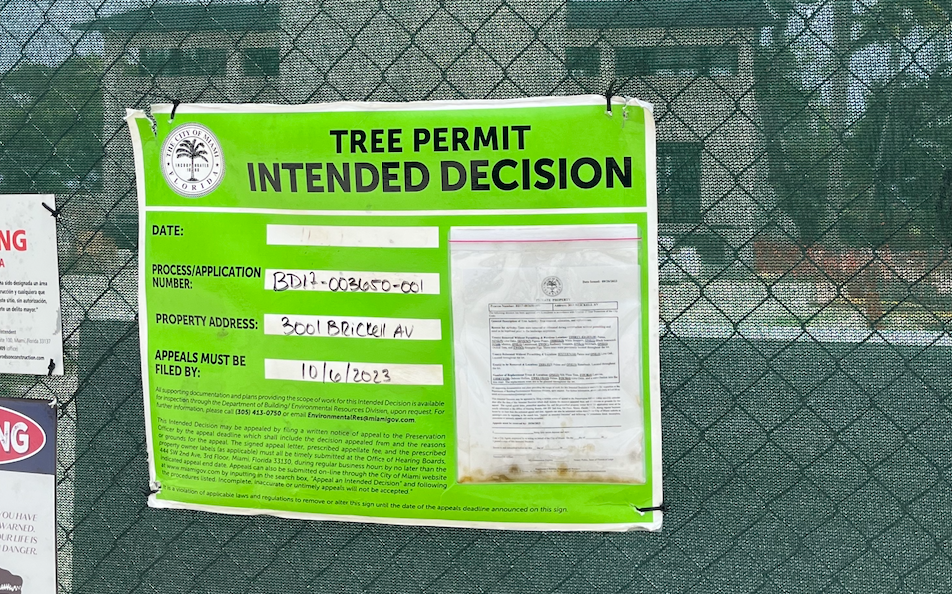
In a move that rekindles debate over Miami’s tree protections, city commissioners on Thursday unanimously approved a $180,000 contract with the Florida State University Consensus Center to lead a public engagement process on revising the city’s tree ordinance.
The vote marks a shift from a previous plan by Commission Chair Christine King, who had proposed a city-led assessment of tree and environmental regulations. King pulled that item last month, opting instead to bring in the state-backed mediation group to facilitate outreach and dialogue on changes to the ordinance.
“Updating our tree ordinance is important and it should not be rushed,” King told the Spotlight ahead of the vote. “I withdrew the [June] item after hearing from residents who expressed wanting more time for discussion.”
Tree protection activists cautiously welcomed the city’s decision to bring in outside facilitators — but remain skeptical of officials’ intentions.

“If the $180,000 is necessary to have a clear transparent process, I will support it,” Sandy Moise of the Urban Paradise Guild told commissioners during the meeting’s public comment period. “But keep in mind we don’t want the tree ordinance to be weakened whatsoever.”
Moise and other activists say they were caught off guard by a proposal last October from District 1 Commissioner Miguel Gabela to heavily rewrite the city’s tree protection ordinance.
Facing fierce opposition, Gabela pulled the item in May, but any sense of optimism was dashed soon after when two of his colleagues — King and District 2 Commissioner Damian Pardo, who represents Coconut Grove – signaled their intent to push forward with changes over how, and for whom, the city manages its tree canopy.
In June, King, the District 5 representative, sponsored a resolution directing City Manager Art Noriega to conduct a citywide comprehensive assessment of its tree and environmental regulations, with a focus on how administrative processes impact tree protection.
Tree activists hailed the move as a true “audit” that they had been championing all along. But then came another abrupt pivot: King withdrew her own resolution.
Instead, King pushed to allocate the $180,000 to the Florida State University Consensus Center, a state-sanctioned organization that mediates community discussions on controversial legislation. The Consensus Center will organize and conduct a series of public outreach meetings on revising the ordinance.
Pardo echoed King’s rationale in a recent text response to questions from the Spotlight. “We have issues with the tree ordinance that require revisions,” Pardo wrote. “Community outreach is the first building block to developing good public policy.”
King’s reversal has provoked skepticism from tree activists who fought hard against Gabela’s proposed revisions. One of the leading opponents, Moise, described the hiring of the FSU group as a smokescreen that hides a concerted effort by city commissioners and building department officials to push forward the controversial changes.
“The city has not explained why it wants to revise the ordinance,” Moise wrote in a mass email ahead of Thursday’s vote. “The city has failed to fix its broken permitting system or enforce the current law… FSU has no tree preservation expertise and is only being hired to run meetings. This is about controlling the narrative — not protecting trees.”
Moise and others are highly suspicious about any future revisions proffered by city officials. The Gabela-sponsored rewrite, they note, pointing to emails obtained through a public records request, was crafted with guidance from the building department and the president of the Builders Association of South Florida, a prominent and politically connected land use attorney
Indeed, the city’s own Environmental Resources Division – which oversees tree protections citywide — was never consulted on the Gabela proposal, a city official acknowledged to the Spotlight last year.
Critics argue that the measure, as originally written, would have opened the floodgates for significant canopy loss under the guise of “streamlining” a cumbersome permitting process.
Under the ordinance, for example, homesteaded property owners – including developers who claim residency at a future construction site — would have enjoyed broad latitude to remove trees without a permit or oversight. And developers would be allowed to claim tree-removal privileges to make way for construction staging areas.
“Oh my god, it was horrendous,” Moise told the Spotlight. “They were trying to sell it as something good for the people when it was nothing more than a gift to developers.”
To defeat the measure, a coalition of civic and environmental groups – including Urban Paradise Guild, Sierra Club, Tropical Audubon Society, Dade Heritage Trust, Miami Waterkeepers, Friends of Biscayne Bay, and homeowners associations citywide – formed a loose advocacy group under the name Miami’s Trees Matter Most.
Pardo, whose district includes the city’s Morningside neighborhood, where Moise lives, argues that the tree ordinance, as currently written, “hurts the average property owner” — a sentiment few dispute. But there’s a fundamental split: Where Pardo, city officials and development industry figures see flaws in the law itself, activists say the real rot is in how the ordinance is administered.
The city’s online permit filing system, they say, doesn’t have a user-friendly interface. What’s more, property owners are required to submit surveys of their entire property, must wait for the city to send an arborist to confirm a tree is damaged or dying before cutting it down, and the entire process can cost thousands of dollars, Moise explained. Appealing tree removals can also cost residents four-figure sums, she added.
“Have you ever tried to get a permit to plant or remove a tree?” Moise said. “It doesn’t need to be as expensive or as cumbersome as it is.”
Yet enforcement against illegal tree removal is lax — even against the city itself. Moise points to the unpermitted removal last May of two healthy oak and tamarind trees in Morningside by the city’s Department of Resilience and Public Works — after which the city issued itself “after-the-fact” removal permits, sidestepping process and accountability.
The city’s Building Department’s role also draws suspicion. Pointing to yet another batch of emails obtained through a records search, activists claim department officials are more interested in making tree removals easier than protecting the city’s canopy.
George de Guia, a Coconut Grove tree activist, sees the debate as inherent to the city’s broader failure to confront climate change. “The ordinance isn’t broken,” de Guia says. “What’s broken is the way the city manages it—the permit fees, the appeals, the non-enforcement.”
Katrina Morris, another Grove tree protection advocate, believes the city should “prioritize preserving what we have left” by doing away with the fees residents must pay to appeal tree removal permits.
“There’s no will on the part of the commission to protect trees,” Morris said.
Moise singles out Pardo, accusing him of not forcibly standing with tree activists and voicing opposition to Gabela’s plan. She claims Pardo has been onboard with the controversial changes since April of 2024 when, according to emails she obtained, then-Assistant Building Director Jose Regalado forwarded a copy of the draft ordinance to Pardo’s chief of staff, Anthony Balzebre.
“Long story short, [Pardo] was supporting it all along,” Moise tells the Spotlight. “But he wasn’t in a position to publicly support it because he’s the D2 commissioner, where we have the most canopy and the greatest number of tree huggers.”
Pardo deepened concerns among tree activists when, during a constituent Zoom in June, he announced that once the vacant District 4 seat was filled later that month through a special election, the tree ordinance rewrite effort would be rekindled
Among the residents on that call was Maria “Maji” Ramos, a realtor who lives in Morningside. “It kind of came as a surprise because we were so happy [it was withdrawn,]” Ramos says.
In his text response to the Spotlight, Pardo said the tree ordinance “has never gone away.” He acknowledged that Gabela’s ordinance was principally driven by city staff, not community input. Residents, he argued, don’t have a grasp of the city’s legislative process and how ordinances and resolutions get placed on an agenda. Pardo dismissed Moise’s criticisms as misguided.
“Some tree activists have highly politicized an attempt for good reform and found obstruction to be the preferred solution to an ongoing problem,” Pardo wrote. “My goal is to work collaboratively with city staff, consultants, activists and property owners on an ordinance that protects trees, preserves canopies and upholds property rights.”
At Thursday’s meeting, city commissioners made it clear that the tree ordinance requires an update. In addition to approving the funds to retain the FSU Consensus Center, they also backed King’s suggestion to consider a similar community outreach role for a Florida International University group called Grove Releaf, led by Coconut Grove Village Council Vice-Chair Christopher Baraloto.
The commission also agreed to form a citizens’ committee, made up of members from each district, to help facilitate public engagement with the process.
“The fear is that the City of Miami, without community input, will not do the best job possible,” King said. “Having a committee of residents appointed by each of us will give the community another layer of comfort that we are going to do our best in crafting an ordinance that makes the best sense for the city.”
Gabela and Pardo, the two sources of tree activists’ greatest ire, concurred.
“I think this is a good thing,” Gabela said. “We were accused of all kinds of stuff.”
Added Pardo: “Clearly since we started this, there is a lot of passion behind [the tree ordinance]. This is a critical issue for the city.”









The City of Miami has a dismal track record on tree protection.
Over 1,000 trees were removed from the Mel Reese golf course as part of that horrible scam. Was there any remediation? Fines paid? Did the laws not apply? Or did the City simply give itself a blanket permit?
Developers routinely cut down trees and gladly pay the fine as a small ‘cost of doing business’ expense.
Miami has government of developers, for developers, by developers.
Elvis Cruz
Morningside
As a former chair of the Historic and Environmental Protection Board, I am more than skeptical of these latest attempts by the City to re-write Miami’s Tree ordinance in the guise of strengthening it.
Here’s why: Development in Miami, whether in high-density transit-oriented developments or single family neighborhoods, always means “Bigger is Better” and much more profitable. Trees be damned, since they take up valuable space!
The combined development and real estate industries currently control our elections through their election and re-election campaign funding. This allows their chosen candidates to win with as little as 10% of the registered voters voting. Even “outsiders” like Gabela and Pardo then begin to succumb to this pro-development pressure.
After serving almost 8 years on the Planning and Zoning Appeals Board, I have gradually come to the conclusion that the only way to begin working our way out of this mess is to vote to change the City Charter to increase the Commission to 9 districts from the current 5 (“the solution to pollution is dilution”), and to make local elections happen on even years to coincide with State and Federal elections when voter turn-out is always much higher.
Over time, with just these two changes, we will at least have a chance to see population growth match verifiable infra-structure improvements (sewer, transit, traffic, schools, pedestrian safety, etc.) without destroying our valuable tree canopy or our neighborhoods.
What is being done about Commissioner King’s insistence that FIU and the University of Miami being involved in this Process?
So, Who do these people actually “Work For”? Who’s Paying them? Who do they need to “Kept Happy”, in order to be Hired again?———
“About the Florida State University Consensus Center: (Which I believe, is Not actually a part of the University)
Harald (Hal) M. Beardall, Who currently serves as the Director for the FCRC Consensus Center. In that capacity he has designed and facilitated numerous large and small scale processes to build consensus around public policy issues in regional airspace planning, standards drafting, transportation, community visioning and strategic planning efforts with public and private entities. Projects he has worked on include the Gulf Regional Airspace Strategic Initiative (GRASI), the North American Electric Reliability Corporation (NERC) Cyber Security Standards Drafting Team, as well as the 2020, the 2025 and the 2060 Florida Transportation Plan Updates, the Strategic Intermodal System Steering Committee, the creation of the MPOAC Institute for elected officials, the Committee for a Sustainable Emerald Coast and the “How Shall We Grow” Visioning Process in Central Florida.”…