


Attorney Tucker Gibbs and stonemason Josh Billig – two Grove personalities who left town last month – look back at the neighborhood where they came of age, raised a family, and made a life.
Shortly before he moved out of Coconut Grove, Tucker Gibbs paused at his front door.
“Wait a sec,” he told a reporter, dipping a scoop into a bucket of bird feed and scattering it in his yard, where a peacock, chickens and their little ones were pecking around.
He waved at the lushly landscaped yard, with a garden curated by his wife, Mary Ann, over decades. “It’s going to be tough to leave this place,” said Gibbs, 71, a Grove attorney who was born and raised in the village.
That’s exactly the sentiment of Josh Billig, 68, a master stonemason who’s lived in the village for almost six decades. “Not easy, to be sure,” he said.
Yet, last month both of these men and their spouses left the village for new adventures, selling their 1930s houses for huge profits, with the knowledge that they’re likely to be replaced by large white boxes of the kind that both have complained about for years.
“This has been the saga of Coconut Grove over the past 50 years,” says Gibbs, who fought for years to protect the Grove from unbridled development.
Billig, who helped to save the Miami Circle archeological site in downtown Miami from development back in the late 1990s, said he doesn’t know what will happen to his South Grove house, which was bought by developers.
“We don’t know for sure,” he said. “We’re hoping for the best for the neighbors.”
The back-to-back departure of these two Grove personalities may be a coincidence, but one that also feels like a sign of the times.
As white boxes supplant Grove cottages, and tech bros – and billionaires – replace friends and neighbors, the character of the Grove is changing.
Read more: Billionaires at the Gate: Is Extreme Wealth Reshaping the Grove?
In Billig’s case, he inherited the house from his parents, who bought it for less than $100,000. He and his wife Michelle McGonigal sold it for $1.8 million.
Gibbs and wife Mary Ann bought their house in 1999 for $255,000. They sold it for $3.1 million, according to Miami-Dade County property records.
Billig and his wife are fulfilling their dream of hitting the open road in a camper, with plans to see daughters in Los Angeles and British Columbia. With only “some meager savings and Social Security,” the house sale is providing them the cushion to live the life they want.
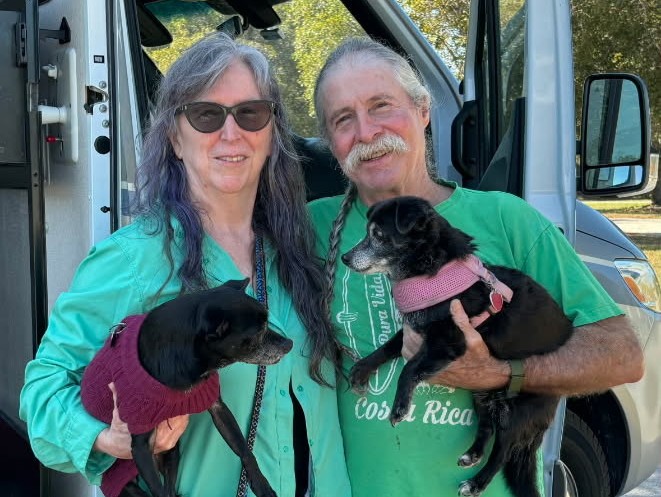
The Gibbs have moved to an apartment in downtown Orlando. He said that because of health reasons, he wanted to be close to four sisters who live in Central Florida.
“I love my house, I really do, but we’re moving on to a new adventure, and we’re going to have experiences we’ve never had before. We’re going to travel.”
Gibbs has long-time friends in the West Grove who are doing the same thing.
“They’re Grove pioneers, Grove activists,” Gibbs said. “They’re getting a lot of money, and it’s the same story: ‘Oh yeah, this is going to become a white box too.’”
But Gibbs believes that the people who move into those white boxes will come to care about the Grove and its canopy like his current neighbors do. “I represented people who have white boxes who don’t want next-door neighbors with white boxes,” Gibbs said.
Billig said his old house is “almost surrounded by construction sites. A few houses away, there’s a big sugar cube. Demolition permits are in place.”
Both have fond memories of the old Coconut Grove.
Gibbs grew up on Poinciana Avenue near the bay in one of the first houses built on the street. His father was an assistant county attorney. His mother was a homemaker who later became publisher of the Village Post, a magazine in the 1960s and 1970s.
He and his sisters had a pet spider monkey, and their house was a place of great parties. One night, after a few drinks, his dad and friends decided the Grove needed music. They put an upright piano on the back of a pickup truck and drove around the Grove performing for astonished residents.
“Coconut Grove was a small town back then,” Gibbs said. It “was the kind of place where you were told to come home when the sun came down.” They’d get their clothes from Little Jack Horner and a soda at the Grove Soda Fountain.
It was idyllic in some ways, but there was a darker side. Gibbs remembers the mid-1960s when he had long hair and went to a barber and asked, “Is there any way you can straighten my hair?”
“He said to me, ‘If I could straighten hair, I would have every (n-word) in Coconut Grove down here in a flash.’ And there was a big guffaw” from those in the barber shop.
Billig’s family moved from Queens to the Grove when he was 10. His dad, Ned, opened an art gallery. His mother, Sue, was an interior designer.
“It was a big change, seeing the boats and the marina. I was a little street urchin, meeting all the shop owners. At 14, I was a bus boy. It was a very small-town atmosphere.”
His childhood was marred by a horrific event – the disappearance of his older sister, Amy, in 1974. Their mother spent decades seeking answers, but Amy was never found.
Read more: The Long and Lasting Shadow of Amy Billig
In his late teens, Billig left home and lived at various spots in Center Grove. “Great times,” he said. “They call them homeless people now. We called them street people. There were Hare Krishna vegetarian feasts, a real sense of community.”

At some point, pressured by new residents, the city clamped down. It took out the picnic shelters at the bottom of Peacock Park that were a refuge for street people. And the city started discouraging persons who lived in boats outside the marina. “There were a lot of interesting people, fun, light-hearted people.”
In 1992, the tenant in his parents’ cottage moved out. He and Michelle moved in. His parents had cancer, and it was simpler being close to take care of them. They took over the main house after they died.
He got into stone-working when he was asked to work on a section of wall from across from the Taurus. At first, “we weren’t that serious about it. Things were slow, and I was still doing side things working in restaurants.”
When his first daughter was born, he decided it was time get serious about a career.
“I stayed with the stone work and I really liked it, studying it, doing it properly.” He got a license and insurance to pull building permits, developing a reputation, doing work at Vizcaya, Fairchild Tropical Gardens, the Deering Estate and the wall in front of The Moorings.
In 1999, Billig was hired by a local developer to dismember and move the Miami Circle – the Native American archeological landmark at the mouth of the Miami River – so a high-rise tower could be built on the site. When the plan was announced, Billig had second thoughts. He went public with his decision to refuse the job, adding momentum to the preservation effort that eventually saved the archeological treasure.
Gibbs went to the University of Wisconsin and became a lawyer. Early on, he joined the Coconut Grove Civic Club, the main organization in the village through the 1980s.
Eventually, he served for a decade as president of Coconut Grove Cares, dedicated to fighting injustice in the West Grove, and for years he was the pro bono lawyer for the Coconut Grove Cemetery Association, which maintains gravestones in the West Grove.
In the 1990s, he was elected to the Coconut Grove Village Council and for a while was its chair. “It was a big deal for a while,” he said. He recalls big-time zoning attorneys, like Robert Traurig, coming to the council to lobby.
“We didn’t have zoning capabilities, but we had a lot of influence.”
Billig and McGonigal have been planning their road life for more than a year, selling their house on condition that they had six months to move out. Even so, they didn’t clear out all the clutter and rented a storage unit for stuff of their daughters’ and parents’.
“It was too much to get rid of.”
They bought a Winnebago Class C, 26-feet long, mounted on a Mercedes truck frame. It has a shower, bathroom and galley, with solar power, a big lithium battery and a propane tank when they’re not hooked up at a camp site.
They brought along two aged mix breeds, Lucy, who is blind and “pretty deaf,” and Ricky, who has arthritis.
They started in the Keys and meandered northward. When the Spotlight talked to them last, they were in the Texas panhandle, planning to spend the night on a private property that offered space for a camper.
Most of the time, they’ve been avoiding large camper grounds with vehicles packed side by side, in favor of state and federal parks and private spots.
“We’ve been happy with everything,” said McGonigal. “It’s a surprise how easy it’s been.”
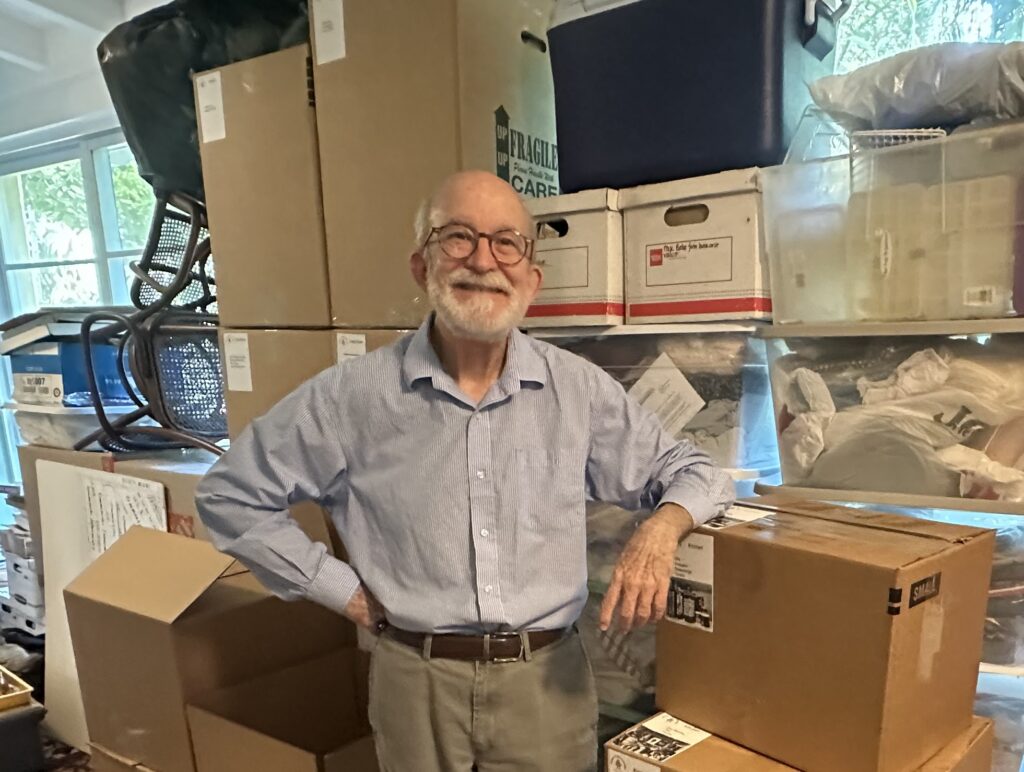
In Orlando, the Gibbs have spent their first days just settling in. “Unpacking all our boxes is taking a lot of time,” he said.
Both couples plan to come back occasionally to the Grove. They know plenty of people who leave and say the village went to hell after a beloved building was torn down or a particularly awful monstrosity was built.
Neither family feels that way, though they acknowledge all the changes they’ve seen during the decades.
Of the residents in the new white boxes, “we never happen to meet them,” McGonigal said. “There are a lot of children, young children in strollers, but a lot of time they’re with nannies. Their parents are off at jobs.”
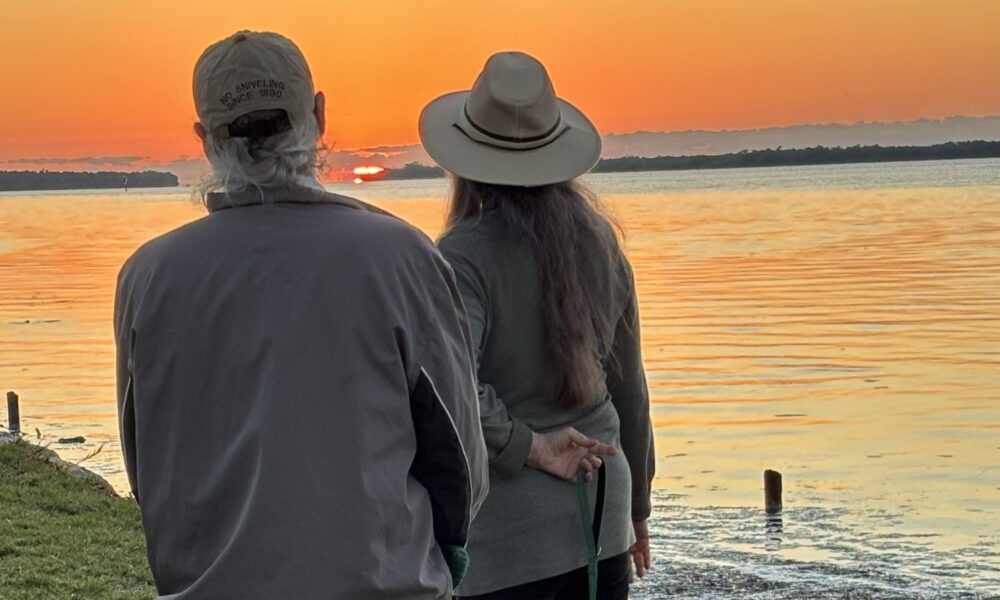
Still, during their last years in Coconut Grove, when they took walks with the dogs to see the bay at sunrise, Billig said, “we meet a lot of nice people, pretty good-natured people. We don’t think it’s gone to hell yet.”
Gibbs: “I’m disappointed in stuff, but I love it. There are people who live on South Bayshore Drive [in the condos] and you should hear them yell about government and the high rises.”
He acknowledged that some people, particularly the ultra-wealthy, “come from different places and don’t really understand” the village.
“I know MAGA people who hate what’s happening in development in this town. I love the fact that Coconut Grove is filled with people like that.
“I don’t want to say it’s the circle of life, but that’s what it is,” Gibbs said. “People come, people go, but people are still more important than buildings. If people are still pissed off at the city of Miami in 100 years, we’ve all done our job. I’m serious. People are what’s important.”
Spotlight editor Don Finefrock contributed to this story.















Great article… I agree, it’s quite unfortunate, with the Grove now becoming completely commercialized. My Grandmother moved to old Gables back in 37′ when she purchased a stucco two story and my Mother attended the University of Miami in 43′. Myself, I moved to Miami in June of 83′, living Village of Kings Creek, in a one bedroom condo, that my Grandmother purchased for my parents. I still remember, going the Grove on Friday nights, driving down Grand Ave. past Gil’s Spot, which was quite scary. Hanging out at the Taurus, where I met many close friends. Over the years, the continued development of the Grove, it had lost that feel, of being an alternative to Greenwich Village of South Florida.
All best to Tucker and Josh on their new adventures… And thanks to John and Don, for another great story speaking to the soul of the Grove. 💫
Great story that certainly resonates with our own situation. Very well written article John.