



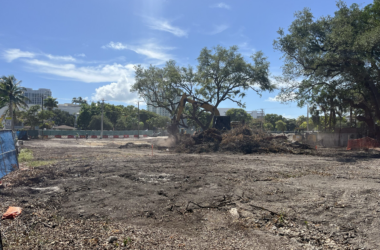
New internal permitting policies are in, the longtime tree protection chief is out, and the city is gearing up for another round with residents to rewrite its tree laws.
Miami’s effort to rewrite its tree protection laws is springing back to life, with a proposed overhaul expected to reach the City Commission later this year — but parts of it may already be in place.
Internal records reviewed by the Spotlight show that in early 2024 — as city officials were drafting a controversial set of proposed changes to Miami’s tree ordinance — they were also revising internal permitting policies governing tree removal. Some of those policy changes, officials say, are only now being implemented.
Among the recent changes: no site visits by reviewing officers before issuing tree removal permits, a move critics say could harm the tree canopy by allowing false or misleading applications to go unchecked. Instead, documents show, permitting decisions will rely more heavily on information submitted by arborists, other licensed professionals and, in some cases, property owners themselves.
Meanwhile, the city’s longtime chief overseeing tree permitting and enforcement was abruptly reassigned last month to another department, a move city officials have not publicly explained amid the ongoing overhaul of tree permitting practices.
The legislative push to rewrite Miami’s tree laws surfaced publicly in October 2024, when District 1 Commissioner Miguel Gabela introduced a proposal that would have reduced permitting requirements, loosened oversight of tree removals and altered how mitigation funds — the fees property owners pay when trees make way for development — are used.
The item drew immediate backlash from environmental groups and neighborhood advocates, who objected not only to the substance of the proposed changes but also to the lack of public notice ahead of a binding commission vote. The commission ultimately deferred the proposal.
Read More: Commission Defers Proposed Changes to City Tree Protection Ordinance
But the changes were anything but sudden. Emails obtained through a public records request and reviewed by the Spotlight show that officials in the Building Department — which has authority over tree permitting for the city — had, by early 2024, begun laying out plans
to significantly alter the regulatory scope of the city’s tree protection laws by amending the city code.
At the same time, internal documents show, those same officials were advancing internal policy changes designed to “streamline the overall permitting process” by eliminating “redundant work efforts and bottlenecks” — changes that could reshape how the code is applied even without legislative action.
Only now, city officials say, are those changes beginning to take hold.
“We’ve had some minor changes in procedures,” Building Department Director Ed Santamaria said in an interview with the Spotlight. “Where the code is open to some interpretation, we’re looking to interpret in a way that doesn’t slow down things and just speeds up processes. We’re looking to be more responsive.”
Santamaria says the effort aligns with a broader directive from new Mayor Eileen Higgins and City Manager James Reyes to adopt a more user-friendly permitting ecosystem at city hall.
“The new administration has taken up this banner of improving the permitting process,” he said. “And we are here to deliver around the mission as much as possible.”
Santamaria said reviewers are being instructed to rely on the accuracy of permit applications — including the size, number, species, location and condition of trees proposed for removal — while acknowledging the process depends largely on the competence and integrity of applicants and their arborists.
“There are bad actors,” he acknowledged, noting that some applicants may attempt to misrepresent conditions in order to secure approvals.
While Santamaria is quick to insist that Chapter 17 of the city code – the tree protection and permitting ordinance — remains intact, the internal guidelines outlined in the Building Department’s updated manual of policies and procedures reflects a clear departure from a review process historically grounded in on-site inspection and staff discretion, toward a faster, applicant-driven system built around documentation and standardized workflows.
Santamaria said he has seen an uptick in tree removal permits in recent months, which he cited as evidence of the success of the new approach.
The internal changes are unfolding alongside a leadership shakeup within the Building Department division responsible for enforcing the city’s tree protections. Quatisha Oguntoyinbo-Rashad, a 26-year City Hall veteran who spent the last 14 years leading the 10-member Environmental Resources Division, has been reassigned to the Department of Resilience and Public Works, where she no longer has a role in tree permitting or enforcement.
City officials refused repeated requests to make Oguntoyinbo-Rashad available for an interview. (Under city policy, employees are forbidden from speaking with the media without prior authorization).
Oguntoyinbo-Rashad raised eyebrows during the public outcry over the proposed changes to the tree laws in late 2024 when she told civic leaders that neither she nor her staff had been asked to weigh in on the legislative overhaul — even though her division is charged with implementing and enforcing the laws.
“Neither I nor the Environmental Resources Division has been involved in the proposed changes to this ordinance,” she wrote to community stakeholders in a widely circulated email.
Performance reviews obtained by the Spotlight through a public records request show glowing evaluations throughout her long tenure with the city, followed by a sudden red flag in 2024, when she received a “needs improvement” in the “Judgment” category, with a Building Department official recommending that she “show more willingness to accept and implement directions from supervisors.”
Her 2025 performance review, completed in December, has been withheld from the Spotlight without explanation, despite repeated requests and despite state law requiring that any documents exemption be justified.
Oguntoyinbo-Rashad’s reassignment comes as the effort to revisit the city’s tree ordinance gains momentum — this time with broader public input and, city officials hope, buy-in from residents.
Last summer, after yet another false start at revising the tree ordinance, city commissioners instructed staff to engage Florida State University’s Florida Conflict Resolution Center under a $180,000 contract to help find common ground among civic groups pushing for stricter tree removal and enforcement laws and development interests who see them as overly burdensome.
Read more: City Offloads Public Outreach on Tree Ordinance Rewrite
While off to a slow start, Assistant Building Director Melissa Fernandez-Stiers said in an interview that the center is now conducting outreach to a broad cross-section of community stakeholders — residents, civic groups and developers. Later this year, the center will conduct at least one and perhaps two community workshops within each of the city’s five commission district to engage the public.
“This has been an ongoing effort,” Fernandez-Stiers said. “We want to make sure we’re hearing from all sides before anything is put forward.”
The center’s principals did not respond to a request for comment.
Also off to a slow start is the creation of a resident advisory group that will work in tandem with the Conflict Resolution Center. Fernandez-Stiers said the exact makeup of the group, which will include two nominations from each commissioner, has yet to be finalized.
(District 2 Commissioner Damian Pardo has not responded to the Spotlight’s request to say who, if anyone, he has nominated, but North Grove arborist Ian Wogan said he has been asked to serve.)
At the earliest, Fernandez-Stiers said, a draft ordinance — which, like its 2024 predecessor, will be overseen by officials in the city’s Building Department — is not expected before December. “And even that,” she cautioned, “is a best-case scenario if everything goes according to plan.”












We need more trees, not concrete!
I strongly oppose the proposed changes to the tree permitting process, particularly the elimination of required site visits.
Trees are not interchangeable assets — they are living infrastructure that contribute measurable environmental, economic, and neighborhood value. That value cannot be accurately assessed from a desk. Without in-person review, we risk approving removals that significantly degrade tree canopy, reduce property value, and negatively impact entire neighborhoods.
Site visits are not a burden — they are essential due diligence.
Additionally, inspections should be conducted by local professionals who understand the unique character, environmental priorities, and long-term needs of our community. Outsourcing this responsibility undermines accountability and local expertise.
At a time when we should be strengthening protections for our urban canopy, this proposal moves us in the opposite direction.
When I chaired the Miami HEPB two decades ago, I remember one contentious application for a new swimming pool that required removing a “dead” oak tree — and it turned out the arborist hired by the property owner had never visited the site. So, relying solely on “honest” arborists hired by applicants is not the way to go without more.
That “more” should be required at the start of the permit application process, be quick, easy, and clearly show which trees should stay, which ones removed, and what mitigation replanting would look like. Most importantly, it would show the result from Day 1 until after 5 and even 20 years.
Fortunately, that tool is already available. It’s the South Florida Urban Tree Permit Calculator (UTPC) technology created by FIU’s Institute of Environment and led by Professor Chris Baraloto. I saw it in action when Baraloto presented it to the PZAB last month.
It was amazing. Using the County’s existing aerial surveys, any proposed development can be analyzed within seconds to estimate canopy coverage from pre-construction through decades of mitigation growth. Plans can then be “tweaked” across configurations to work toward the county-wide goal of 30% tree canopy by mid-century. The tool is flexible enough that owners and developers alike will find it useful, cost effective and even more profitable.
Remember, everyone loves trees. Trees create value. This tool would give us all a way to have our cake and eat it, too.
This is amazing! Sorry I missed the presentation.
If local advocates have been reached out to, I don’t know who they are. I’m pretty involved and no one I know has been contacted.