
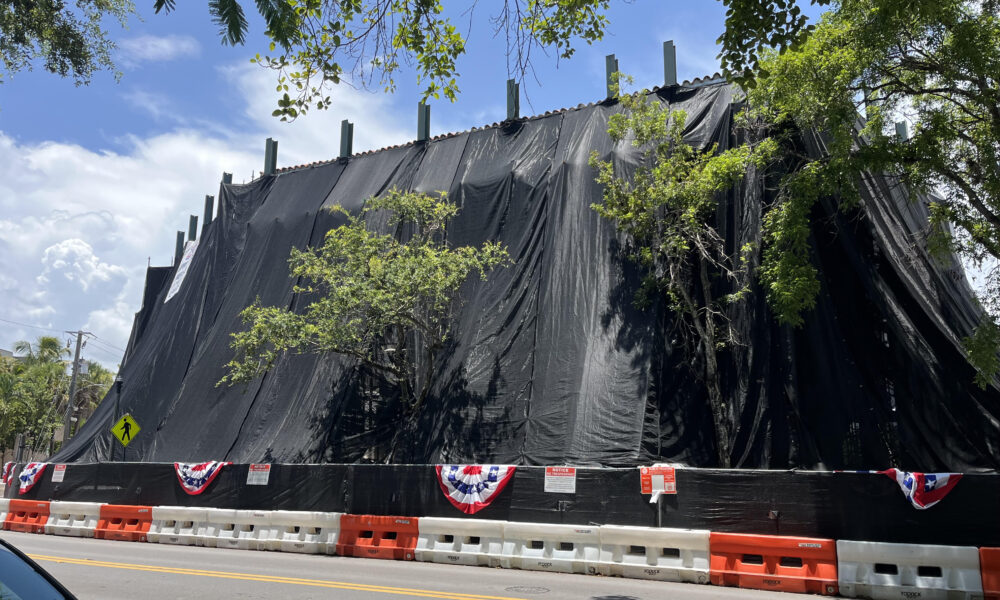

The long-festering debate over the Coconut Grove Playhouse moves to the City Commission this week for what could be a final vote on the county’s controversial plan to surround a new, smaller theater with shops, a restaurant, and office space.
Twenty years after the Coconut Grove Playhouse closed its doors, the Miami City Commission is poised to decide this week whether the county can revive the much-loved – and fought over – cultural icon as a smaller theater with shops, offices and parking.
Miami-Dade County officials are asking the city commissioners to grant five exceptions and four zoning waivers so they can restore the playhouse’s 1926 facade, construct a new 310-seat theater behind it, and build a 289-space parking garage next door.
The county’s zoning application was previously heard – and rejected – by the city’s Planning, Zoning and Appeals Board (PZAB) on May 6 after a bruising hearing
Five members of the planning board voted to approve the request, four members voted to deny, and the request failed for lack of a super-majority, setting up Thursday’s showdown before the City Commission.
Read more: Miami Planning Board Rejects the County’s Playhouse Plan
As they did previously, the city’s planning director and his staff are recommending approval. “The restoration, expansion, and master planning of the Coconut Grove Playhouse will reactivate a historic cultural facility, benefit the area by continuing to provide a service to the community, and is compatible with the surrounding neighborhood,” city officials wrote in their evaluation of the county’s application.
Neighbors who live immediately west of the playhouse disagree.
Neighborhood concerns about the commercial elements of the plan – the shops and offices which the county says will provide needed financial support for the theater – were a major reason why the planning board voted down the zoning request.
Those neighbors – represented by Preserve the West Grove and three other community groups – want the county to sign an agreement to address their concerns about traffic, commercialization, jobs, programming and recognition for their historic neighborhood.
Their concerns haven’t gone away. Miami District 2 Commissioner Damian Pardo brought the two sides together on June 22 in hopes of addressing those concerns, but opponents of the playhouse plan were largely unmoved by the county’s offer to compromise.
Read more: A Final Showdown Over the Coconut Grove Playhouse?
Community leaders met at least once with the county since then, at a meeting brokered by Clarice Cooper and the Coconut Grove Homeowners and Tenants Association (HOATA), but nothing was resolved, according to Cooper.
“It was a good meeting,” she said Monday. “They are willing to listen, we know that, but as far as giving us what we want…”
Cooper for one acknowledges how frustrating – and exhausting – the fight over the fate of the playhouse has been. “This has been so draining because it has gone on for so long,” she said.
But she doesn’t expect a commission decision on Thursday will resolve all of the issues that divide the county and the community. Instead, she expects that HOATA and others will continue to negotiate with the county over the final details of the plan.
“We know whatever happens Thursday is just the beginning of the process,” she said.
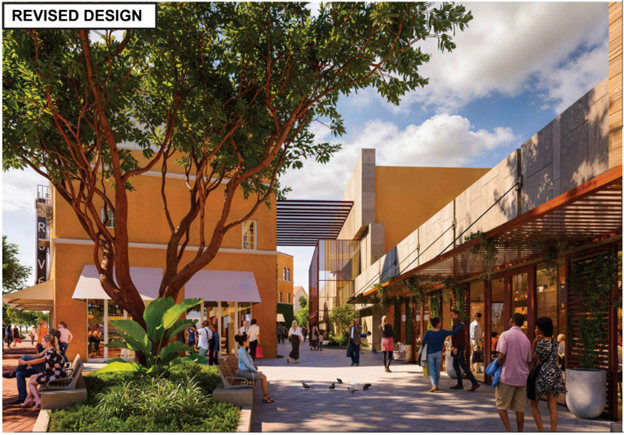
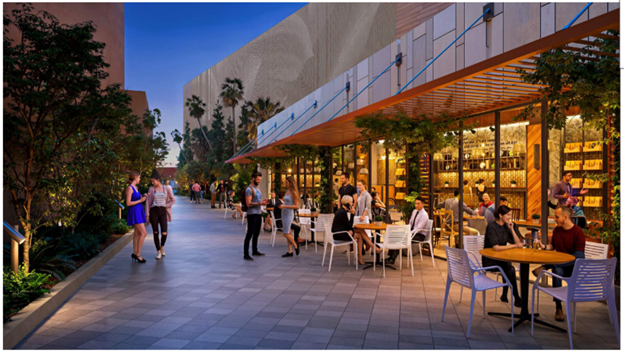
As part of its plan, the county wants to place the new theater at the center of an open-air plaza with 2,600 square feet of retail space, 3,800 square feet of food and beverage space, 28,000 square feet of office space, and 2,600 square feet of educational space.
The plaza would connect to the formerly segregated Black neighborhood behind it – a design element meant to address past discrimination but which residents say will result in commercial intrusion and unwanted traffic.
The zoning exceptions and waivers the county needs to move forward with its plan have become a bargaining chip for neighbors seeking to address those concerns.
On the zoning front, the county is seeking the city’s permission to increase the maximum lot coverage, from 50% to 62.4%, and reduce the project’s green space, from 30% to 14.9%.
In addition, the county wants the city to relax its rules so it can install impervious pavement throughout the complex and construct a 30-foot driveway for cars to enter the parking garage from Main Highway.














We all miss Arva very much.
Let’s recall how she felt about our Treasured Playhouse.
Arva Moore Parks’ ultimate wish for the Coconut Grove Playhouse was to save the historic theater from demolition and restore its unique cultural legacy.
Because of her tireless advocacy, supporters proposed that the restored landmark be renamed “The Arva Moore Parks McCabe Coconut Grove Playhouse”.
Throughout her life as a prominent Miami historian and preservationist, Parks championed the preservation of the nationally celebrated 1927 theater.
She frequently testified before Miami’s Historic & Environmental Preservation Board, passionately opposing plans by Miami-Dade County that would have demolished the majority of the original auditorium while preserving only the front facade.
“This has been so draining because it has gone on for so long.” Clarice Cooper, the President of the West Grove Tenants and Homeowners Association, is fighting not just for the Playhouse but also for the very survival of her historic community now re-named by the City of Miami as “Little Bahamas.”
Here (I have a photocopy of the letter) is what one of her famous predecessors, Esther Mae Armbrister for whom Armbrister Park is named, wrote three decades ago to the then Florida Secretary of the Interior:
June 30, 1997
Dear Secretary Mortham.
I have spent 61 years of my life fighting to preserve the Black Community of Coconut Grove.
In the 1980’s the State of Forida rezoned single family lots in the Black Community of Charles and Williams Avenues for the Coconut Grove Playhouse. Now you want to take the Coconut Grove Playhouse, bought for the benefit of the public, and give it to a private developer to build a large commercial building that will ruin our neighborhood. This is just another way to resettle the Black Grove. We won’t have it. We would like to meet with you and help you understand that public property is for the public not private developers.
We would like your office to take a positive role in protecting our neighborhood.
Sincerely,
Esther Mae Armbrister
Cc: Mayor of City of Miami
Miami Herald
Miami Times
Palm Beach Post
Suns Sentinel
Orlando Sentinel
St. Petersburg Times
Tallahasee Democrat
NAACP