
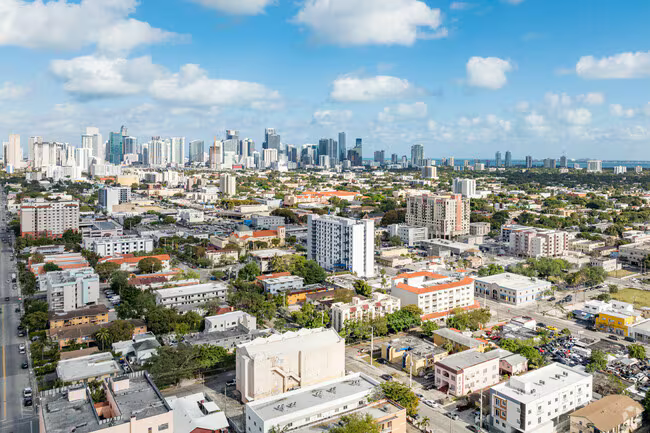

Two city-backed proposals affecting hundreds of properties in and around Little Havana would allow substantially more development — potentially adding capacity for nearly 20,000 residents — without requiring the increased density to produce affordable housing.
A sweeping City of Miami proposal to allow denser development across hundreds of properties west of downtown could create capacity for nearly 20,000 additional residents and generate more than 124,000 additional vehicle trips a day at maximum development, according to city planning documents.
The proposed land-use and zoning changes, scheduled to go before Miami’s Planning, Zoning and Appeals Board (PZAB) on Wednesday, would affect properties across Little Havana, including areas along the Miami River, allowing greater residential density, taller buildings and more intensive development. The city’s calendar confirms PZAB is scheduled to meet Wednesday, Sept. 2.
The proposals continue a pattern of city-backed land-use changes intended to allow substantially denser development in Miami.
Indeed, in recommending the latest rezoning, city planning staff pointed to previous increases in development intensity in the area as evidence of “significant efforts made to increase the density of new developments and the intensity within the surrounding areas by unlocking allowable uses via rezone.”
But while city planners cite affordable, workforce and mixed-income housing among the goals advanced by the changes, there is no guarantee the additional development capacity would produce any affordable housing.
The comprehensive-plan analysis says the increased density “may facilitate affordable, attainable, workforce, and mixed-income housing” by expanding the overall supply and diversity of housing. But the amendment itself does not require developers receiving the higher allowable densities to provide affordable or workforce housing.
In other words, the additional density is guaranteed by the proposed land-use changes; the affordable housing is not.
That distinction is significant because some properties would move from land-use categories with base residential densities of 36 or 65 units per acre into Restricted Commercial, which allows residential density of up to 150 units per acre. The additional development rights could therefore be used for market-rate housing regardless of whether they produce affordable or workforce units.
City planners estimate the land-use changes could accommodate 19,523 additional residents, bringing the maximum potential population of the affected properties to 36,215.
A transportation analysis estimates that development at the maximum potential allowed under the proposed land-use designations could generate 124,131 net new external vehicle trips per day, including 23,193 during the morning peak hour and 20,275 during the afternoon peak hour.
Schools could also face pressure.
Miami-Dade County Public Schools found in a preliminary review that six of the nine schools serving the affected area do not currently have sufficient capacity to serve the development contemplated by the application. The district noted that the finding would not, by itself, prevent development and that additional school capacity or other measures could be required as the area grows.
The population and traffic figures represent potential impacts if the affected properties were ultimately developed to the maximum contemplated under the proposed land-use changes, rather than forecasts of what the city expects will actually be built.
The changes come in two related applications that overlap but do not cover precisely the same properties.
One would amend Miami’s Comprehensive Neighborhood Plan for 349 properties covering approximately 72 acres. Of those, 47 properties would be designated Medium Density Multifamily Residential and 302 would become Restricted Commercial.
The companion rezoning is considerably larger, encompassing 661 parcels across 11 corridor areas totaling approximately 136 acres.
The companion zoning changes would make corresponding increases in building intensity — a measure of how much development can be built on a property. Some properties now in the city’s lower-scale “general urban” zoning category would move into the more intensive “urban center” category, while others would move from urban-center zoning into T6-8 urban-core zoning, which allows greater development intensity and, in these proposed districts, buildings generally up to eight stories.
Planning staff says the changes would promote more intensive redevelopment in areas with access to bus routes and other transportation corridors. The report says the rezoning would allow “more dense and intense uses” and cites a Miami 21 planning principle that “Density and Intensity of Use should relate to degree of transit service.”
Last year, the Spotlight reported on a separate package of citywide zoning changes designed to encourage much greater housing density and taller buildings around Metrorail stations and other transit corridors. City officials described that effort as part of a strategy to concentrate population near transit and reduce automobile dependence.
Read more: Miami Poised to Approve Sweeping Zoning Overhaul
The affected properties in the latest proposal are north and northwest of Coconut Grove, primarily in Little Havana and along the Miami River. Like the Grove, the surrounding areas contain a mix of lower-scale residential neighborhoods, apartment buildings and commercial corridors. City staff describes portions of the affected area as surrounded by single-family homes, duplexes and low-density multifamily housing.
City planners say the additional density could support housing growth and redevelopment while encouraging compact, pedestrian-oriented development near existing transportation corridors.
Planning staff concluded that the proposed changes are consistent with Miami’s growth policies. For the rezoning, staff says the changes would encourage “a balanced mix of uses including areas for employment, shopping, entertainment, housing, and recreation in close proximity to each other” and allow more intensive redevelopment along transit corridors.
Staff recommends approval of both proposals.
If PZAB recommends approval Wednesday, the proposals would advance to the Miami City Commission for consideration.














It seems the City of Miami may be turning its historic “Littles” into “Bigs.” Same trend noted in the Grove: bungalows, mature trees replaced by out-of-scale Sugar Cube houses.
Little River—and now Little Havana—appear to be major frontiers for substantially increased density.
First PZAB’s agenda includes the rehearing of the Little River Enhanced TSND Master Plan (File 19600), as well as the rezoning of 661 parcels across 136 acres in Little Havana from T4 to T5/T6-8 and the Shenandoah Dog Park rezoning.
The question is not whether Miami should accommodate growth, but whether infrastructure, public services, and environmental capacity are increasing at the same pace as development intensity. Edgewater, Brickell, and other rapidly developed areas already reveal this gap.
A genuine 15-minute city requires more than density. It requires reliable transit, safe sidewalks, drainage, parks, schools, and nearby daily services. It must also include nature-based solutions, meaningful tree conservation, expanded canopy, and permeable landscapes. When intensive development removes mature trees, reduces permeable land, and adds heat-retaining surfaces, it can worsen urban heat.
Before approving density increases of this scale, the City should present a cumulative assessment showing how infrastructure, affordability, tree canopy, and neighborhood livability will keep pace.
Once again the City of Miami shows it loves to please the developers that make campaign contributions to the politicians, and it couldn’t care less about the quality of life of the residents.
Nor does it care how all this over-development taxes infrastructure like traffic congestion, water supply, sewage treatment and garbage disposal, and hurricane evacuation time.
Another example of how we have government of developers, for developers, by developers.
This is what systematic greed looks like.