

After years of violations, the owners of Grove Princess Apartments finally repaired a crumbling wall. But the fine remainunpaid, and the city has not explained what it will do next.
The owners of a Coconut Grove apartment complex have finally repaired a crumbling wall and fence that frustrated neighbors for years, ending a prolonged code violation that cost them $432,000 in city fines.
But five months after the repairs were completed, the City of Miami has yet to collect a dollar of the penalty.
And despite repeated questions from the Spotlight, city officials have not explained what additional steps, if any, they intend to take to recover the money.
The case raises a larger question about the effectiveness of Miami’s code enforcement system: What incentive do property owners have to correct violations and pay accumulated fines if they aren’t convinced the city will ultimately collect the penalties?
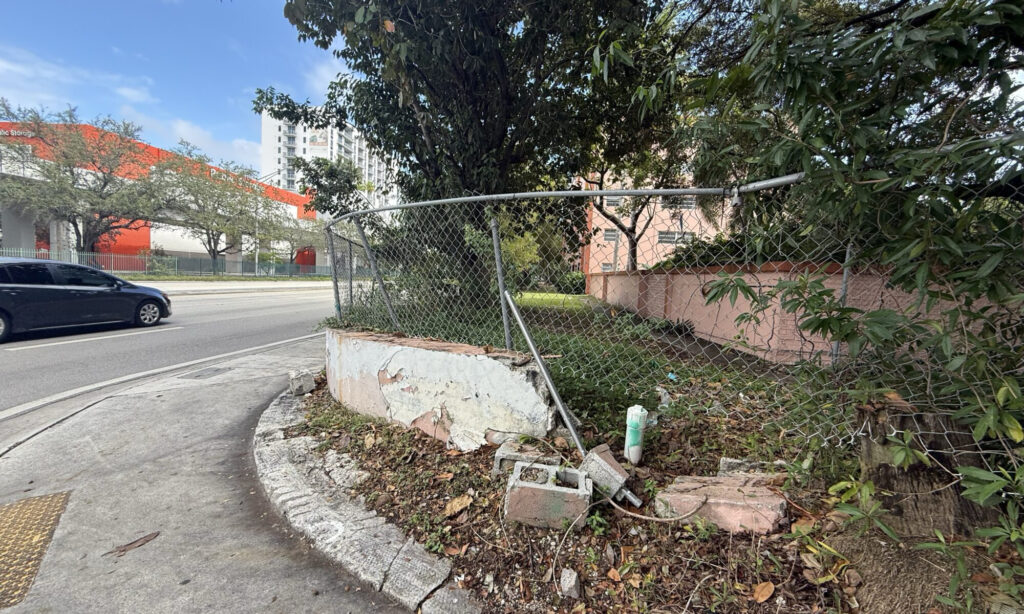
At Grove Princess Apartments, a five-story, 100-unit complex at the corner of U.S. 1 and Virginia Street, the owners allowed a deteriorating wall and chain-link fence to remain in violation of city maintenance requirements for nearly five years after daily fines began accumulating.
The repairs were finally completed in May. The $432,000 fine remains unpaid.
The property, built in 1967, is familiar to Coconut Grove residents, particularly those who pass through the busy intersection at one of the neighborhood’s principal entrances.
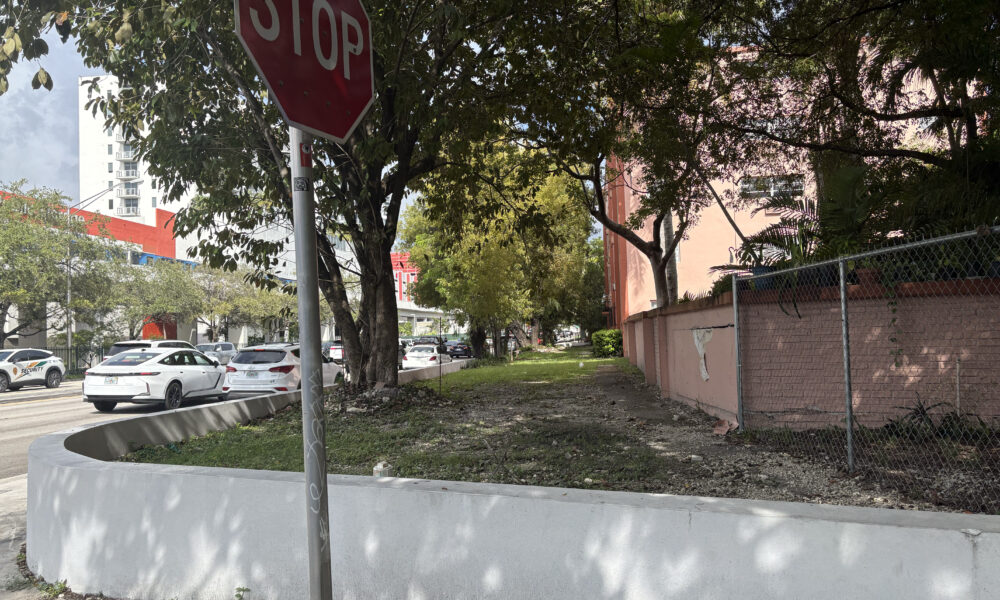
Last October, the Spotlight reported that the complex’s crumbling, two-foot-high pink wall, sagging chain-link fence and graffiti-covered exterior had become a longstanding neighborhood eyesore despite repeated complaints and mounting city fines.
By then, the penalty had already exceeded $380,000, and the owners had obtained a permit for repairs but had yet to complete the work.
David Rosen, a Center Grove resident who regularly passed the property, was among those who complained about the neglected conditions.
“Why do we have this major eyesore that is riddled with graffiti, that is a danger, that is horrible looking as one of our entrances to our beloved Coconut Grove?” Rosen told the Spotlight at the time.
Read more: The Grove’s Graffiti Gateway?
The problems dated back at least to 2019, when city inspectors were alerted to the property’s deteriorating exterior, according to emails previously reviewed by the Spotlight.
Property records identify the owner of the complex as Grove Princess Apartments Inc., a company linked to Juan Zorilla through state corporate records.
On Dec. 3, 2020, a representative of the owners appeared before Miami’s Code Enforcement Board, acknowledged the property-maintenance violation, according to the city, and was given 90 days to make repairs.
At the hearing, Fara Barrero-Dominguez, a vice president of Grove Princess Apartments, described difficulties navigating paperwork and online procedures during the pandemic. She said the wall and fence had been damaged by vehicles crashing into them and that she was working with a contractor to make repairs.
The board subsequently granted another 90-day extension in May 2021.
But the property still was not in compliance when the extended deadline expired. On Aug. 18, 2021, a $250 daily fine began accumulating.
It continued for 1,728 days.
By the time the city determined that the property had finally come into compliance on May 12, 2026, the penalty had reached $432,000.
The repairs ended the violation and stopped the daily fines from accumulating. They did not erase the money already owed.
In a written response to questions from the Spotlight, the city’s Communications Office confirmed that the owners had paid none of the $432,000 and had not requested a reduction of the penalty.
The city also acknowledged that, while the property remained in violation, it had not initiated foreclosure proceedings or taken additional enforcement action beyond the Code Enforcement Board process, the accumulating daily fine and collection efforts.
When asked what it was doing to recover the money, the city said it sends demand letters to property owners with outstanding code enforcement liens.
“The City issues demand letters on an established schedule for properties with outstanding liens,” the Communications Office said. “The lien remains subject to the City’s collection process while the balance remains unpaid.”
But the administration did not say whether the Grove Princess case had been referred to the City Attorney’s Office for collection, whether foreclosure or other legal action was being considered, or whether the owners had been given a deadline to pay.
City officials also did not say if the fine was formally recorded as a lien against the property, what additional steps they planned to take to collect it or what would happen if the owners continued not to pay.
The unresolved collection effort is particularly significant because financial penalties are one of the principal tools available to Miami’s Code Enforcement Board.
When owners fail to correct violations within deadlines established by the board, daily fines can accumulate until the property comes into compliance. The penalties are intended to encourage owners to address violations rather than allow them to continue indefinitely.
But imposing a fine and collecting it are two different things.
And a 2024 change to Miami’s code enforcement rules raises additional questions about how much incentive property owners have to pay their fines promptly.
Under the previous rules, owners who corrected violations and paid their fines within 30 days could qualify for substantial reductions. The longer they waited, the smaller the available reductions, until fines outstanding for more than 270 days were no longer eligible for mitigation.
That changed in November 2024, when the city adopted a new system allowing property owners to seek reductions regardless of how long their fines had been outstanding.
The city said the change would create a more orderly and streamlined process. But it also eliminated a financial incentive for prompt payment.
The owners of Grove Princess Apartments have not requested a reduction, according to the city. Their entire $432,000 fine remains outstanding.
The Spotlight asked city officials how the revised rules would apply to the complex, including how much the owners might ultimately have to pay if they sought a reduction.
The city has not answered.
The Grove Princess case is not the first time Coconut Grove residents have questioned whether Miami is doing enough to enforce its property-maintenance rules.
In December, the Spotlight reported on West Grove residents’ efforts to get city officials to address overgrown lots, broken fences, accumulated trash and other neglected conditions.
Residents — including a former member of the city’s Code Enforcement Board — described a frustrating process of repeatedly documenting violations and contacting city officials, sometimes waiting months for action. They also questioned whether neglected properties in their neighborhood would be tolerated elsewhere in Coconut Grove.
Read more: One Man’s Crusade for a Cleaner, Safer West Grove.
For Rosen, the unresolved Grove Princess fine raises a related concern: whether the city will follow through on the financial penalties it imposes.
“What are fines for if we can’t levy them?” he asked recently. “We need to collect those fines and use them towards other city services in Coconut Grove.”
The owners of Grove Princess Apartments did not respond to the Spotlight’s requests for comment.