



Amid an ever-changing development landscape, longtime resident Harry Gottlieb says neighborhood blight has never been worse — and vows to hold the city accountable for enforcing its own laws.
Every morning, Harry Gottlieb pedals out from his Grand Avenue apartment, weaving through the West Grove on a route he’s traveled for decades.
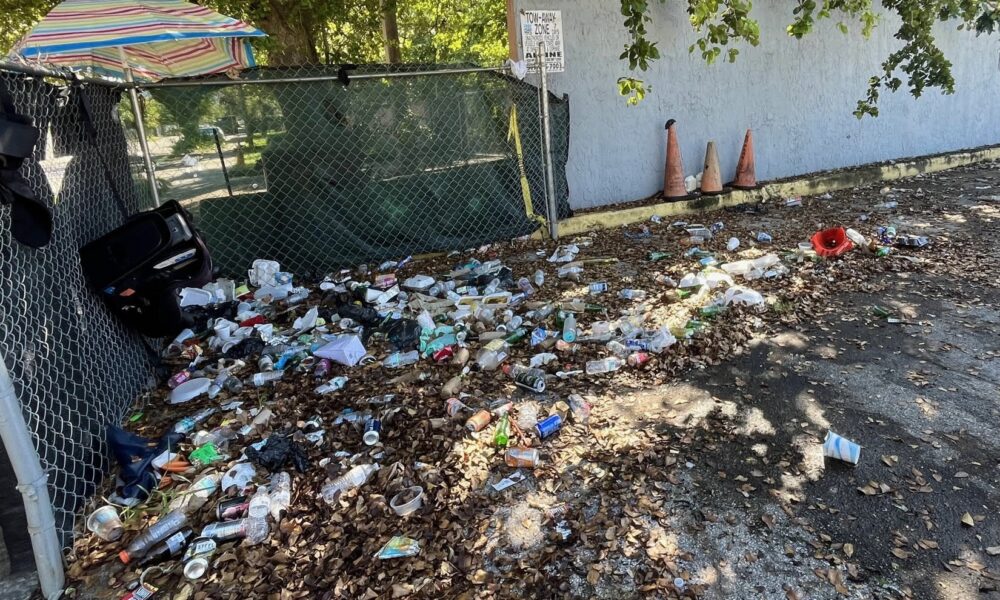
But the neighborhood’s appearance is nothing to be proud of within this historically low-income, African-American section of Coconut Grove: Vacant lots sit overgrown, fences sag into the sidewalk, trash gathers behind ripped privacy screens, and stretches of pavement buckle beneath his tires.
With a practiced eye — sharpened by a stint on Miami’s Code Enforcement Board — Gottlieb spots violation after violation, many lingering for months with no response from the city.
“This wouldn’t happen in other areas of the Grove,” he said.
Gottlieb, a transportation, mobility, and cycling advocate, has lived in Coconut Grove for 35 years, the last eight at the five-story Gibson Plaza apartment complex.
On a recent stroll through the neighborhood with a Spotlight reporter, Gottlieb stopped at several sections of the sidewalk on Douglas Road and Grand Avenue — maintained by the city and county, depending on the location — that are crumbling or uneven, pushed out of place by tree roots or damaged by construction, forcing him to dismount.
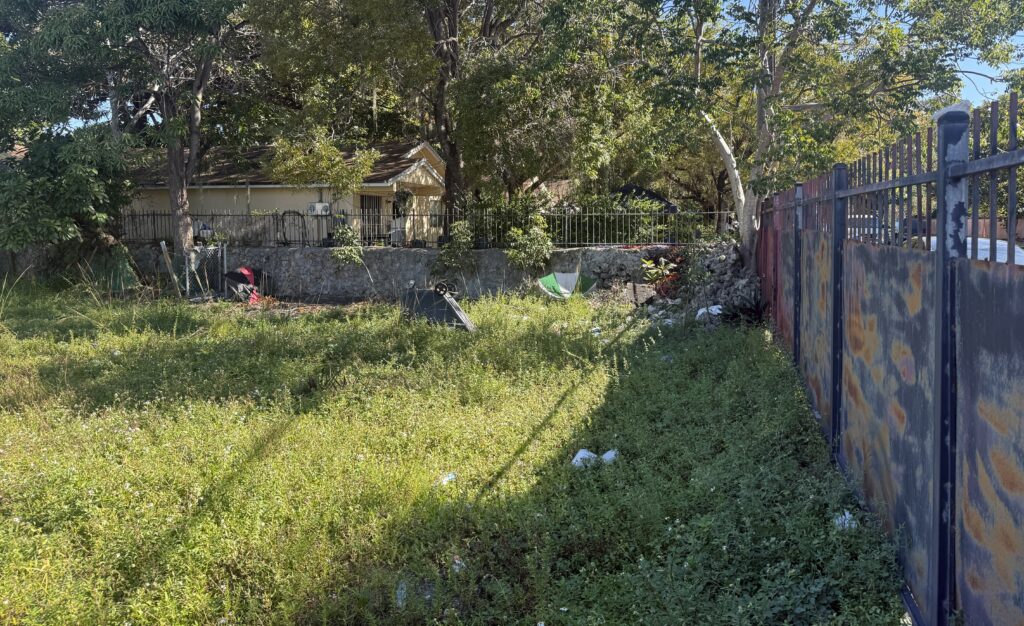
Within a few minutes, he points out nearly a dozen examples of what, in his view, could amount to violations of city codes that require properties to remain clean, safe and secured. Most, he says, have been that way for months, if not years. With each unsightly scene and hazardous condition, Gottlieb’s frustration grows.
In the absence of enforcement from city officials, Gottlieb has taken on the cause, documenting the problems he sees during daily bike rides and sending photos en masse, to both city and county code compliance staff – often, he says, to little or no avail.
Officials from the City of Miami’s Department of Code Compliance did not respond to multiple requests from the Spotlight seeking information about complaints or active cases pertaining to a list of West Grove properties.
Gottlieb is not the only one losing patience.
Jamila Stephens, a doctoral student at the University of Miami and longtime Grove resident living near Elizabeth Virrick Park, finds her frequent complaints about issues in the neighborhood — squatters in a nearby home and materials left behind from construction sites — fall on deaf ears.
“I can call code [compliance]. I can file a complaint or inquiry with [Miami District 2 Commissioner Damian] Pardo’s office, and I can do that every day, and I may see one code person one time,” she said. “I’m taking videos, I’m taking time-stamped images, and nothing. I don’t even receive a follow up, like we investigated into this, or X, Y and Z. It’s frustrating.”
Pardo’s office did not respond to requests for comment for this article.
Gottlieb has taken particular issue with the vacant lot located at 3365 Douglas Road between Florida Avenue and Grand Avenue, owned by the development arm of the Urban League of Greater Miami.
For several months, the fence surrounding the lot was falling down and litter piled up around the property’s borders, making for what he said was an unpleasant welcome to the Grove.
After months of conversations with inspectors, a citation for the owners, and two rescheduled hearings before the Code Enforcement Board, the property was cleaned up. Sort of.
In a Nov. 20 email — four months after Gottlieb’s complaints began pouring in — Department of Code Compliance field supervisor Luis Gomez explained that the property was still not in compliance due to its unsightly appearance.
“They shouldn’t have let it become an eyesore in the first place, right? I see their responsibility as a property owner is to keep it looking halfway decent or at least conceal the litter and the broken fences from the public,” Gottlieb said.
Urban League of Greater Miami did not respond to a request for comment.
Gottlieb is now fighting to ensure that months of non-compliance do not go unpunished. He plans to monitor the case as the owners appear before the city’s Code Enforcement Board, which can uphold, waive or reduce the fines that, in most case, accrue daily until corrections are made. The case is yet to be scheduled.
“We’ve had to live with the eyesore and all the people coming driving in on Grand Avenue to the Grove had to see this eyesore,” he said.
A few blocks east on the corner of U.S. 1 and Virginia Street, a crumbling wall has accrued nearly $400,000 in fines after four years of violations, according to Spotlight calculations. Plans are in place to restore the wall, a Pardo aide insists.
In May, the City Commission voted on legislation that would allow properties with outstanding code violations to qualify for zoning change applications and other land-use entitlements, sidestepping its own rules undercutting the deterrence of the fines.
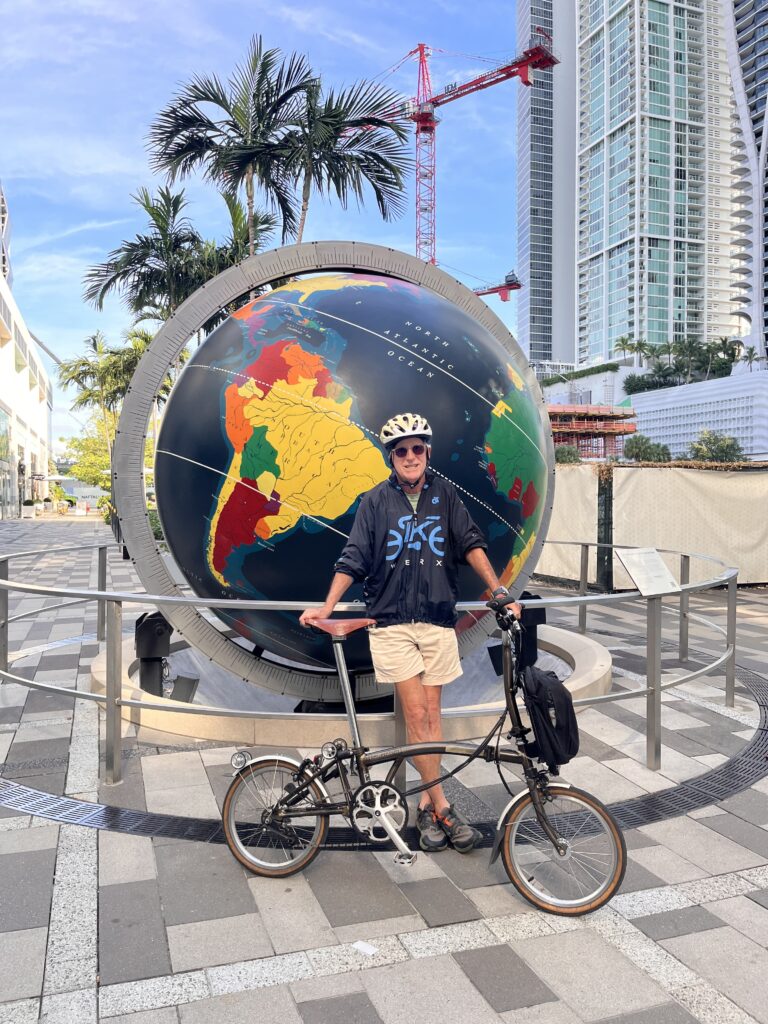
Gottlieb’s frustration stems from a rather Hobbesian mindset: that when the city fails to enforce its own rules, property owners take advantage of the situation, and residents suffer the consequences.
“Why did Code Compliance officers or Miami [District 2 commission office] not address this issue before a neighbor residing at nearby Gibson Plaza felt compelled to do so?” Gottlieb wrote in an email to code compliance and City of Miami elected officials and staff.
Behind many of the neighborhood’s code compliance efforts is a trail of resident complaints, often filed out of frustration or inconvenience, rather than a proactive response from the city.
“We complain a lot,” said Coconut Grove Village West Homeowners and Tenants Association (HOATA) President Clarice Cooper. “If you care about your community being maintained you need to [speak up].”
She, as well as Stephens, remarked that they found it hard to believe these same conditions would be tolerated in more affluent sections of Coconut Grove.
Stephens hopes the promise of new developments in the area and boom of million-dollar homes might help turn the problem around.
“As more developments come, I welcome that, in a sense, because that means more resources will be provided to this area, which is frustrating,” she said. “I shouldn’t have to wait for $2-million homes to be sold on my street, for [the city] to fix a pothole that’s been there for five years, right?”
Gottlieb says resolving complaints was far less challenging when the City of Miami’s Coconut Grove Neighborhood Enhancement Team—Grove NET—was still operational.
“It functioned very well. And whenever somebody left trash out in front of their house, you would call them up and they would send somebody out there. They would have it removed within hours. They would not have tolerated all this,” he said.
Up until 2020 there were 13 NET offices spread throughout the City of Miami, each tasked with fielding resident complaints, administering services and communicating government information with its respective neighborhoods. The offices were dissolved as a cost-saving measure in the aftermath of COVID-19, and their functions were absorbed by the five district offices and city departments.
“You go to Instagram and their Linktree and there’s a form for you to fill out. I’ve done it so many damn times, and you never hear nothing,” Stephens said. “It’s annoying. You’re actually following the processes and you just get ignored. People don’t care.”
With complaints piling up, Pardo staff aide Javier Gonzalez announced last month at a HOATA meeting that the city was creating a new position of Grand Avenue Ambassador, tasked with maintaining the street by cleaning up trash and responding to complaints along the corridor.
Gonzalez did not respond to requests for comment about the new position or how the office planned to address resident complaints about the handful of other West Grove properties.
Meanwhile, Gottlieb is keeping watch.
“The important thing is that it looks good for the neighborhood,” he said. “That we don’t look like we live in a ghetto, right?”
















Thank you, Harry! I’ve done trash pickups in the Grove with Debris Free Oceans and we went from Peacock Park, up through the Grove and over to Grand Avenue. Once we crossed 32nd Ave, the trash was plentiful. You can’t tell me that people are messier from one block to the next. It’s that one area has amenities and staff and the other doesn’t. Same City, different treatment. And it’s been that way since I moved to the Grove in 1993. We should be ashamed of ourselves as a city.